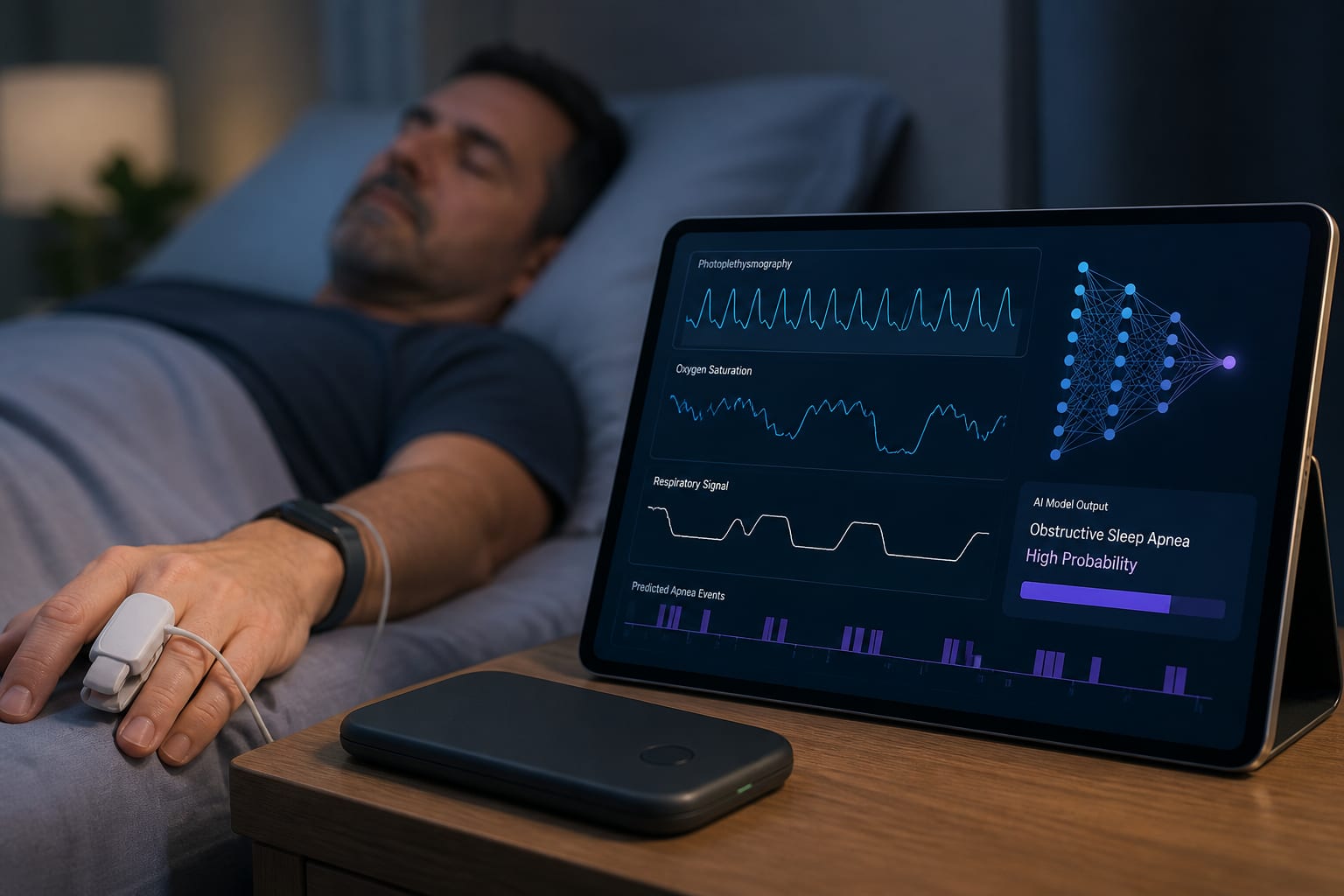
Accuracy of Artificial Intelligence in Diagnosing Obstructive Sleep Apnea Using Photoplethysmography: Systematic Review and Meta-Analysis - Summary - MDSpire
Coming Soon: Introducing MDSpire News. Learn more
Conexiant’s news site is now MDSpire News. Learn more

Evaluating the Precision of AI in Diagnosing Obstructive Sleep Apnea Through Photoplethysmography: A Systematic Review and Meta-Analysis

  • By

  • Brian Sheng Yep Yeo

  • Esther Yanxin Gao

  • Joan Ern Xin Tan

  • Jun Yuan Koo

  • Yi Siang Lee

  • Nicole Kye Wen Tan

  • Adele Chin Wei Ng

  • Zhou Hao Leong

  • Thun How Ong

  • Leong Chai Leow

  • Guang-Bin Huang

  • Benjamin Kye Jyn Tan

  • Song Tar Toh

  • September 25, 2026

Share

Objective:

To evaluate the diagnostic accuracy of AI models that use photoplethysmography (PPG) to detect obstructive sleep apnea (OSA).

Approach:
  • Study Design: A systematic review and meta-analysis registered with PROSPERO (CRD42024534235) following PRISMA guidelines.
  • Search Strategy: Systematic searches were conducted in PubMed, Embase, Scopus, Web of Science, and IEEE Xplore using terms related to OSA, AI, and PPG.
  • Study Selection: Eligible studies included observational investigations of adults addressing OSA diagnosis using AI with reference standards based on apnea-hypopnea index (AHI).
  • Data Extraction: Relevant information was extracted by independent authors and included variables such as publication year, sample size, and diagnostic accuracy data.
  • Statistical Analysis: A Bayesian bivariate random-effects model was utilized for analysis.

Original Source(s)

Related Content