Glycemic variability and muscle loss in elderly type 2 diabetes: insights from continuous glucose monitoring and chest CT in 303 patients - Summary - MDSpire

Glycemic variability and muscle loss in elderly type 2 diabetes: insights from continuous glucose monitoring and chest CT in 303 patients

  • By

  • Xiao-le Zhang

  • Ning Bai

  • Chun-pu Mao

  • Chun-yan Liu

  • June 22, 2026

  • 0 min

Share

Objective:

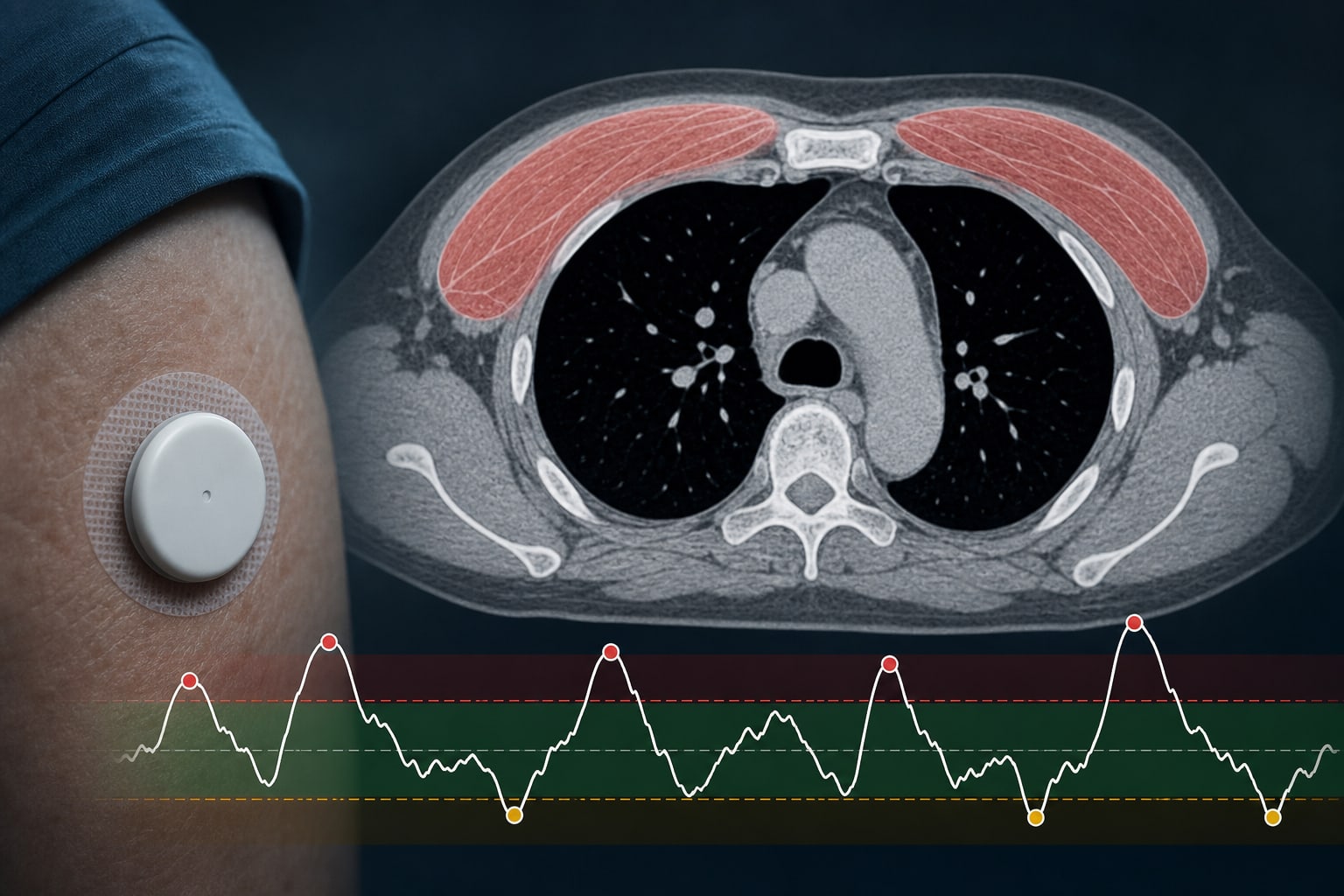
To investigate the association between glucose fluctuation and pectoralis muscle mass in elderly patients with type 2 diabetes mellitus (T2DM).

Approach:
    Key Findings:
    • Four glycemic variability indicators (CV, SD, MAGE, TBR) were independently associated with lower PMI (all P < 0.05).
    • CV explained the largest proportion of PMI variance (adjusted R² = 0.22).
    • A linear dose-response relationship was observed between CV and PMI (P for trend < 0.001).
    • The inverse association was stronger in patients with diabetes duration ≥ 10 years and those with BMI < 24 kg/m².
    Interpretation:

    Greater glycemic variability is independently associated with lower pectoralis muscle mass in elderly patients with T2DM.

    Limitations:
    • Retrospective design may limit causal inferences.
    • Single-center study may affect generalizability.
    Conclusion:

    Stabilizing glucose fluctuations may be important for preserving muscle mass in elderly patients with T2DM.

Original Source(s)

Related Content