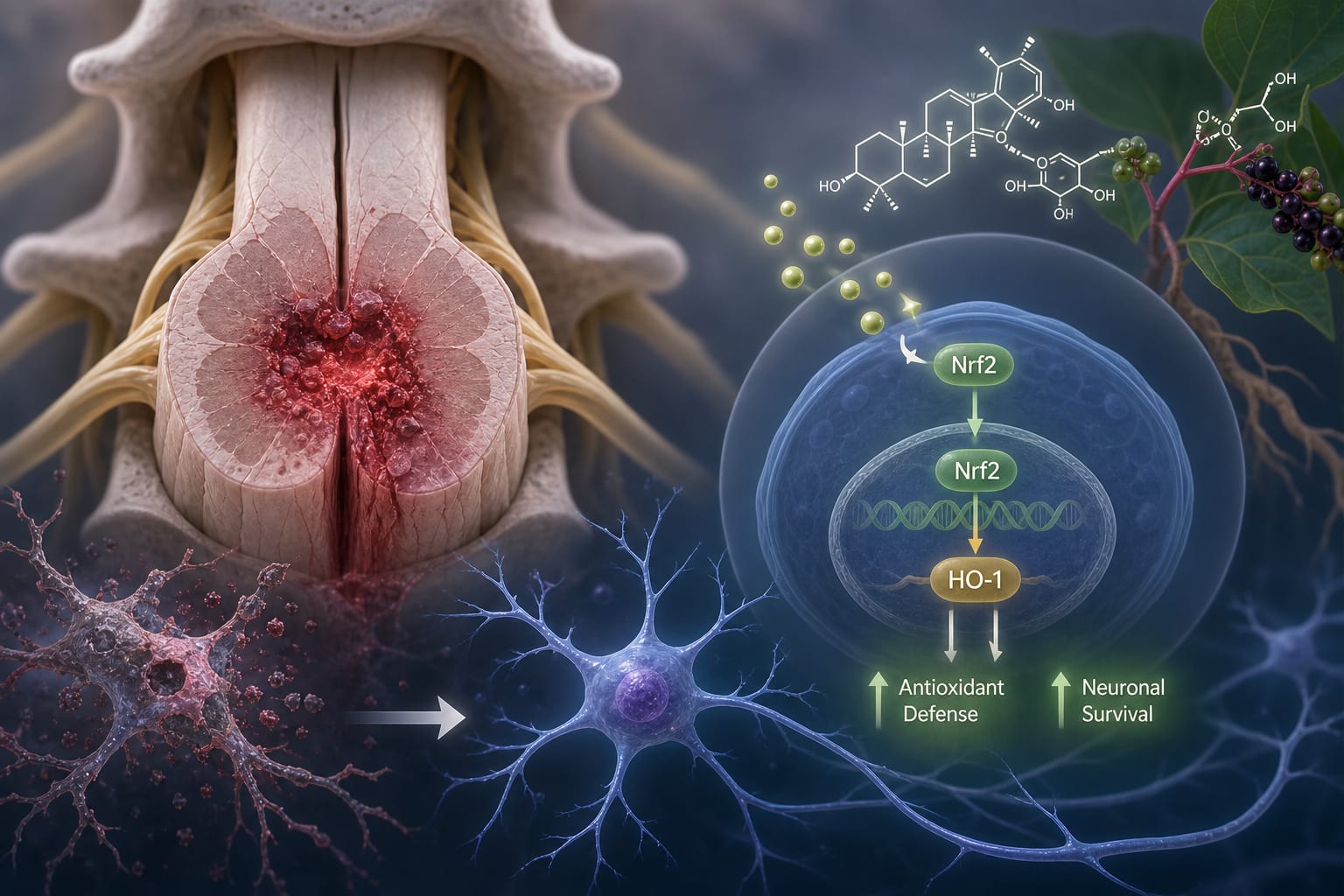
To investigate the protective potential of Esculentoside A (EsA) against oxidative stress and neuronal apoptosis following spinal cord injury (SCI) and to elucidate the associated molecular mechanisms.
Approach:
Animal Model: SCI was modeled in rats via contusion using the PSI-IH 0400 Striker impactor.
Treatment: Rats were treated intraperitoneally with 10 mg/kg EsA once daily.
Assessment Methods: Motor function was evaluated using the BBB scale, grid walk analysis, and footprint test. Histopathological alterations were examined by HE, LFB, and Nissl staining.
Biomarker Analysis: Oxidative stress markers and antioxidant enzymes were quantified in spinal cord homogenates using commercial assay kits.
Mechanistic Studies: Western blot, immunofluorescence staining, and molecular docking were employed to investigate underlying mechanisms.
Key Findings:
EsA significantly improved motor function and reduced histopathological damage in SCI rats.
EsA treatment resulted in significant improvements in oxidative stress biomarkers, including hydrogen peroxide and malondialdehyde, and reduced neuronal apoptosis.
Activation of the Nrf2/HO-1 pathway was associated with the neuroprotective effects of EsA.
Interpretation:
EsA exerts a neuroprotective effect against SCI by modulating oxidative stress and neuronal apoptosis, partially through activation of the Nrf2/HO-1 pathway.
Limitations:
The study was conducted in a rat model, which may limit the generalizability of the findings to humans.
Further studies are needed to fully elucidate the molecular mechanisms involved.
Conclusion:
EsA reduces oxidative stress and neuronal apoptosis in spinal cord injury.