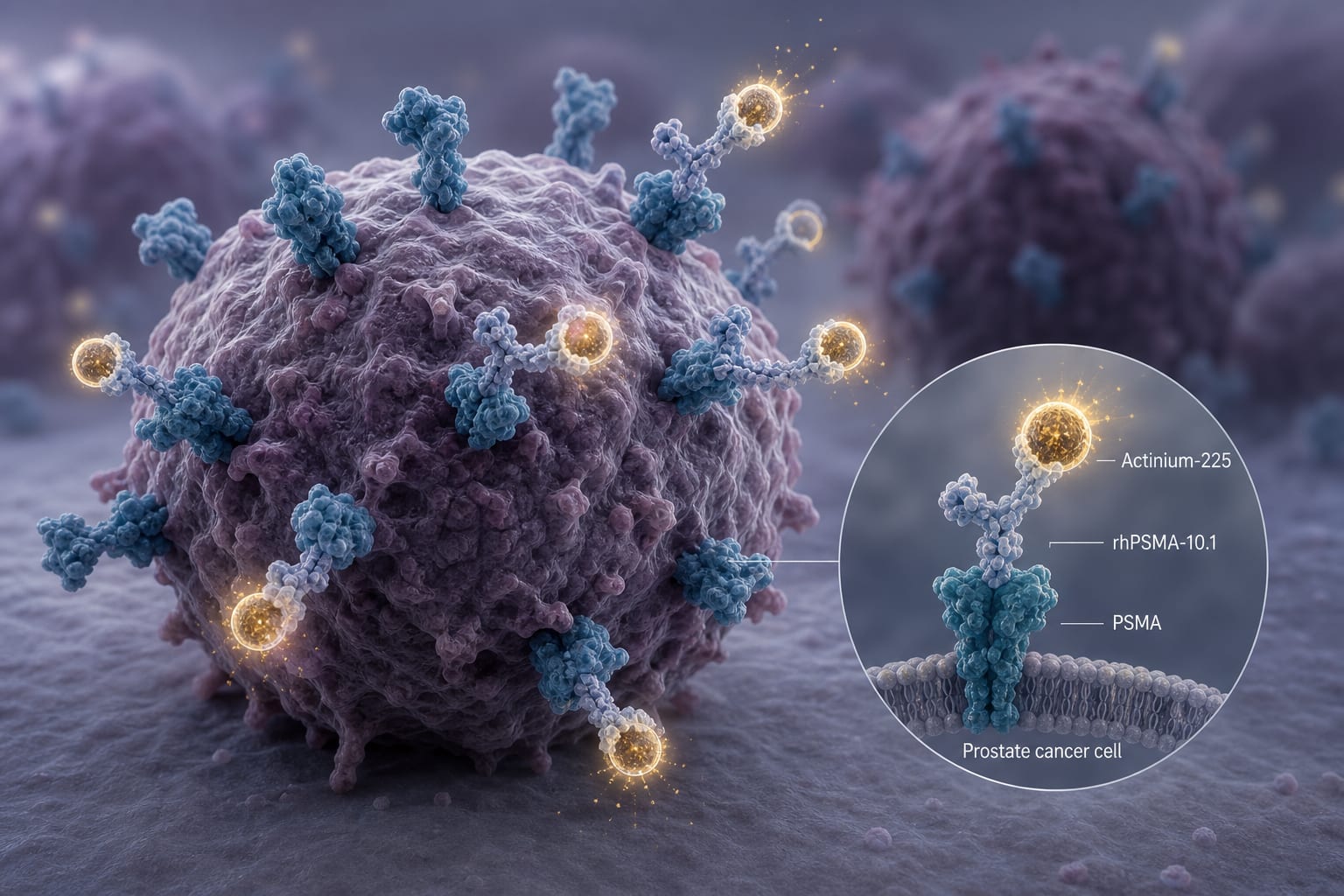
To evaluate [225Ac]Ac-rhPSMA-10.1 as a potential alpha-particle-emitting, PSMA-targeted radiopharmaceutical therapy for prostate cancer.
Approach:
In Vitro Assessments: Lipophilicity, PSMA-binding affinity, and cellular internalization of [225Ac]Ac-rhPSMA-10.1 and [177Lu]Lu-rhPSMA-10.1 were assessed in PSMA-expressing LNCaP cells.
In Vivo Assessments: Efficacy and tolerability were evaluated in PSMA-expressing 22Rv1 prostate cancer xenografts in mice, comparing the effects of a single dose of [225Ac]Ac-rhPSMA-10.1 and [177Lu]Lu-rhPSMA-10.1.
Key Findings:
[225Ac]Ac-rhPSMA-10.1 and [177Lu]Lu-rhPSMA-10.1 exhibited similar low lipophilicity and high PSMA binding affinity.
[225Ac]Ac-rhPSMA-10.1 significantly reduced tumor growth (p < 0.05) and prolonged median survival (43.5 days vs. 27.0 days; p = 0.006) compared to controls.
No significant differences in tumor growth suppression or survival were observed between the two radiopharmaceuticals.
Interpretation:
[225Ac]Ac-rhPSMA-10.1 demonstrated comparable in vivo properties and efficacy to [177Lu]Lu-rhPSMA-10.1 in prostate cancer models.
Limitations:
The study was conducted in preclinical models, and clinical outcomes remain to be validated.
Further investigations are needed to compare the efficacy of alpha versus beta particle therapies.
Conclusion:
[225Ac]Ac-rhPSMA-10.1 warrants further clinical investigation as a treatment option for metastatic prostate cancer.
by Caroline Foxton, Bradley Waldron, Alexander Wurzer, Calogero D’Alessandria, Alfred Morgenstern, Frank Bruchertseifer, Tea Kirkegaard Nielsen, Rikke Veggerby Grønlund, Mathias Wikke Hallund, Daniel J. Stevens
In the first installment of a new series on the investment environment in cell and gene therapy, Circio CEO Erik Wiklund explains how he had to get creative to raise funds in a difficult biotech market