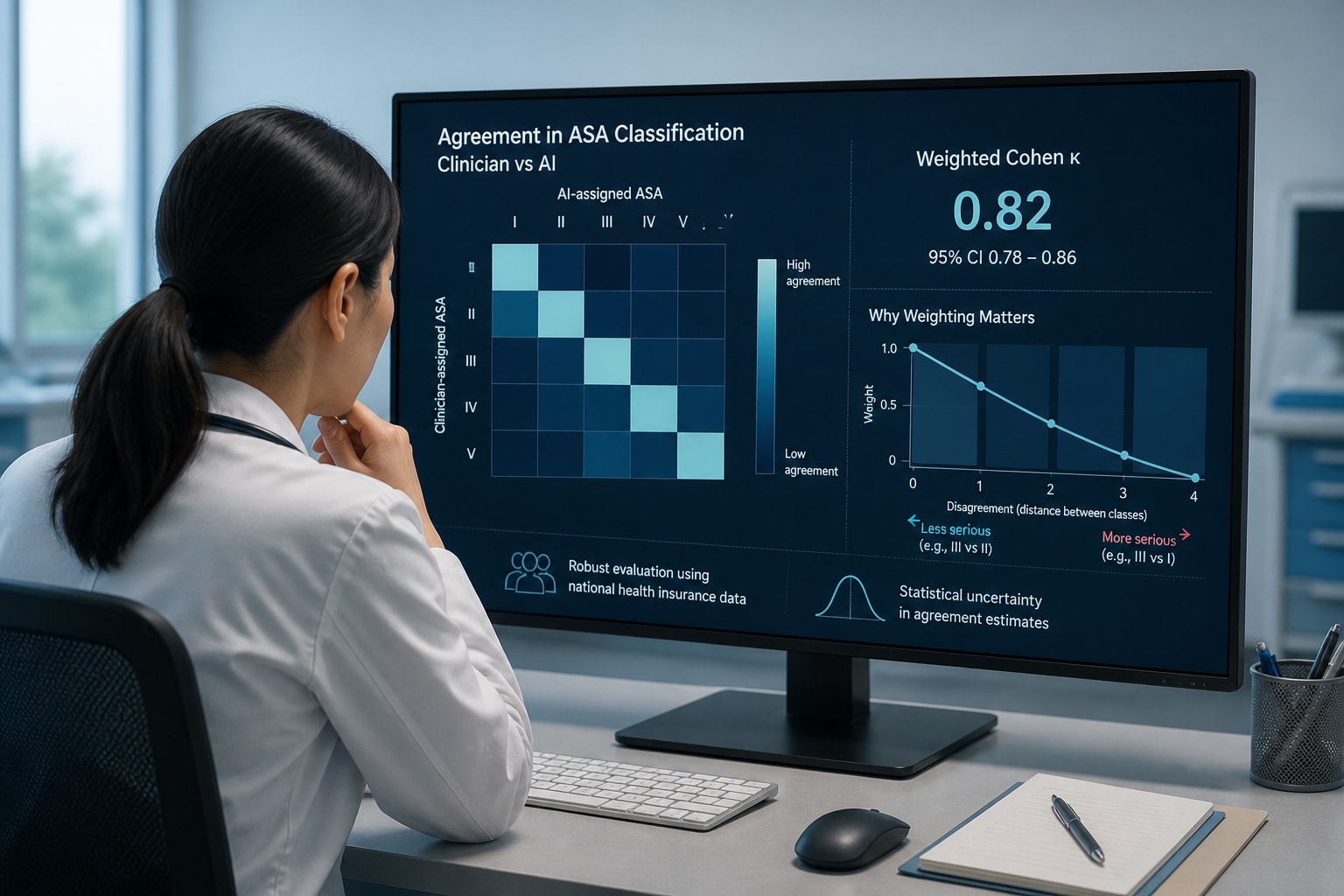
Assess how the reported agreement between a GPT-4o-powered preanesthetic system and clinicians should be interpreted, focusing on ASA classification and the contribution of Taiwan National Health Insurance (NHI) data.
Approach:
ASA agreement: The commentary examines whether the reported Cohen κ was weighted and notes that patient-level cross-tabulation was not provided.
NHI comparison: It reviews the κ estimates from evaluations with and without NHI data in the same 600 patients and the absence of an uncertainty estimate for their difference.
Key Findings:
The study reported high agreement between clinician-assigned and AI-generated ASA classifications, but did not specify whether Cohen κ was weighted.
Of 600 patients, 498 (83%) were classified as ASA II; 57 were ASA III and 6 were ASA IV. Without patient-level cross-tabulation, the pattern and severity of disagreements cannot be determined.
κ increased from 0.518 without NHI data to 0.883 with NHI data, a difference of 0.365. No confidence interval or other uncertainty measure for this difference was reported.
Interpretation:
The commentary states that weighted κ and patient-level cross-tabulation, particularly for ASA III and IV, would help characterize disagreement. Because both NHI evaluations used the same patients, an uncertainty estimate for the paired difference in κ would better quantify the reported change.
Limitations:
The source does not provide the patient-level cross-tabulation needed to assess the distribution of disagreements.
It does not report whether κ was weighted or provide an uncertainty estimate for the difference between the NHI conditions.
Conclusion:
The commentary calls for additional reporting on disagreement patterns and the precision of the estimated change associated with NHI data to support interpretation of the reported agreement.