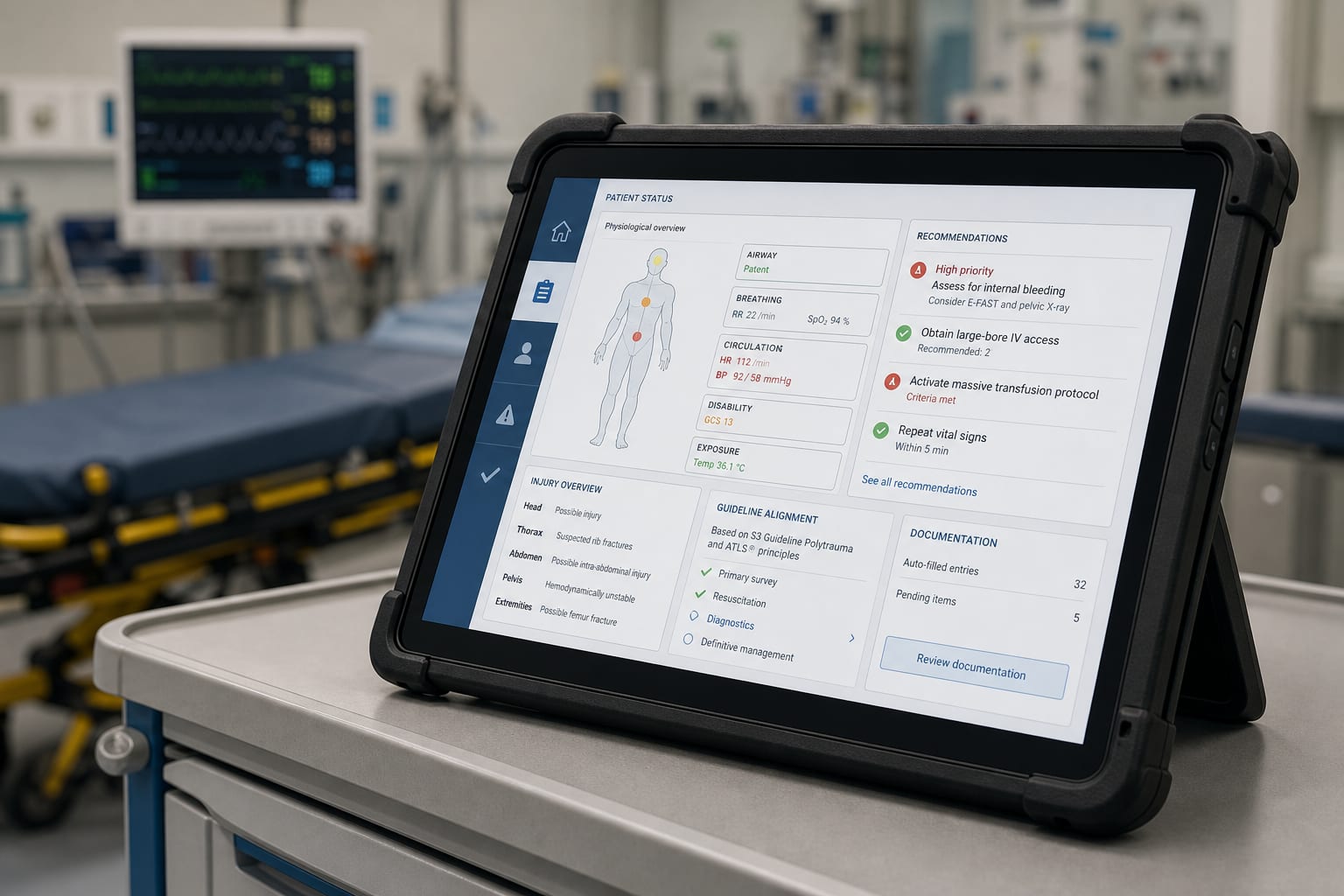
To evaluate the clinical application of TraumaFlow, a CDSS, in improving compliance with clinical guidelines, the completeness and accuracy of documentation in polytrauma care, and reducing cognitive strain among trauma team members.
Approach:
Study Design: A prospective study at a level 1 trauma center comparing TraumaFlow with standard paper protocols in managing 30 polytrauma cases.
Participants: Eighteen residents participated, managing cases with TraumaFlow and comparing results with a historical cohort of 30 cases documented conventionally.
Data Collection: Documentation quality was assessed, workload measured using NASA Raw Task Load Index, and usability evaluated through questionnaires.
Key Findings:
Documentation completeness was significantly higher with TraumaFlow (82%) compared to paper (74%), p = 0.002.
Of 74 system-generated clinical prompts, 37% triggered clinically relevant actions.
No significant difference in workload between TraumaFlow-supported and conventional cases.
Interpretation:
TraumaFlow improved documentation quality and supported guideline-based management in acute polytrauma care.
Limitations:
No measurable reduction in workload was observed.
Study limited to a single trauma center and a small sample size.
Conclusion:
TraumaFlow enhanced documentation quality and supported clinical decision-making in polytrauma care.