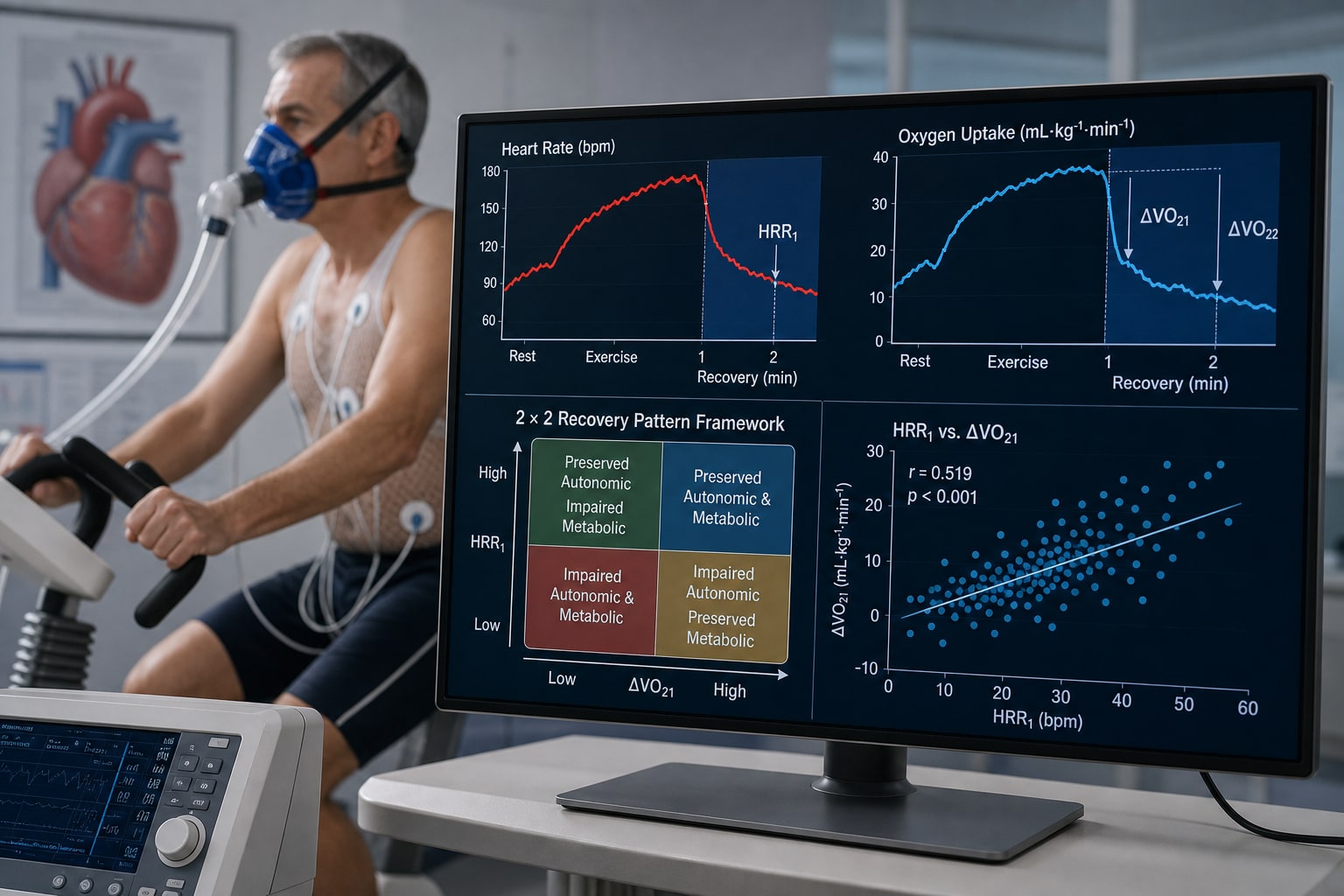
To investigate the relationship between heart rate recovery (HRR) and oxygen uptake (VO₂) recovery in patients with coronary artery disease (CAD) and to characterize cardiometabolic recovery patterns.
Approach:
Study Design: Retrospective observational study including 200 patients with stable CAD who underwent symptom-limited cardiopulmonary exercise testing (CPET).
Data Analysis: HRR at 1 min (HRR1), ΔVO₂ values, and VO₂ recovery indices were analyzed, and patients were classified according to combined HRR and VO₂ recovery patterns using a 2 × 2 recovery framework.
Key Findings:
HRR1 was significantly correlated with ΔVO₂1 (r = 0.519, p < 0.001) and ΔVO₂2 (r = 0.510, p < 0.001), as well as VO₂ recovery indices at 1 and 2 min (r = 0.496 and 0.531, respectively; both p < 0.001).
Distinct recovery phenotypes were identified, indicating heterogeneity in post-exercise recovery dynamics.
Significantly lower VO₂ recovery was observed in the Good HRR–Poor VO₂ phenotype compared to the Poor HRR–Good VO₂ phenotype (p = 0.027).
Interpretation:
Limitations:
Retrospective design may limit causal inferences.
Exclusion of patients with atrial fibrillation may affect generalizability.
Data derived from a single tertiary cardiac rehabilitation center may limit broader applicability.