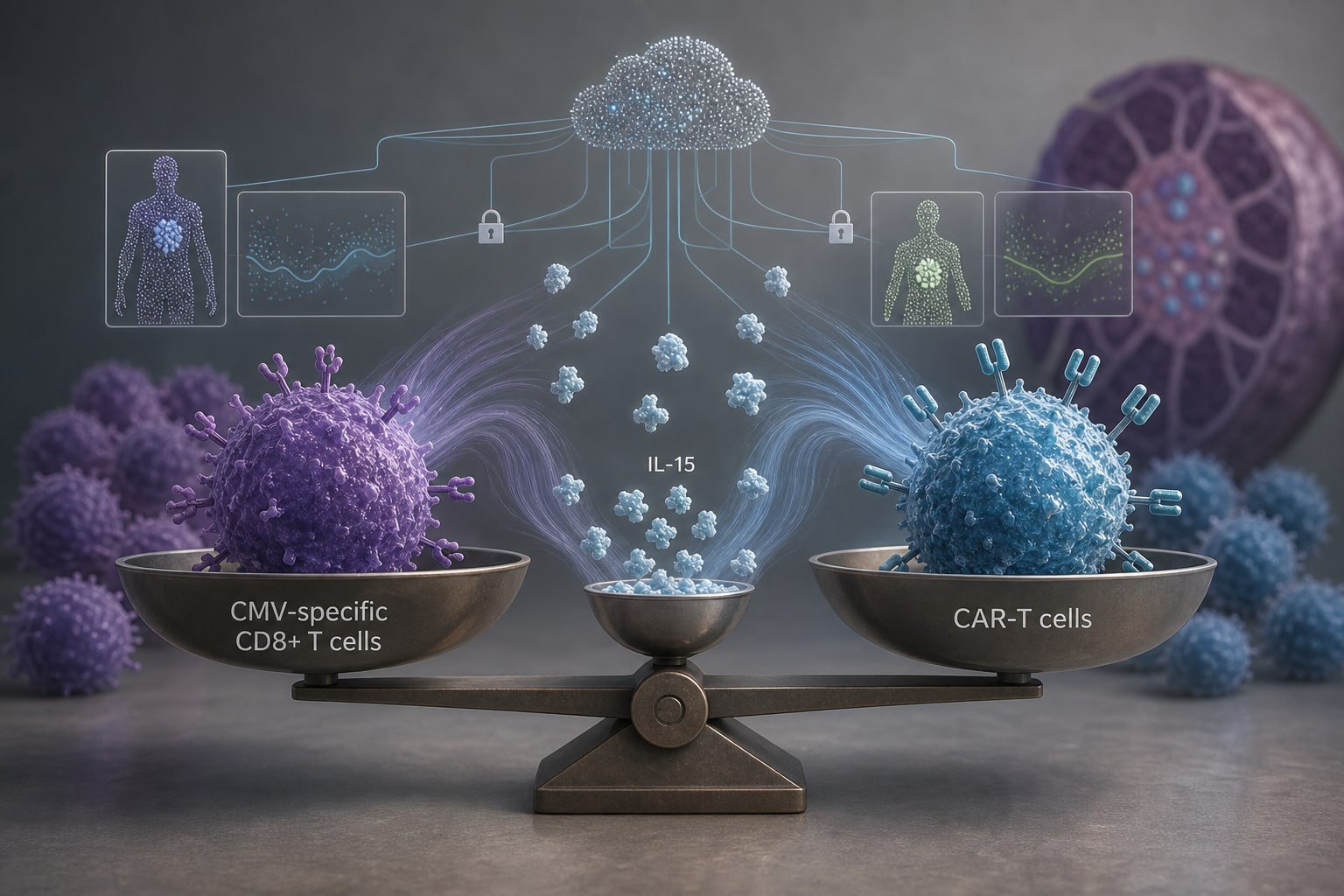
To investigate the cytokine sink hypothesis and its impact on CAR-T therapy outcomes in the context of cytomegalovirus (CMV) reactivation, emphasizing its significance in treatment efficacy.
Approach:
Key Findings:
The digital twin predicted clinically significant CMV reactivation with an AUROC significantly outperforming existing clinical risk scores, indicating improved predictive capability.
CMV reactivation was associated with reduced peak CAR-T expansion.
Global sensitivity analysis identified the pre-infusion frequency of CMV-specific T-cell precursors and the resource competition coefficient as primary drivers of CAR-T impairment.
In silico simulation of a risk-adapted antiviral prophylaxis strategy reduced projected six-month progression while decreasing aggregate drug exposure.
In the prospective validation cohort, model-predicted kinetic impairment independently predicted progression-free survival.
Interpretation:
The data quantitatively support resource competition as a mechanism linking CMV reactivation to CAR-T impairment, reinforcing the cytokine sink hypothesis over exhaustion-based alternatives.
Limitations:
Randomized interventional evidence is required for definitive causal proof, which would clarify the relationship between CMV reactivation and CAR-T therapy outcomes.
Validation of clinical utility necessitates a randomized controlled trial guided by the digital twin’s predictions.
Conclusion:
A privacy-preserving, mechanistic digital twin can serve as a clinically actionable tool for early risk stratification and personalized intervention, potentially transforming patient management in CAR-T therapy.