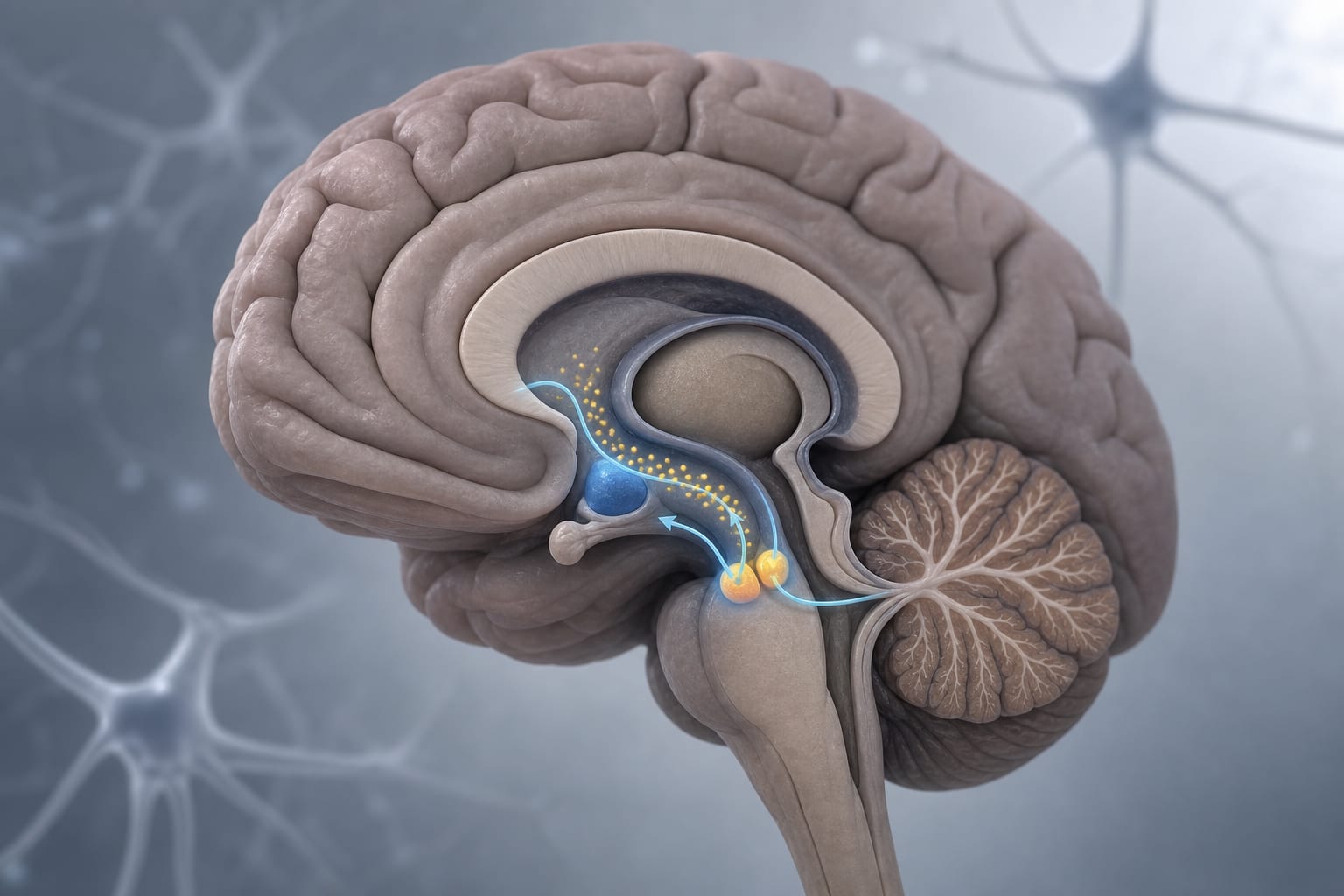
To investigate the role of the nucleus basalis of Meynert (NbM) in cognitive function and disease progression in early Parkinson's disease (PD) and isolated REM sleep behavior disorder (iRBD), highlighting its significance as a potential biomarker.
Key Findings:
Significantly lower NbM grey matter volume in both PD and iRBD compared to controls.
Higher NbM volume in PD associated with better cognitive function and lower symptom burden.
Lower NbM volume in iRBD linked to decreased risk of phenoconversion to PD or dementia.
Associations between NbM deficits and clinical state were less pronounced in iRBD.
Interpretation:
NbM volume may serve as a biomarker for predicting cognitive decline and disease progression in early PD, while also indicating phenoconversion risk in prodromal stages, suggesting a need for further exploration.
Limitations:
Study focused on early PD and iRBD, limiting generalizability to other stages.
Specific potential confounding factors, such as age and comorbidities, were not fully addressed in the analysis.
Conclusion:
Structural deficits in the NbM may precede clinical symptoms, suggesting compensatory mechanisms in iRBD that could fail over time, leading to clinical conversion; this highlights the need for ongoing research into NbM's role in disease progression.
by Tamir Eisenstein, Karolien Groenewald, Ludo van Hillegondsberg, Falah Al Hajraf, Tanja Zerenner, Michael A Lawton, Yoav Ben-Shlomo, Ludovica Griffanti, Michele T Hu, Johannes C Klein
Aviva Abosch, M.D., Ph.D., a neurosurgeon at Baptist Health Miami Neuroscience Institute, part of Baptist Health Brain and Spine Care, was installed as the Esernia Endowed Chair in Surgical Treatment of Adult Epilepsy and Movement Disorders.