Establishment and evaluation of a predictive scoring system for successful decannulation of tracheostomy in neurosurgery patients - Summary - MDSpire

Establishment and evaluation of a predictive scoring system for successful decannulation of tracheostomy in neurosurgery patients

  • By

  • Yin Hu

  • Lifang Mao

  • Qing Liu

  • Yanhua Jiang

  • Shun Li

  • May 22, 2026

  • 0 min

Share

Objective:

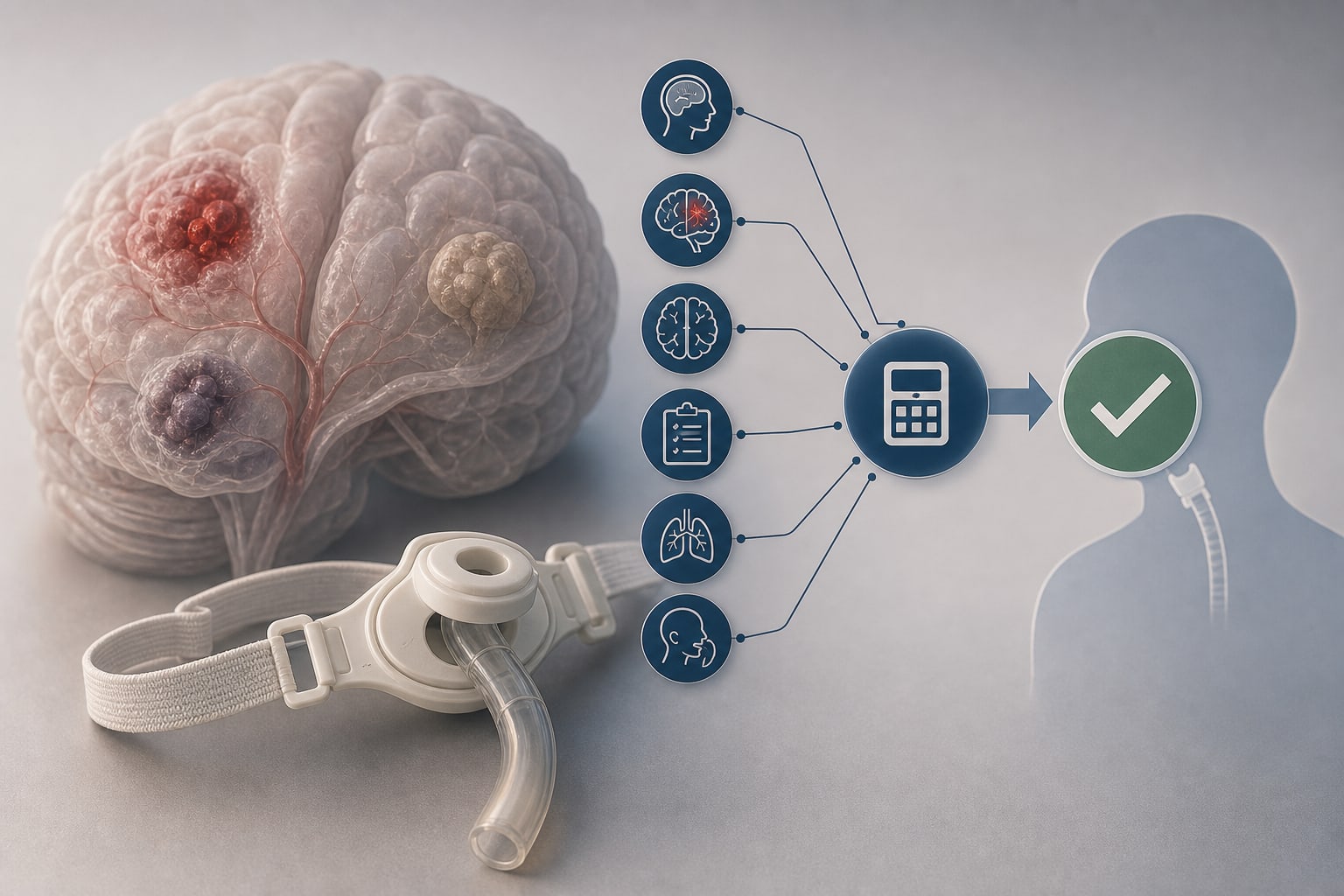
To establish and evaluate a predictive scoring system for successful decannulation of tracheostomy in neurosurgery patients.

Key Findings:
  • Overall decannulation success rate was 63.9%.
  • Independent predictive factors included: supratentorial lesion location (OR 8.05), GCS >8 at decannulation (OR 21.21), < 6 airway suctioning episodes/24 h (OR 13.13), capping trial ≥24 h (OR 6.28), and serum albumin ≥35 g/L (OR 4.71).
  • The scoring system achieved an AUC of 0.933 in the training set and 0.930 in the validation set.
  • A cut-off of ≥10 points yielded a sensitivity of 91.9% and specificity of 84.3%.
Interpretation:

The predictive scoring system provides a tool to assist in decannulation decision-making.

Limitations:
  • The study was conducted in two tertiary hospitals, which may limit generalizability.
  • The sample size may not fully represent all neurosurgical patients requiring tracheostomy.
Conclusion:

The scoring system offers a tool for decannulation in neurosurgical patients.

Original Source(s)

Related Content