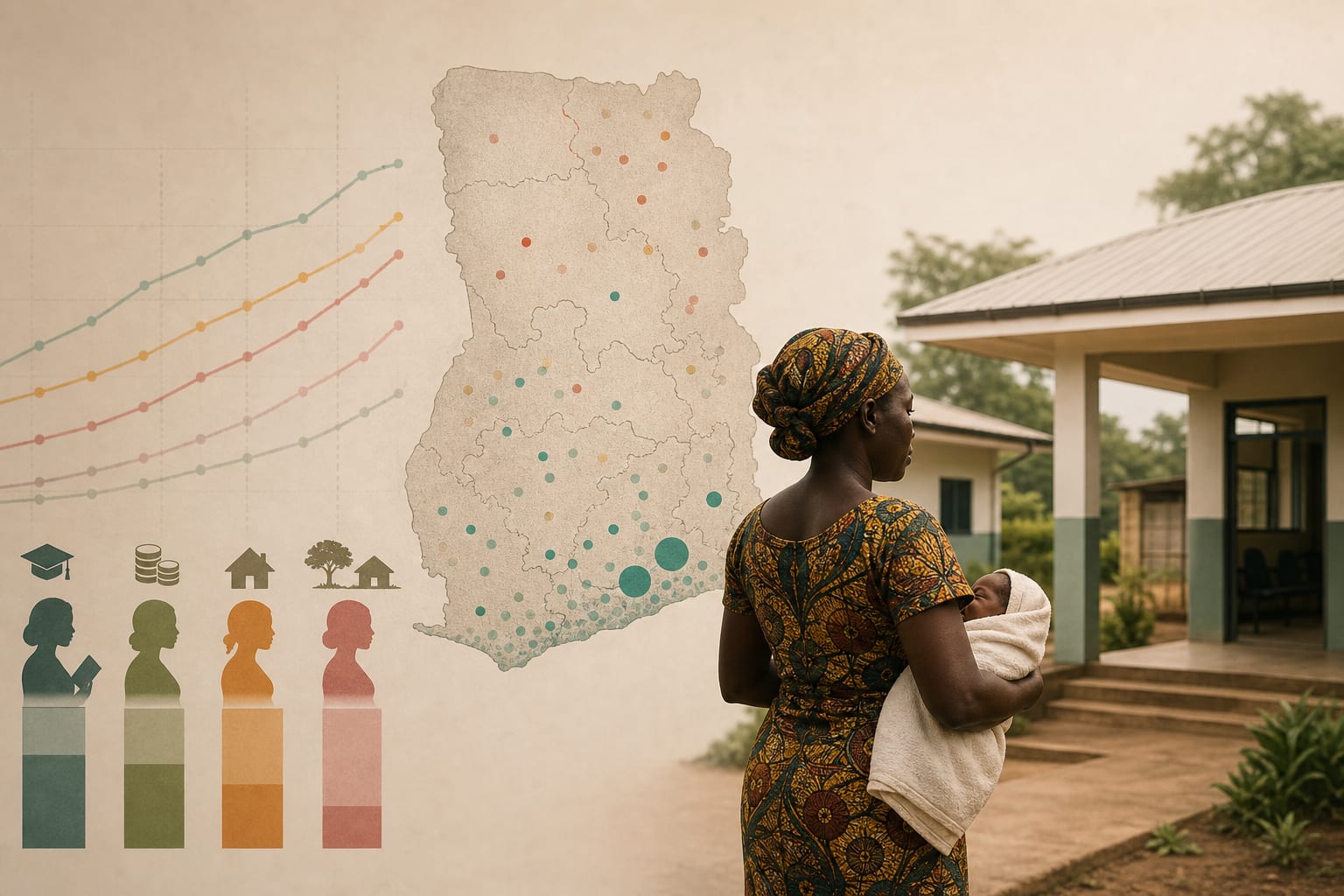
To examine trends and inequalities in health facility deliveries among women of reproductive age in Ghana from 1993 to 2022, focusing on socioeconomic and demographic factors.
Approach:
Data Source: Data were extracted from the WHO Health Equity Assessment Toolkit (HEAT) using weighted, age-standardised estimates from Ghana Demographic and Health Surveys (DHS) and Multiple Indicator Cluster Surveys (MICS) for specified years.
Outcome Measurement: The outcome was the percentage of live births occurring in a health facility, measured using WHO HEAT indicator code: MNCH7.
Inequality Measurement: Inequality was assessed using absolute difference (D), ratio (R), population attributable fraction (PAF), and population attributable risk (PAR) for each dimension.
Key Findings:
National health facility delivery prevalence increased from 42.3% (95% CI: 39.5–45.1) in 1993 to 85.4% (95% CI: 84.1–86.7) in 2022.
Disparities in health facility deliveries in 2022 included: richest vs. poorest quintile (97.1% vs. 71.1%; D = 25.7 percentage points), higher education vs. no education (98.0% vs. 72.3%; D = 25.7 percentage points), urban vs. rural (93.7% vs. 77.9%; D = 15.8 percentage points), and Upper East vs. Northern region (97.7% vs. 69.0%; D = 28.7 percentage points).
Absolute economic inequality declined from 60.6 percentage points in 1993 to 25.7 in 2022; educational inequality fell from 53.6 to 17.8; rural–urban inequality declined from 35.8 to 9.7.
Interpretation:
Marked inequalities by wealth, education, place of residence, and region persist despite overall gains in health facility deliveries in Ghana.
Limitations:
The descriptive analysis does not establish causality regarding the impact of policy reforms on health facility delivery rates.
Conclusion:
Targeted interventions for women in poorer, less educated, and rural settings are needed to achieve equitable maternal healthcare.