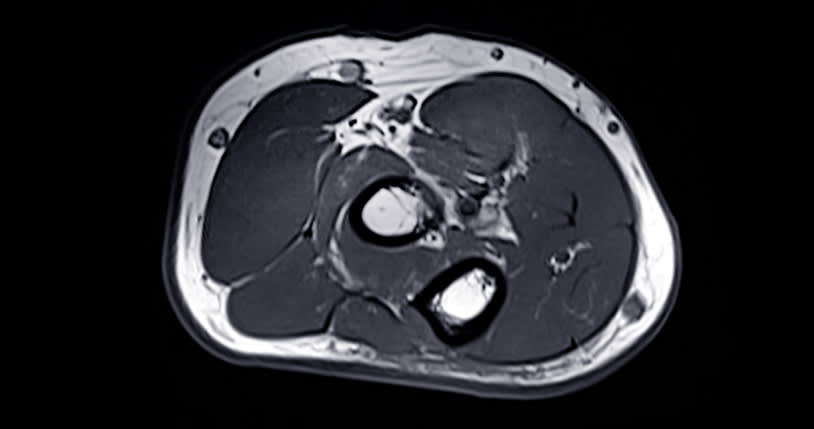
To investigate the association between ultraprocessed food (UPF) consumption and thigh muscle fat infiltration in older patients at risk of knee osteoarthritis.
Key Findings:
Higher UPF consumption was associated with greater muscle fat infiltration across all thigh muscles, particularly in flexors and adductors.
Associations were stronger when adjusted for abdominal circumference.
For every 1-standard deviation increase in UPF intake, Goutallier grade increased by 0.1 standard deviations.
No significant differences were observed by sex.
MRI showed highest fat infiltration in flexor muscles and lowest in extensors.
Interpretation:
The study suggests a concerning link between higher UPF intake and poorer muscle quality, as indicated by increased fat content in thigh muscles, regardless of sex.
Limitations:
Cross-sectional design limits causal inference.
Reliance on self-reported dietary data may introduce recall bias.
Use of semiquantitative grading instead of quantitative fat measurement.
Cohort consisted of older patients at risk for knee osteoarthritis, limiting generalizability.
Conclusion:
The findings provide evidence that UPF consumption is associated with increased muscle fat infiltration, which may negatively impact muscle quality in at-risk populations.