Integrated single-cell and bulk RNA sequencing analyses identify a myeloid state-related gene signature for molecular subtyping in stomach adenocarcinoma - Summary - MDSpire
Advertisement
Integrated single-cell and bulk RNA sequencing analyses identify a myeloid state-related gene signature for molecular subtyping in stomach adenocarcinoma
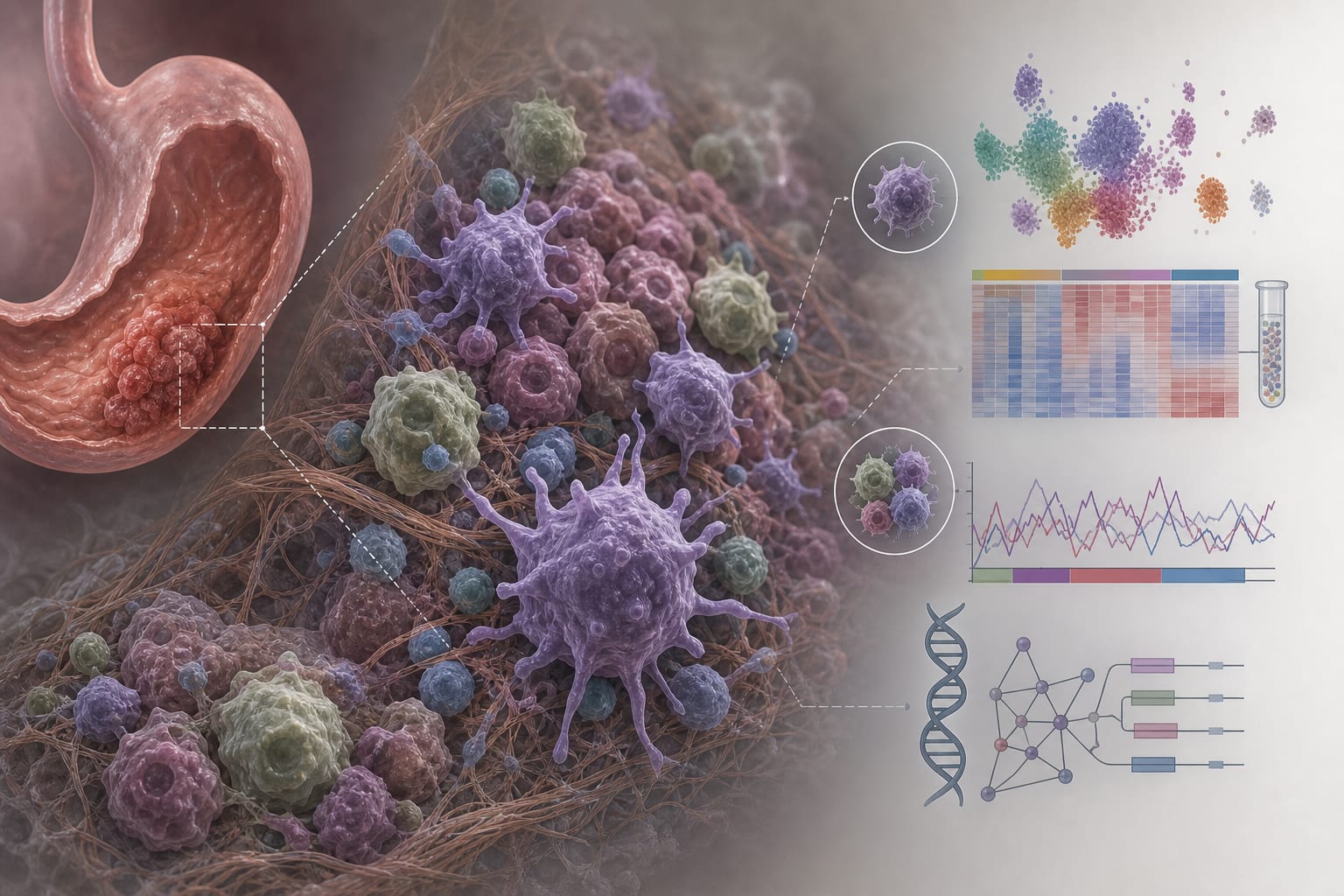
To elucidate the roles of myeloid cells in stomach adenocarcinoma (STAD) and establish a molecular classification based on myeloid states, while exploring their relationship with patient prognosis and therapeutic response.
Approach:
Data Integration: Integrated single-cell RNA-seq profiles and 443 bulk RNA-seq profiles from the TCGA-STAD cohort.
Myeloid State Identification: Identified myeloid state-related prognostic genes (MSRPGs) and constructed a molecular classification (STAD-MSC) using pseudotime analysis and survival analysis, along with correlation analysis to establish regulatory networks.
Validation: Evaluated a 5-gene risk model in a public 355-patient validation cohort and assessed the STAD-MSC framework at the protein level in a 70-patient retrospective cohort.
Key Findings:
Identified 32 MSRPGs across five distinct myeloid states.
Stratified patients into three subtypes: low immune infiltration STAD (LI-STAD), moderate immune infiltration STAD (MI-STAD), and high immune infiltration STAD (HI-STAD).
HI-STAD subtype exhibited the poorest overall survival (global log-rank p = 0.018).
Constructed a 5-gene prognostic signature and identified subtype-specific drug response differences, including nominal associations for dabrafenib (p = 0.0051) and ruxolitinib (p = 0.041).
Interpretation:
The STAD-MSC framework provides a myeloid state-centric molecular taxonomy that stratifies STAD patients into subgroups with distinct prognoses and immunosuppressive features.
Limitations:
The study relies on data from public cohorts, which may limit generalizability.
Further validation in larger, independent cohorts is necessary to confirm findings.
Conclusion:
The study establishes a framework for immune-informed patient stratification in STAD based on myeloid states.
Robot-assisted surgery (RAS) has led to shorter hospital stays, faster recovery and reduced pain for patients with many types of cancer. Now, thanks to the pioneering work of Moshim Kukar, MD, FACS, Department of Surgical Oncology, and his Roswell Park team, RAS is the standard of care for eligible patients with gastroesophageal junction cancers.