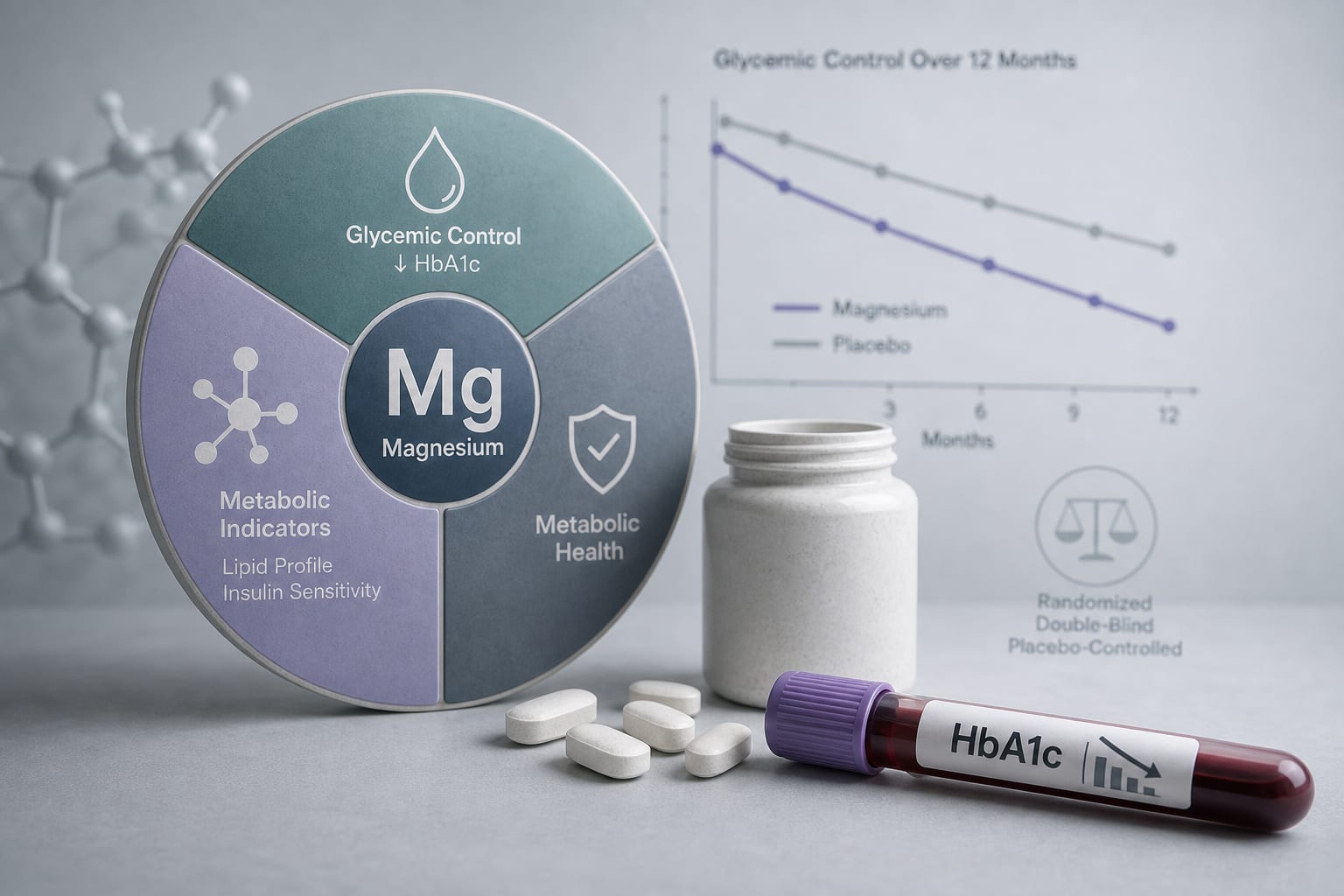
The effect of oral magnesium supplementation on glycemic control and metabolic parameters in type 2 diabetes mellitus: a double-blind randomized controlled trial - Summary - MDSpire
Advertisement
The effect of oral magnesium supplementation on glycemic control and metabolic parameters in type 2 diabetes mellitus: a double-blind randomized controlled trial
To assess the effect of oral magnesium supplementation on glycated hemoglobin (HbA1c) and metabolic biomarkers in adults with Type 2 Diabetes Mellitus (T2DM).
Approach:
Trial Design: A prospective, randomized, double-blind, placebo-controlled, parallel-group clinical trial.
Participants: Adults (≥18 years) with T2DM, randomized 1:1 to receive magnesium oxide (500 mg) or placebo.
Eligibility Criteria: HbA1c level ≥7.0% and creatinine clearance >30 mL/min.
Analysis: Intention-to-treat (ITT) and per-protocol (PP) analyses conducted.
Follow-up: Biochemical and clinical parameters assessed at baseline and three follow-up visits over 12 months.
Key Findings:
Mg-oxide supplementation significantly reduced fasting blood glucose in a subgroup (p = 0.039).
There was a modest, non-significant reduction in HbA1c (−0.30% vs. −0.05%; p = 0.145).
A higher proportion achieved controlled HbA1c (<7%) with Mg-oxide compared to placebo (14.0% vs. 6.0%; p = 0.043).
HbA1c reductions were more pronounced among participants with baseline hypomagnesemia (−0.60% vs. +0.25%; p = 0.074).
No differences were observed in other metabolic parameters or adverse drug reactions between groups.
Interpretation:
Mg-oxide supplementation improved magnesium status and showed favorable trends in glycemic control without compromising safety.
Limitations:
Median HbA1c reduction did not reach statistical significance.
Findings may not be generalizable beyond the studied population.
Conclusion:
Mg supplementation may serve as a safe adjunct to long-term T2DM management, particularly among selected subgroups.
by Juhaina Salim Al-Maqbali, Abdullah M. Al Alawi, Alaa Osman, Ahmed Al-Farqani, Suneel Kumar, Abdullah Al Futisi, Ali Al-Mamari, Ibrahim Al-Zakwani, Mohammed Al Za’abi