Progression-free survival outcomes of PARP inhibitors in ovarian cancer: an exploratory analysis of treatment heterogeneity based on organ vulnerability - Summary - MDSpire
Advertisement
Progression-free survival outcomes of PARP inhibitors in ovarian cancer: an exploratory analysis of treatment heterogeneity based on organ vulnerability
To explore whether organ vulnerability is associated with variation in progression-free survival (PFS) between PARP inhibitors in ovarian cancer patients.
Approach:
Study Design: A retrospective analysis of 604 ovarian cancer patients using an organ vulnerability score (OVS) based on pre-treatment laboratory indicators.
Benchmark Analysis: Conducted in 280 patients with complete BRCA status to evaluate the framework against established prognostic associations.
Statistical Methods: Applied G-computation-based counterfactual survival standardization and causal forest analyses to explore treatment heterogeneity.
Key Findings:
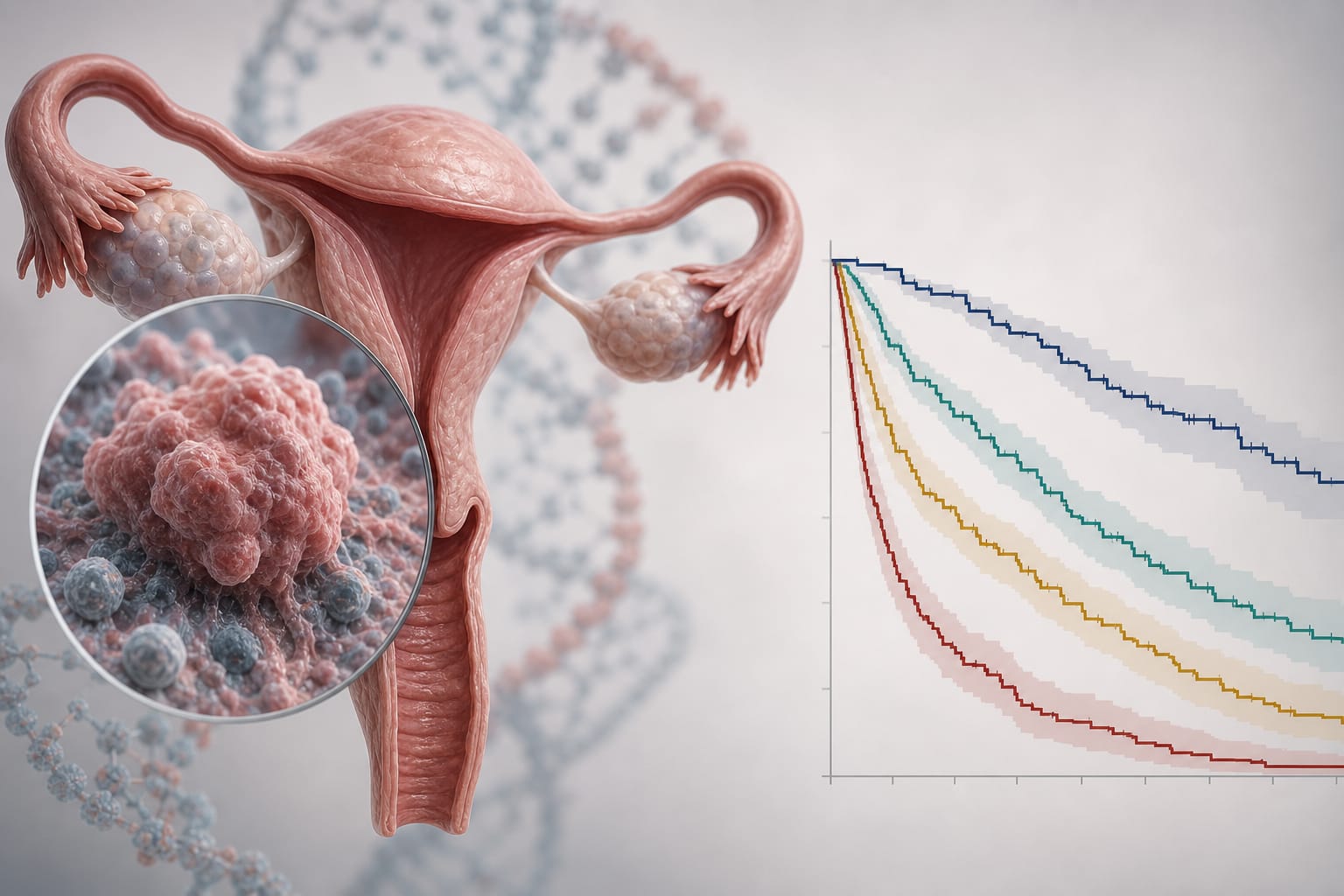
The association between BRCA mutation status and PFS was consistent with prior clinical evidence (HR = 0.685, 95% CI: 0.490–0.959; P = 0.028).
A significant treatment-by-OVS interaction was observed (interaction HR = 0.488, 95% CI: 0.293–0.813; P = 0.006).
In low vulnerability patients (OVS 0–1), olaparib showed a modest PFS advantage over niraparib (HR = 0.744, 95% CI: 0.558–0.988; P = 0.030).
In high vulnerability patients (OVS 2–3), olaparib's relative benefit was more pronounced (HR = 0.363, 95% CI: 0.206–0.640; P < 0.001).
Individual-level variation in treatment response was noted, with some patients favoring niraparib.
Interpretation:
Baseline physiological vulnerability may be associated with heterogeneity in the relative effectiveness of PARP inhibitors.
Limitations:
The estimates are model-dependent and should not be interpreted as definitive comparisons.
The study is retrospective and exploratory in nature.
Conclusion:
The findings suggest a potential link between physiological vulnerability and treatment response variability, laying groundwork for future prospective studies.