Real-world practices and challenges of radiologically isolated syndrome: results of a cross-sector survey by the DACH MS guidelines group - Summary - MDSpire

Real-world practices and challenges of radiologically isolated syndrome: results of a cross-sector survey by the DACH MS guidelines group

  • By

  • Friederike Held

  • Antonios Bayas

  • Katharina Christe

  • Christian Dettmers

  • Burkhard Domurath

  • Juliane Ebert

  • Edeltraud Faßhauer

  • Peter Flachenecker

  • Jutta Gärtner

  • Dzenita Hasanbasic

  • Christoph Heesen

  • Harald Hegen

  • Thomas Henze

  • Peter Huppke

  • Veronika Kana

  • Michael Khalil

  • Ruth Kirschner-Hermanns

  • Thomas Korn

  • Tania Kümpfel

  • Sabine Lamprecht

  • Uwe Meier

  • Gerd Meyer zu Horste

  • Mathias Mäurer

  • Frederike Cosima Oertel

  • Caroline Pot

  • Anne-Katrin Pröbstel

  • Kevin Rostásy

  • Anke Salmen

  • Jutta Scheiderbauer

  • Markus Schmidt

  • Erwin Stark

  • Corinna Trebst

  • Regina Trollmann

  • Clemens Warnke

  • Mike P. Wattjes

  • Benedikt Wiestler

  • Brigitte Wildemann

  • Uwe Zimmermann

  • Klaus Gehring

  • Achim Berthele

  • Bernhard Hemmer

  • July 14, 2026

Share

Objective:

To evaluate real-world Radiologically isolated syndrome (RIS) management practices across Germany, Austria, and Switzerland and identify key gaps for future guideline development.

Approach:
  • Survey Design: An anonymous online survey was conducted among neurologists in Germany, Austria, and Switzerland to assess RIS diagnosis, treatment, and monitoring practices.
  • Participant Recruitment: Board-certified neurologists were invited to participate using a snowball sampling method, with a total of 127 respondents included in the analysis.
  • Data Analysis: Quantitative data were analyzed using descriptive statistics, reporting categorical variables as frequencies and percentages.
Key Findings:
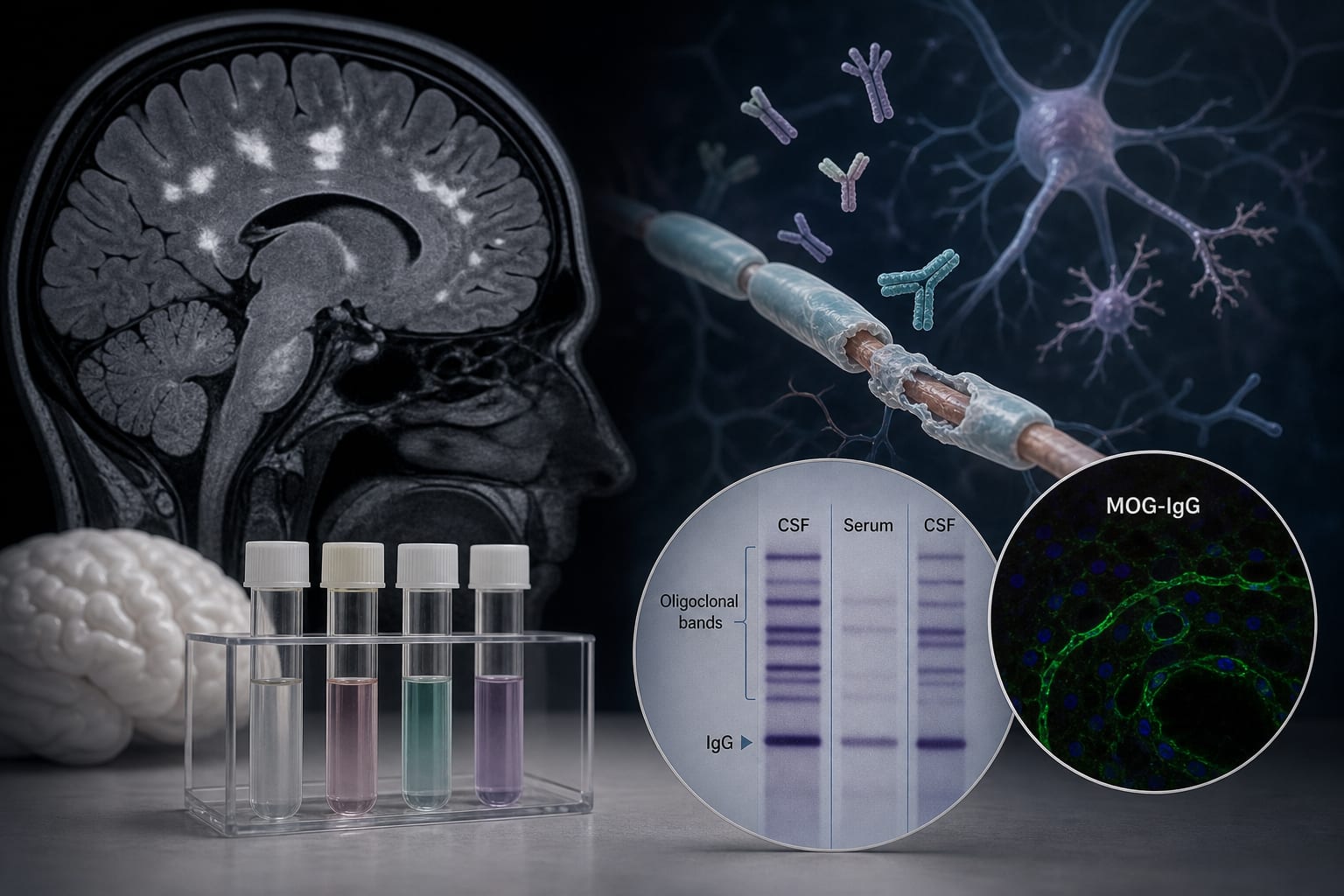
  • Diagnostic practices were relatively uniform, with over 85% performing comprehensive MRI and CSF analysis.
  • Awareness and implementation of the 2023 RIS criteria varied: 34% consistent use, 42% partial implementation, 16% non-adoption, and 8% unaware.
  • 54% of clinicians considered therapy initiation, but 69% treated less than 25% of their RIS cases.
  • 72% of respondents lacked standardized treatment algorithms.
  • Key barriers included reimbursement challenges (61%), patient communication difficulties (42%), and limited access to specialists.
Interpretation:

Real-world RIS care in the DACH region shows substantial practice heterogeneity alongside shared clinical approaches.

Limitations:
  • The survey may not capture all neurologists in the DACH region, potentially limiting the generalizability of findings.
  • Responses may be influenced by individual clinician biases and experiences.
Conclusion:

The findings reveal critical unmet needs in RIS management.

Original Source(s)

Related Content