Baroreflex sensitivity impairment in Long-COVID patients: a diagnostic tool for classifying the autonomic dysfunction spectrum - Summary - MDSpire

Baroreflex sensitivity impairment in Long-COVID patients: a diagnostic tool for classifying the autonomic dysfunction spectrum

  • By

  • Alejandro Sáinz-Jiménez

  • Ignacio Romero Fragoso

  • Guadalupe Estrella Salazar Calderon

  • Santiago Martinez-Falcon

  • Hannah Molinari Luna

  • Jesus Portocarrero Nieto

  • Andrea Barajas-Aguilar

  • Antonio Barajas-Martínez

  • Isael Guillermo García Macedo

  • Felipe Gonzalez-Alvarez

  • Maria Silvia Lopez-Yañez

  • Brayans Becerra-Luna

  • Raul Martinez-Memije

  • Erwin Chiquete

  • Carlos Cantu

  • Karla Maria Tamez-Torres

  • Jose Sifuentes-Osornio

  • Claudia Lerma

  • Ruben Fossion

  • Tania Reyes-Cruz

  • Bruno Estañol

  • Jose de Jesus Aceves-Buendia

  • July 14, 2026

Share

Objective:

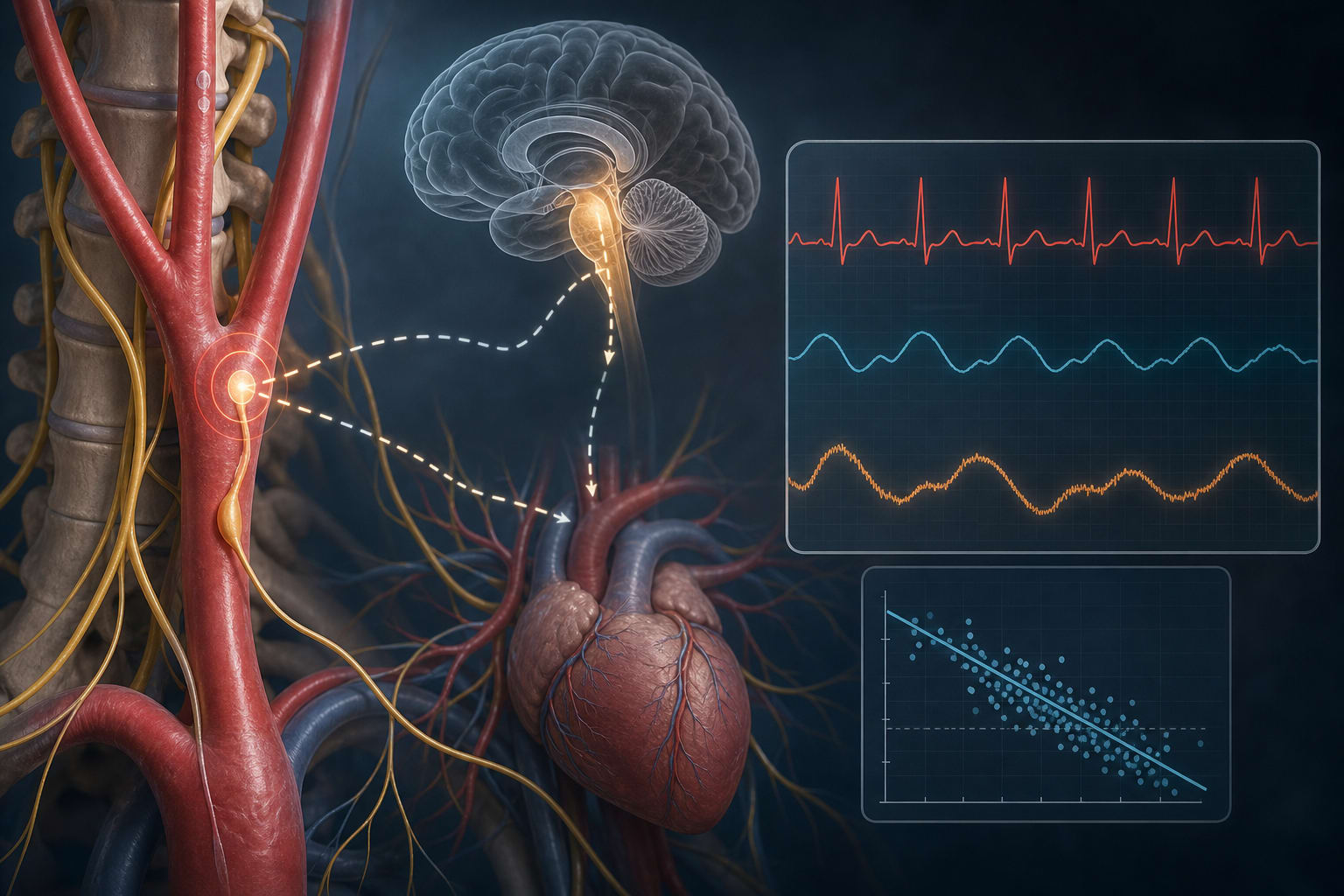
To determine if decreased baroreceptor sensitivity (BRS) can be used to diagnose different degrees of autonomic dysfunction in Long-COVID patients.

Approach:
  • Study Design: A cross-sectional study was conducted on individuals with long-term symptoms following moderate acute COVID-19 infection.
  • Methodology: A new method was developed to characterize cardiovascular dynamics through beat-to-beat physiological time series, focusing on baroreceptor sensitivity.
Key Findings:
  • Patients with Long-COVID exhibited significantly lower BRS compared to healthy controls during orthostatism.
  • Lower BRS was associated with higher arterial blood pressure, increased heart rate, and reduced heart rate variability.
  • The new method correlated with established heart rate variability variables and was validated with the sequence method.
Interpretation:

Limitations:
  • The study was limited to a specific cohort of individuals with mild to moderate COVID-19.
  • Further validation in larger and more diverse populations is needed.
Conclusion:

Original Source(s)

Related Content