Application of a posterior tibial artery perforator-based fasciocutaneous flap with a broad fascial pedicle in reconstruction of complex lower-leg wounds: a retrospective clinical study - Summary - MDSpire
Advertisement
Application of a posterior tibial artery perforator-based fasciocutaneous flap with a broad fascial pedicle in reconstruction of complex lower-leg wounds: a retrospective clinical study
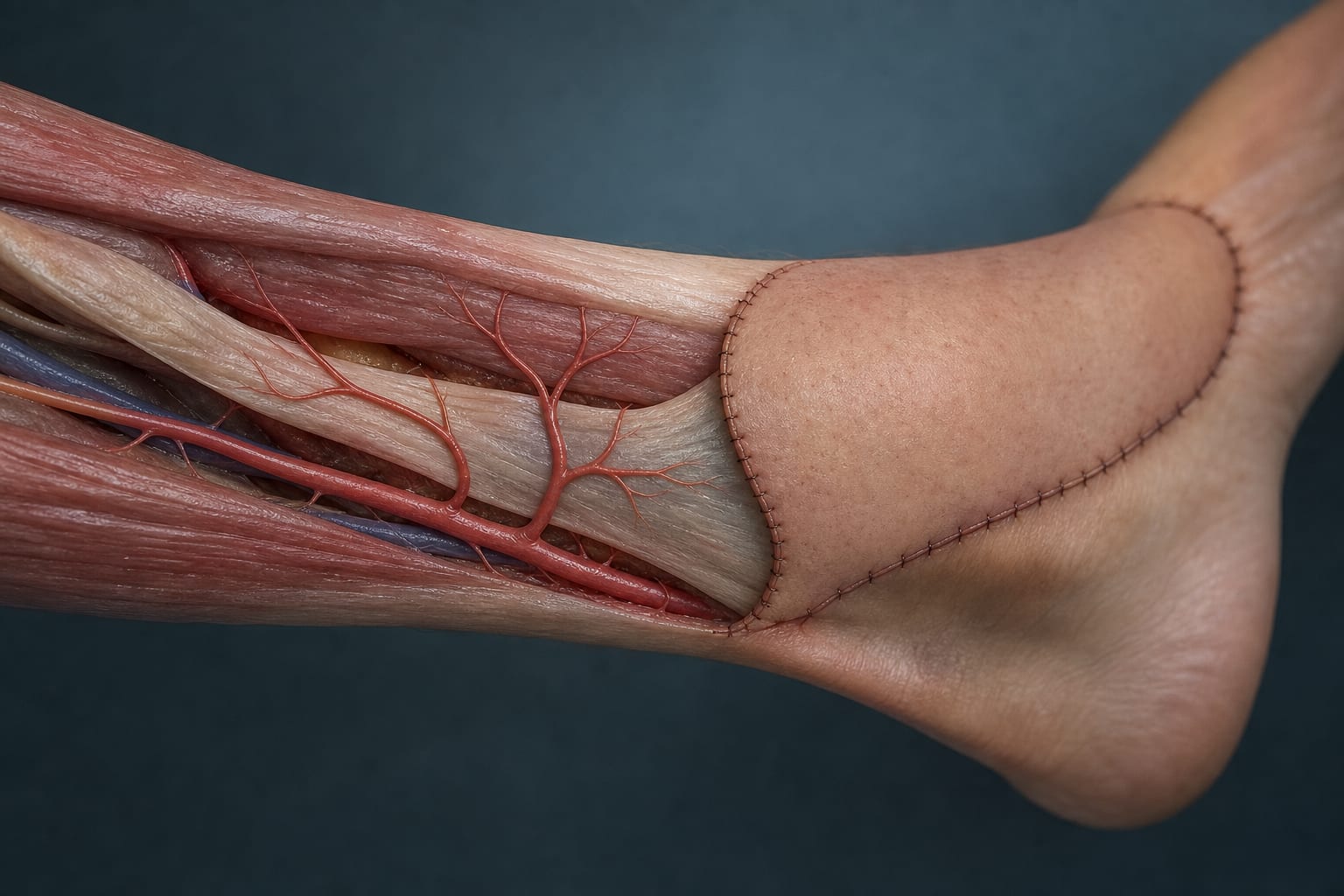
To evaluate flap survival, donor-site morbidity, sensory recovery, ankle function, and wound healing using a posterior tibial artery perforator-based fasciocutaneous flap.
Approach:
Follow-Up: Surgical outcomes, flap viability, donor-site morbidity, sensory recovery, and ankle motion were assessed at 6, 12, and 24 months of follow-up.
Key Findings:
Sensory recovery was noted with 8 flaps recovering to S3, 5 to S2, and 2 to S1 on the Medical Research Council scale.
Interpretation:
The posterior tibial artery perforator-based fasciocutaneous flap with a broad fascial pedicle provided stable coverage for complex lower-leg wounds.
Limitations:
Retrospective and uncontrolled study design.
Small sample size limits generalizability.
Conclusion:
This technique should be viewed as one application within the established spectrum of posterior tibial artery perforator-based flaps.