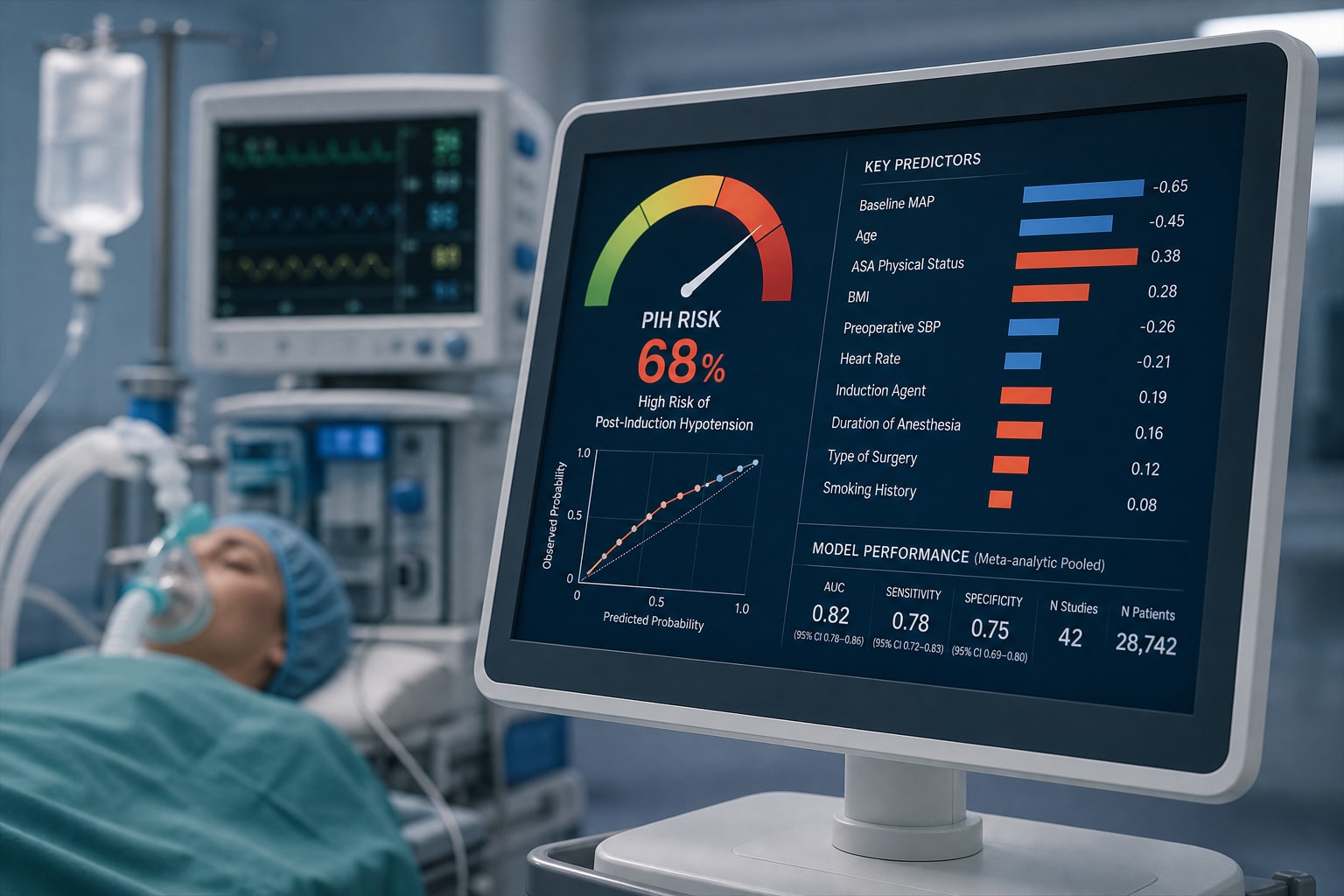
To systematically evaluate the predictive performance, methodological quality, and frequently used predictors of post-induction hypotension (PIH) prediction models among patients receiving general anesthesia.
Approach:
Study Selection: Studies were selected based on specific inclusion criteria, focusing on adults receiving general anesthesia and reporting PIH prediction models.
Data Extraction: Two reviewers independently conducted data extraction and assessed risk of bias using the PROBAST tool.
Meta-Analysis: A random-effects meta-analysis estimated the area under the receiver operating characteristic curve (AUC) and pooled odds ratios (ORs) for predictors.
Key Findings:
15 studies (88.2%) were classified as high risk of bias; 2 (11.8%) as low risk.
Discrimination estimates varied: modeling groups AUC/C-statistics ranged from 0.68 to 0.95, while validation groups ranged from 0.654 to 0.893.
The pooled AUC for the 17 optimal models was 0.81 (95% CI 0.77–0.85).
Significant risk predictors included age (OR 1.031, 95% CI 1.016–1.046) and propofol dose (OR 1.357, 95% CI 1.046–1.667).
Interpretation:
Existing PIH prediction models show good discrimination but are mostly at high risk of bias and lack external validation.
Limitations:
High risk of bias in most studies.
Lack of external validation for the majority of models.
Inconsistent definitions of PIH across studies.
Conclusion:
Future research should standardize PIH definitions, refine predictor selection, and conduct multicenter external validation.
Investigators compared intra-articular microbial profiles and predicted metabolic pathways in patients with hip osteoarthritis and nonarthritic controls.