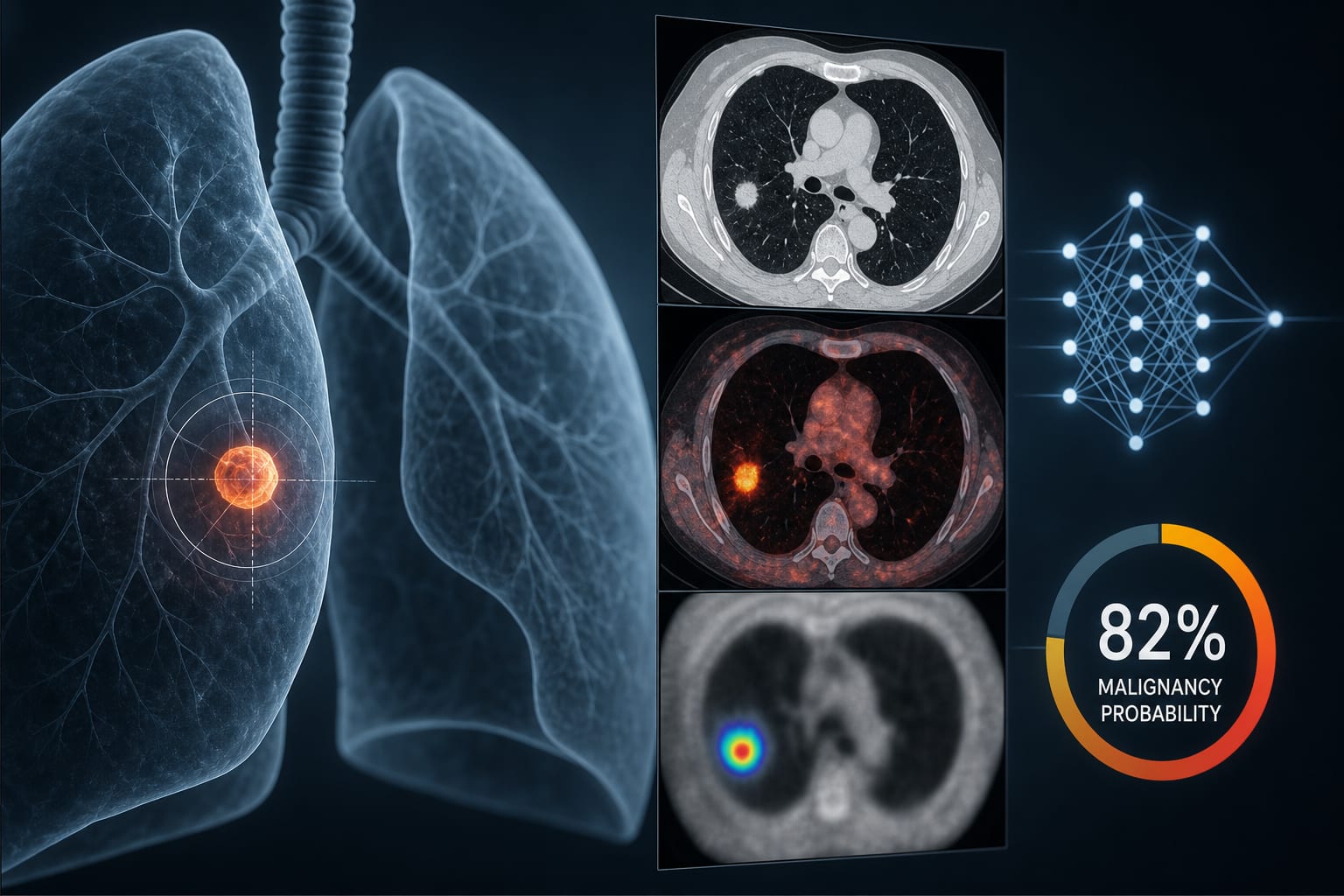
To develop and evaluate a deep learning model (AITO-PETCT-MP) for estimating malignancy probability in indeterminate pulmonary nodules using [18F]FDG-PET/CT imaging, comparing its performance to existing models.
Approach:
Performance Comparison: The model's diagnostic performance was compared against the Herder model and clinician assessments using metrics such as sensitivity, specificity, and area under the curve (AUC), with histological confirmation and follow-up as reference standards.
Key Findings:
The AITO-PETCT-MP model demonstrated improved diagnostic accuracy, with a higher AUC compared to traditional models.
The study validated the model against clinical benchmarks, addressing gaps in existing deep learning approaches.
The model's application as a second reader in clinical settings was explored, showing potential for integration into clinical workflows.
Interpretation:
The AITO-PETCT-MP model shows promise in enhancing the assessment of malignancy risk in pulmonary nodules, potentially aiding clinical decision-making.
Limitations:
The study was conducted at a single center, which may limit generalizability to other populations.
The retrospective nature of the study may introduce biases that could affect the validity of the findings.
Model availability and reproducibility remain challenges in clinical implementation, potentially impacting widespread adoption.
Conclusion:
The AITO-PETCT-MP model represents a notable advancement in the use of deep learning for malignancy risk estimation in pulmonary nodules, necessitating further validation in diverse clinical settings.
by Lars Leijten, Erik H. J. G. Aarntzen, Roel L. J. Verhoeven, Adrienne H. Brouwers, Bram Geurts, Johannes A. van der Heide, Klaas Pieter Koopmans, Walter Noordzij, Gilles N. Stormezand, Erik H. F. M. van der Heijden, Colin Jacobs