Effectiveness and safety of carbon ion radiotherapy for stage III non-small cell lung cancer: a single-center retrospective study - Summary - MDSpire

Effectiveness and safety of carbon ion radiotherapy for stage III non-small cell lung cancer: a single-center retrospective study

  • By

  • Xiaoli Zhao

  • Bole Wang

  • Yihe Zhang

  • Pengqing Li

  • Xuexue Liang

  • Qinli Gong

  • Ling Tian

  • Tianyan Qin

  • Xuelian Chen

  • Zhenglin Li

  • Peng Nie

  • Yanshan Zhang

  • Yancheng Ye

  • June 30, 2026

  • 0 min

Share

Objective:

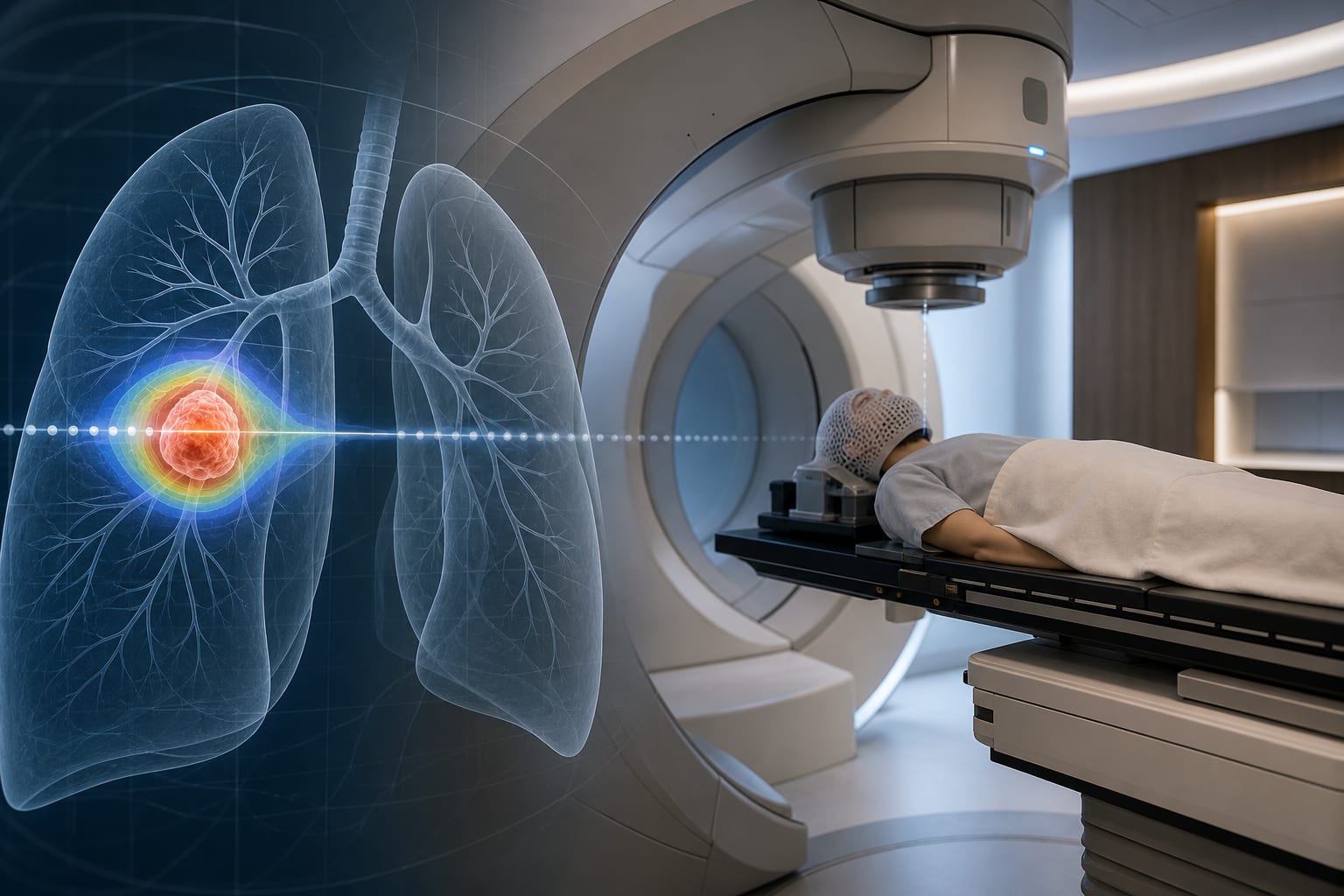
To evaluate the clinical efficacy and adverse reactions of carbon ion radiotherapy (CIRT) for stage III non-small cell lung cancer (NSCLC), and to analyze factors influencing patient prognosis.

Approach:
  • Study Design: A retrospective analysis of clinical data and follow-up records of 82 patients diagnosed with stage III NSCLC who underwent CIRT between March 2020 and March 2024.
  • Treatment and Follow-Up: Patients received a total CIRT dose ranging from 48 to 78 Gy (RBE) with a median follow-up duration of 31.5 months.
  • Statistical Analysis: The Kaplan-Meier method was used for survival rate calculations, and Cox regression models were employed for prognostic factor analysis.
Key Findings:
  • Grade 1 radiation dermatitis was noted in 2 cases (2.4%), grade 2 in 1 case (1.2%), and grade 3 in 1 case (1.2%).
  • Grade 3 or higher adverse reactions were primarily hematologic, with grade 3 lymphopenia being the most common (29 cases, 35.37%).
Interpretation:

Limitations:
  • The study is based on a single institution's retrospective data, and further prospective studies are needed to validate the findings.
Conclusion:

Original Source(s)

Related Content