To report two cases of Autism Spectrum Disorder (ASD) associated with immune dysregulation and congenital cardiac anomalies, emphasizing the genetic findings and their clinical implications for understanding the overlap between these conditions.
Approach:
Key Findings:
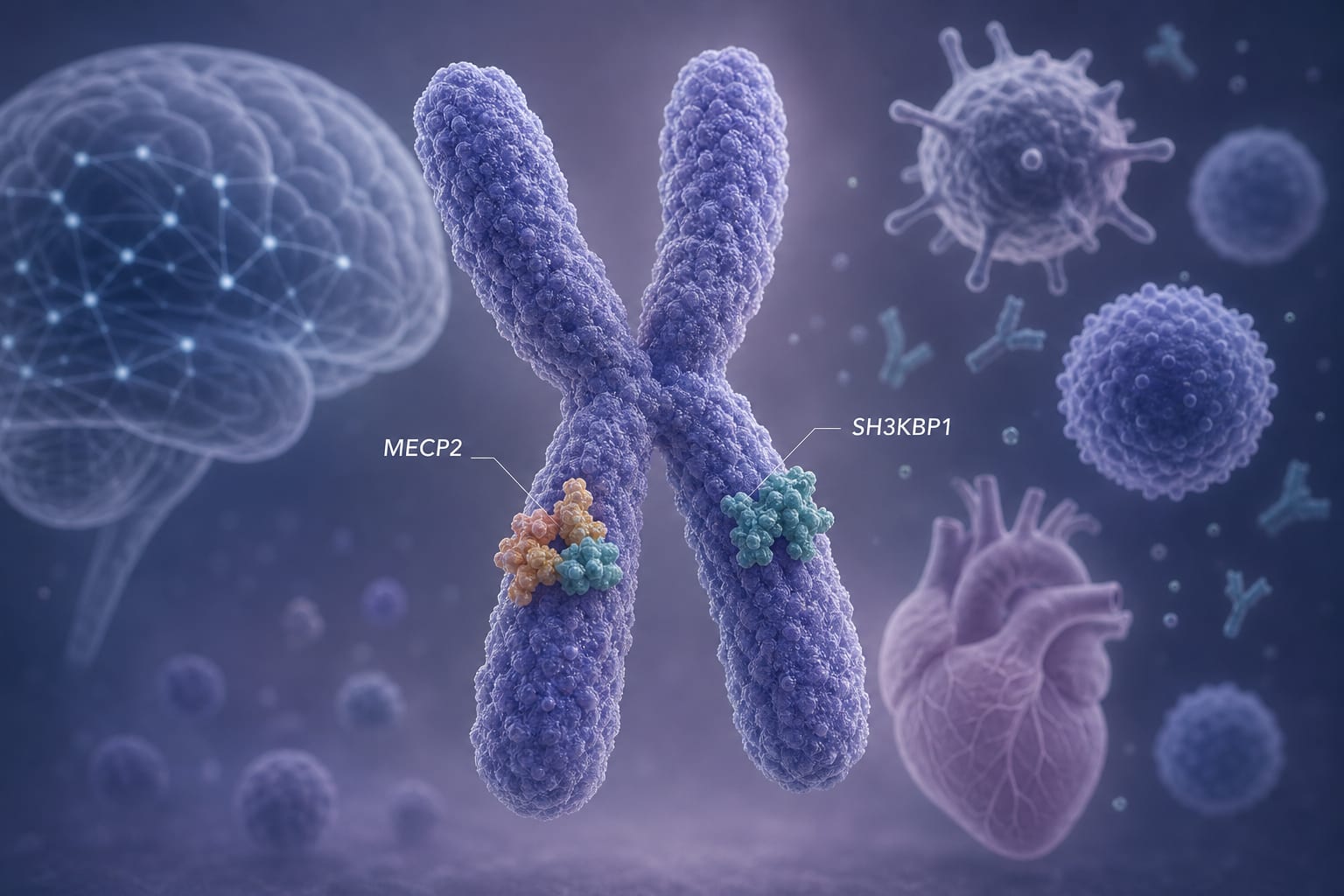
Patient 1 had a duplication of the Xq28 region encompassing the MECP2 gene, consistent with MECP2 duplication syndrome, which is associated with neurodevelopmental impairment and recurrent infections.
Patient 2 had a hemizygous deletion at Xp22.12 partially involving the SH3KBP1 gene, classified as a variant of uncertain significance (VUS), which may contribute to immune dysregulation.
Both patients exhibited recurrent respiratory infections and immunological abnormalities, highlighting the need for further investigation.
Interpretation:
The findings suggest a potential link between genetic variants in MECP2 and SH3KBP1 with ASD and immune dysregulation, emphasizing the need for comprehensive genetic testing and immunological evaluation in ASD patients with complex presentations.
Limitations:
The causal relationship between the identified genetic variants and clinical features remains unproven, which limits the strength of the conclusions.
The study is based on only two case reports, which may limit the generalizability of the findings.
Conclusion:
These cases illustrate the overlap between neurodevelopmental disorders and immune dysregulation, supporting the consideration of immunological evaluation in selected ASD patients, particularly those with recurrent infections or additional systemic features.