A naturalistic, non-invasive method for capturing biometric data during autism evaluations - Summary - MDSpire

A naturalistic, non-invasive method for capturing biometric data during autism evaluations

  • By

  • Khaleel Kamal

  • Janka Hatvani

  • Máté Pethő

  • András Sárkány

  • Imola Hamvas

  • Camille Brune

  • Allison L. Wainer

  • Emily Dillon

  • Elizabeth Berry Kravis

  • Edith Vanessa Ocampo

  • Zachary Enos Arnold

  • Iman Ghazal

  • Fatema Al-Faraj

  • Máté Csákvári

  • Kristóf Katona-Pucsek

  • Péter Kun

  • Dóra Oláh

  • Ferenc Hernáth

  • Attila Schulc

  • Anikó Mezősi

  • Alejandro Latorre

  • Fouad Al-Shaban

  • Latha Valluripalli Soorya

  • Zoltán Tősér

  • June 11, 2026

  • 0 min

Share

Objective:

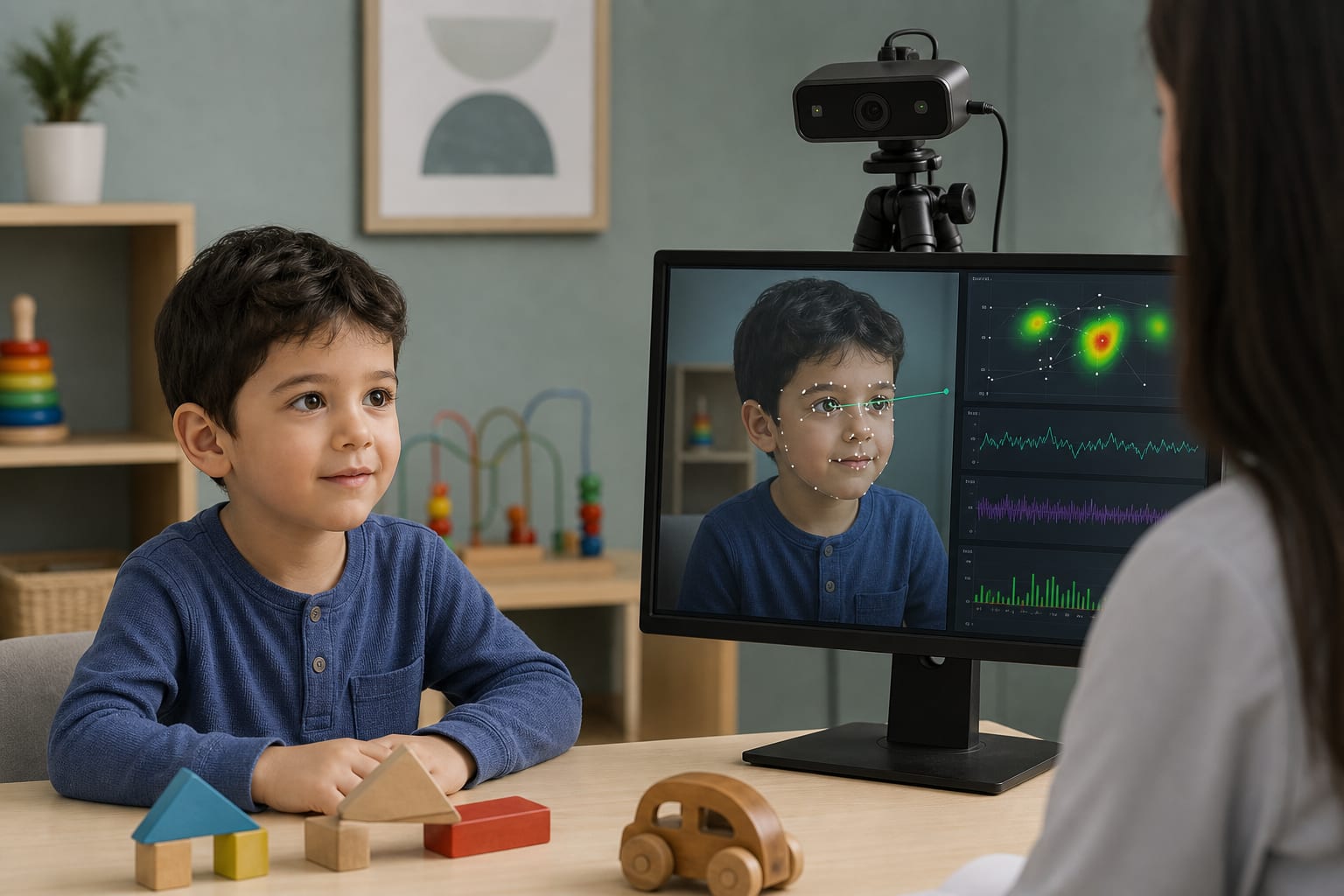
To evaluate a machine learning tool designed to non-intrusively quantify and analyze biometric data of gaze, facial expressions, and paralinguistic social communication features during autism observational assessments.

Key Findings:
  • Achieved 77.8% sensitivity and specificity in distinguishing ASD from non-ASD participants in the inner set.
  • Increased sensitivity and specificity to 82.0% when distinguishing ASD from NT participants.
  • In the hold-out test set, sensitivity was 62.3% and specificity was 81.4% for ASD versus non-ASD, and 72.1% sensitivity and 88.6% specificity for ASD versus NT.
  • Performance varied by sex, with males showing higher sensitivity and females showing higher specificity.
Interpretation:

The study demonstrates the feasibility of using semi-automated multimodal computational analysis to quantify autism social communication behaviors and distinguish ASD from NT in diverse samples.

Limitations:
  • Known difficulties with differential diagnosis in non-ASD neurodevelopmental conditions with autism-like features.
  • The study's reliance on video and audio recordings may limit generalizability due to potential biases in data collection.
Conclusion:

The findings suggest promise for machine learning tools to support task-sharing models within existing clinical approaches, enhancing accessibility in non-specialist settings.

Original Source(s)

Related Content