Association between neutrophil percentage-to-albumin ratio and adverse clinical outcomes after successful percutaneous coronary intervention for chronic total occlusion: a cohort study - Summary - MDSpire
Conexiant’s news site is now MDSpire News. Learn more
Advertisement
Relationship Between Neutrophil Percentage-to-Albumin Ratio and Long-Term Adverse Outcomes Following Successful Percutaneous Coronary Intervention for Chronic Total Occlusion: A Retrospective Cohort Analysis
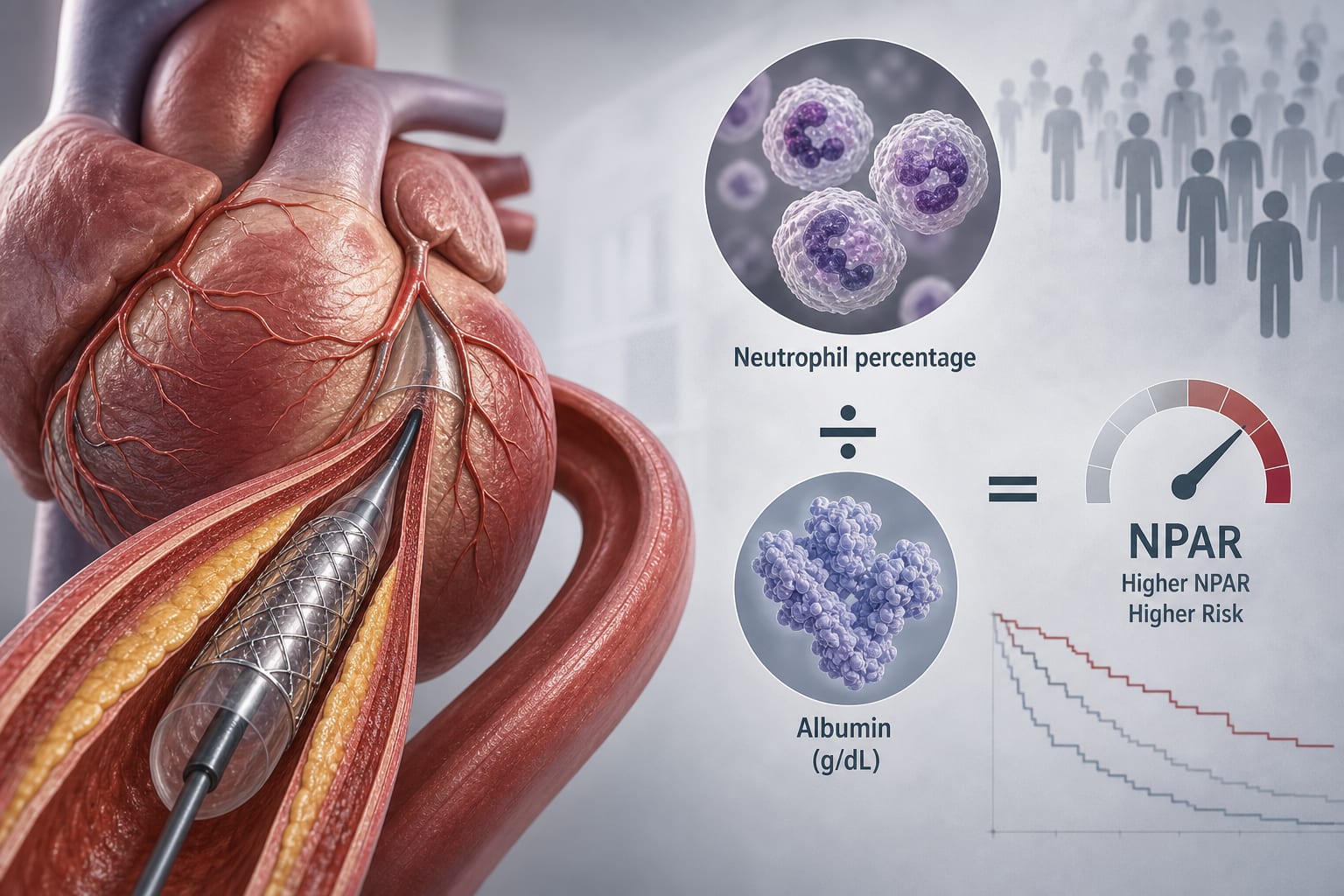
To investigate whether the neutrophil percentage-to-albumin ratio (NPAR) is independently associated with long-term adverse outcomes in patients who underwent successful percutaneous coronary intervention (PCI) for chronic total occlusion (CTO).
Approach:
Study Design: A single-center retrospective cohort study including 1513 patients who underwent successful CTO PCI.
NPAR Calculation: NPAR was calculated as (neutrophil percentage × 100)/albumin (g/dL).
Endpoints: Primary endpoint was all-cause mortality; secondary endpoints included cardiovascular mortality and cardiovascular events.
Statistical Analysis: Multivariable Cox regression and restricted cubic splines assessed the association between NPAR and clinical outcomes.
Key Findings:
83 (5.5%) all-cause deaths, 53 (3.5%) cardiovascular deaths, and 73 (4.8%) cardiovascular events occurred during a median follow-up of 810 days.
Each 1-standard deviation increase in NPAR was associated with a 50% higher risk of all-cause mortality (HR 1.50, 95% CI 1.23–1.83, P<0.001).
NPAR was also associated with a 59% higher risk of cardiovascular mortality (HR 1.59, 95% CI 1.23–2.05, P<0.001) and a 42% higher risk of cardiovascular events (HR 1.42, 95% CI 1.13–1.79, P=0.003).
Time-dependent ROC analyses showed that adding NPAR improved discrimination for all-cause mortality at 1, 2, and 3 years.
Interpretation:
Limitations:
Single-center study may limit generalizability.
Retrospective design may introduce selection bias.