Am80 (tamibarotene) and ATRA induce highly similar molecular responses and myeloid differentiation in non-APL AML, enhanced by LSD1/GCN5 inhibition and increased RARA expression - Summary - MDSpire

Am80 (tamibarotene) and ATRA induce highly similar molecular responses and myeloid differentiation in non-APL AML, enhanced by LSD1/GCN5 inhibition and increased RARA expression

  • By

  • Faezeh Ghazvini Zadegan

  • Clara Stanko

  • Franziska Fiedler

  • Laura Ölsner

  • Setenay Gupse Özcan

  • Jacqueline Schütt

  • Tina M. Schnöder

  • Yordan Sbirkov

  • Lukasz Szymanski

  • Sven Stengel

  • Peter Dittrich

  • Jörg P. Müller

  • Florian H. Heidel

  • Andreas Hochhaus

  • Sebastian Scholl

  • Ulf Schnetzke

  • Annamaria Brioli

  • Tino Schenk

  • June 27, 2026

  • 0 min

Share

Objective:

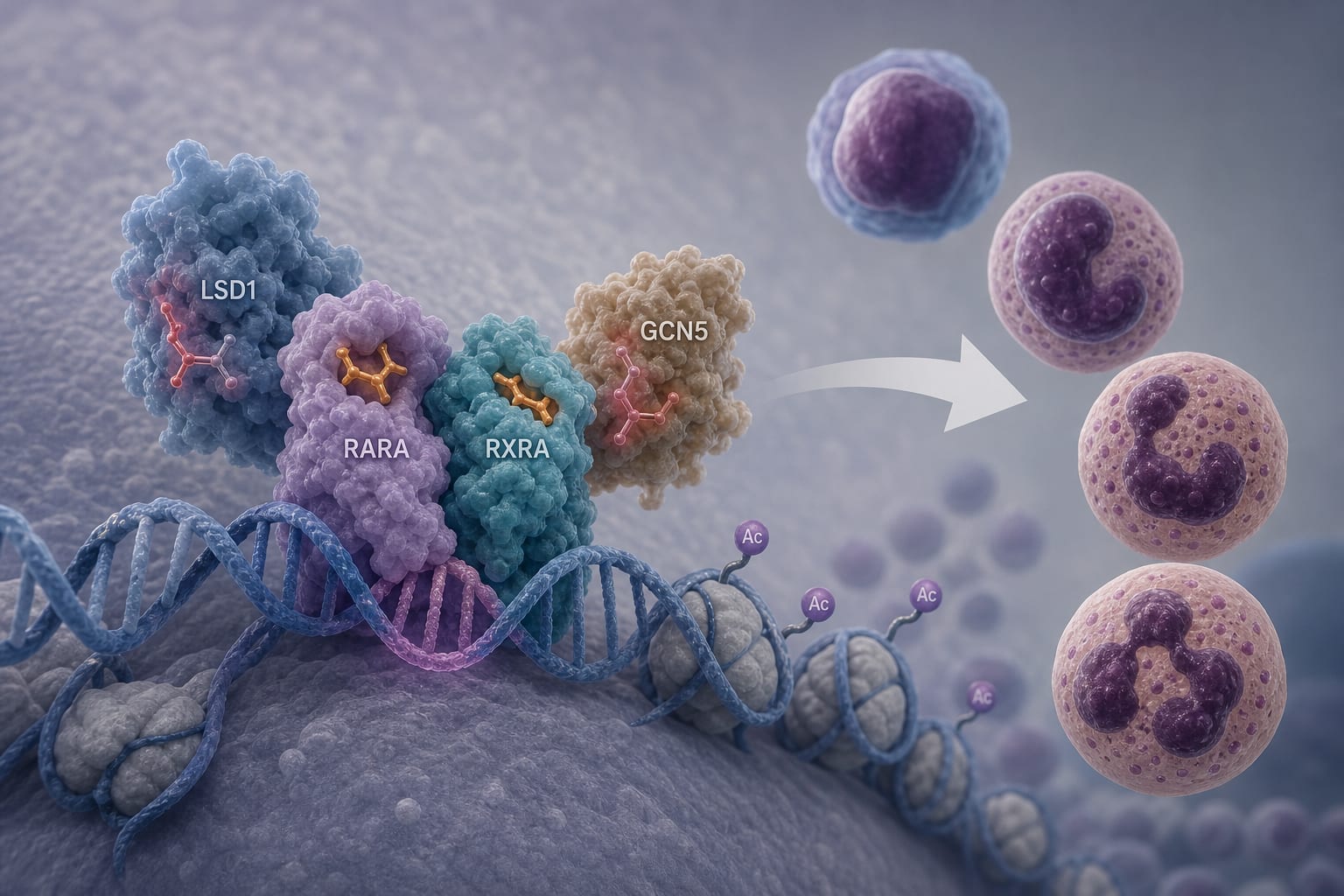
To investigate whether the RARA-selective agonist Am80 can overcome the differentiation block in non-APL AML compared with the pan-RAR agonist ATRA, and to assess the impact of LSD1 and GCN5 inhibition on these responses.

Approach:
  • Study Design: The study examined the effects of Am80 and ATRA in 6 AML cell lines and 67 primary AML samples, focusing on RARA and RARG expression.
  • Treatment Methods: Cells were treated with ATRA, Am80, LSD1 inhibitor (GSK-LSD1), and GCN5 inhibitor (MB3) for 3 days.
  • Analysis Techniques: Flow cytometry was used for surface marker expression, and RNA-seq was performed for gene expression analysis.
Key Findings:
  • RARA was the most abundant retinoic acid receptor in the analyzed samples, with expression levels approximately fivefold higher than RARG.
  • A significant correlation was observed between RARA and RARG expression, both co-expressed with RXRA.
  • Inhibition of LSD1 and GCN5 was shown to enhance the responsiveness to ATRA and Am80.
Interpretation:

Limitations:
  • The study primarily focused on a limited number of AML cell lines and primary samples, which may not represent all AML subtypes.
  • Further clinical validation is needed to confirm the efficacy of Am80 and the impact of LSD1/GCN5 inhibition in a broader patient population.
Conclusion:

Original Source(s)

Related Content