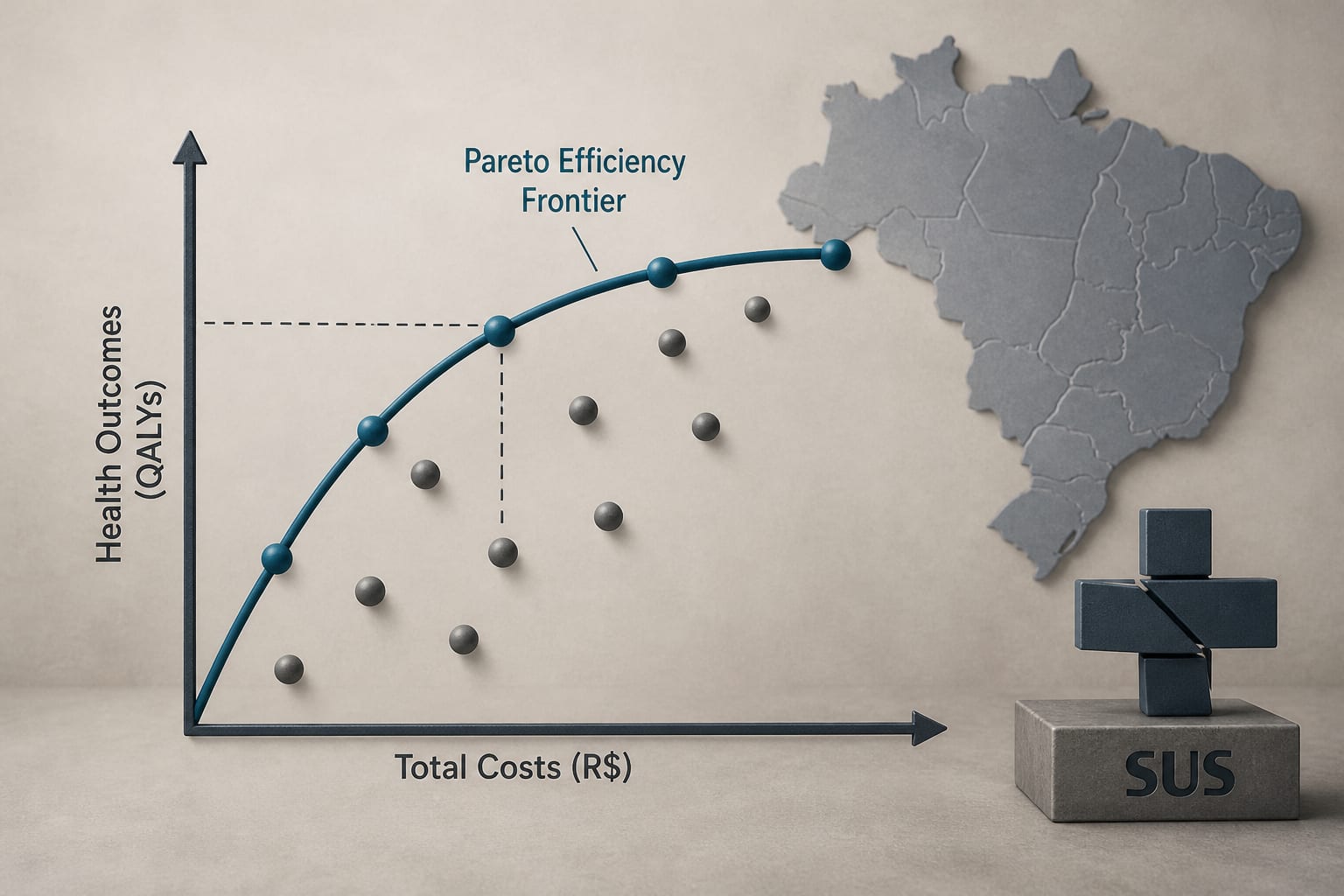
To explore whether a Pareto-based efficiency frontier can describe the relationship between annual treatment costs and hematologic benefits of Gaucher disease therapies available in Brazil.
Approach:
Design: Exploratory analysis from the Brazilian Unified Health System (SUS) perspective; it was not a full economic evaluation or an independent pricing rule.
Treatments: Included imiglucerase, velaglucerase alfa, taliglucerase alfa, and miglustat, which were authorized and available for prescription within SUS in January 2023. Eliglustat was excluded because SUS did not provide it.
Evidence and outcomes: Efficacy estimates were drawn from a selected systematic review of 68 longitudinal studies. The analysis related annual drug acquisition costs to selected hematologic benefits.
Key Findings:
The analysis related annual drug acquisition costs to selected hematologic benefits; comparative results and frontier estimates are not available in the provided context.
The analysis excluded utilities, QALYs, long-term survival modeling, budget impact analysis, and probabilistic uncertainty analysis.
Interpretation:
The authors present the Pareto-based frontier as a descriptive price–benefit benchmark for hematologic outcomes, not as a conventional cost-effectiveness frontier or an optimization rule.
Limitations:
The analysis was not a full economic evaluation and excluded utilities, QALYs, long-term survival modeling, and budget impact analysis.
The analysis did not include probabilistic uncertainty analysis.
The assessment focused on selected hematologic outcomes rather than wider dimensions of clinical value.
Conclusion:
The study explores a Pareto-based approach to describing price–benefit relationships for Gaucher disease therapies available in Brazil. The source states that, if the approach were implemented as a regulatory pricing instrument, comparative efficacy evidence, formal uncertainty analysis, and assessment of broader clinical value would be needed.