Validation of a 2-Gene Blood Test for Kawasaki Disease in Febrile Children - Summary - MDSpire

Validation of a 2-Gene Blood Test for Kawasaki Disease in Febrile Children

  • By

  • Ho-Chang Kuo

  • Xing Xue

  • Fang Liu

  • Richard D. Mortensen

  • C. James Chou

  • Bo Jin

  • Juan Wei

  • Qiong Luo

  • Ken-Pen Weng

  • Mindy Ming-Huey Guo

  • Kuender D. Yang

  • Kuo-Jung Su

  • Shih-Ting Kang

  • Sun Kim

  • Weiwei Li

  • James Schilling

  • Zhi Han

  • Naoto Ozawa

  • Takumi Ichikawa

  • Henry Chubb

  • Scott R. Ceresnak

  • Gary L. Darmstadt

  • Doff McElhinney

  • Harvey J. Cohen

  • Xuefeng B. Ling

  • May 28, 2026

  • 0 min

Share

Objective:

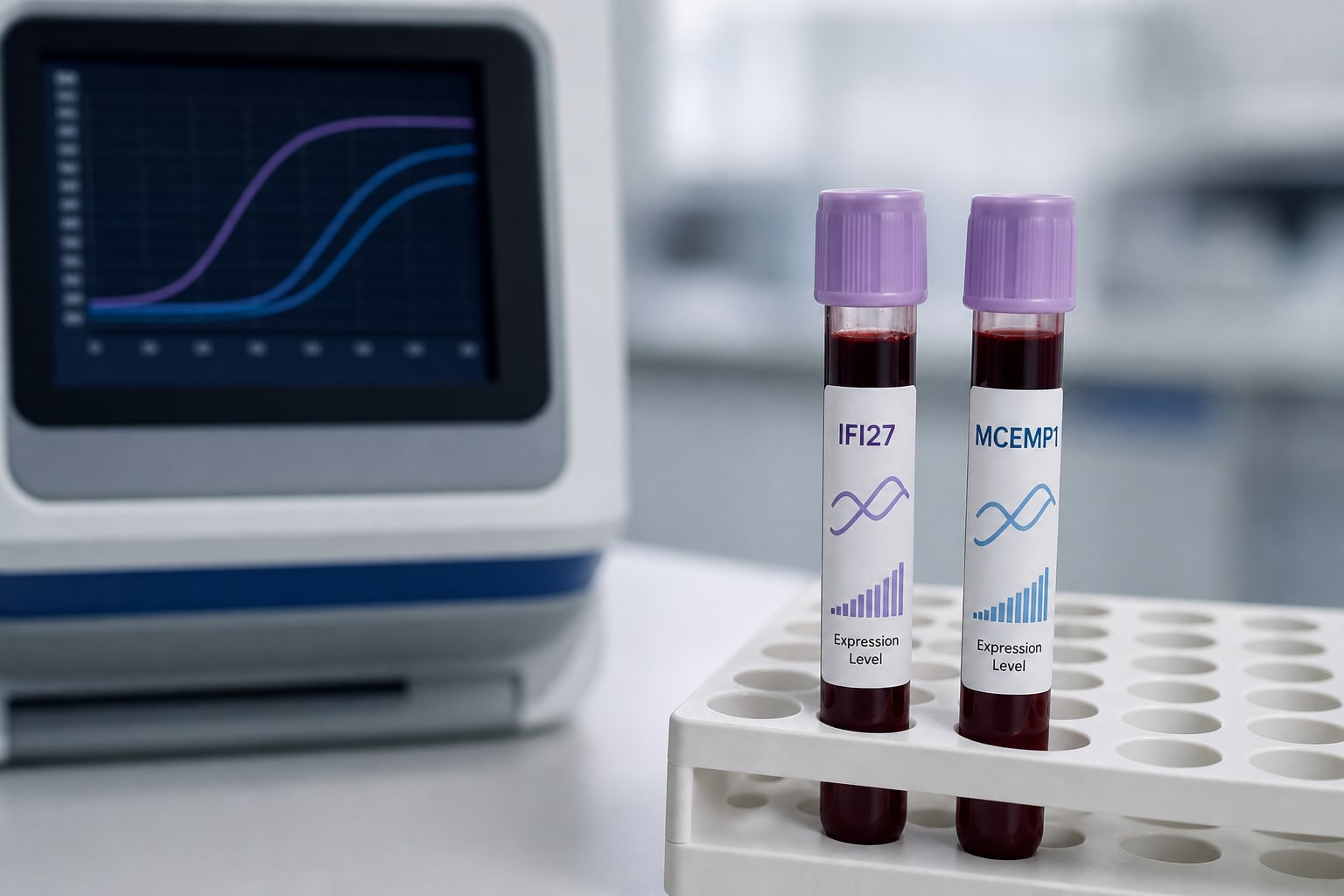
To evaluate the clinical utility of a 2-gene whole-blood signature (IFI27 and MCEMP1) for diagnosing Kawasaki disease (KD) in children with fever, highlighting its potential impact on timely treatment.

Key Findings:
  • 209 out of 243 KD cases were correctly classified, indicating a strong diagnostic capability.
  • 186 out of 298 febrile controls were correctly classified, supporting the test's specificity.
  • 96 participants had indeterminate scores, reflecting biological overlap, which may complicate clinical interpretation.
Interpretation:

The 2-gene blood test demonstrated potential for distinguishing KD from other febrile illnesses, with a high negative predictive value and positive predictive value, suggesting it could significantly improve clinical decision-making.

Limitations:
  • The study was conducted in specific geographic locations, which may limit generalizability.
  • Indeterminate scores may complicate clinical decision-making in borderline cases, potentially affecting treatment timelines.
Conclusion:

The IFI27-MCEMP1 blood test shows promise for improving the diagnosis of Kawasaki disease in children with fever, warranting further research to validate its use in diverse populations.

Original Source(s)

Related Content