Fractionated stereotactic radiotherapy (fSRT) for symptomatic WHO grade 1 cavernous sinus meningiomas: long-term local control, clinical response, and toxicity outcomes - Summary - MDSpire
Advertisement
Fractionated stereotactic radiotherapy (fSRT) for symptomatic WHO grade 1 cavernous sinus meningiomas: long-term local control, clinical response, and toxicity outcomes
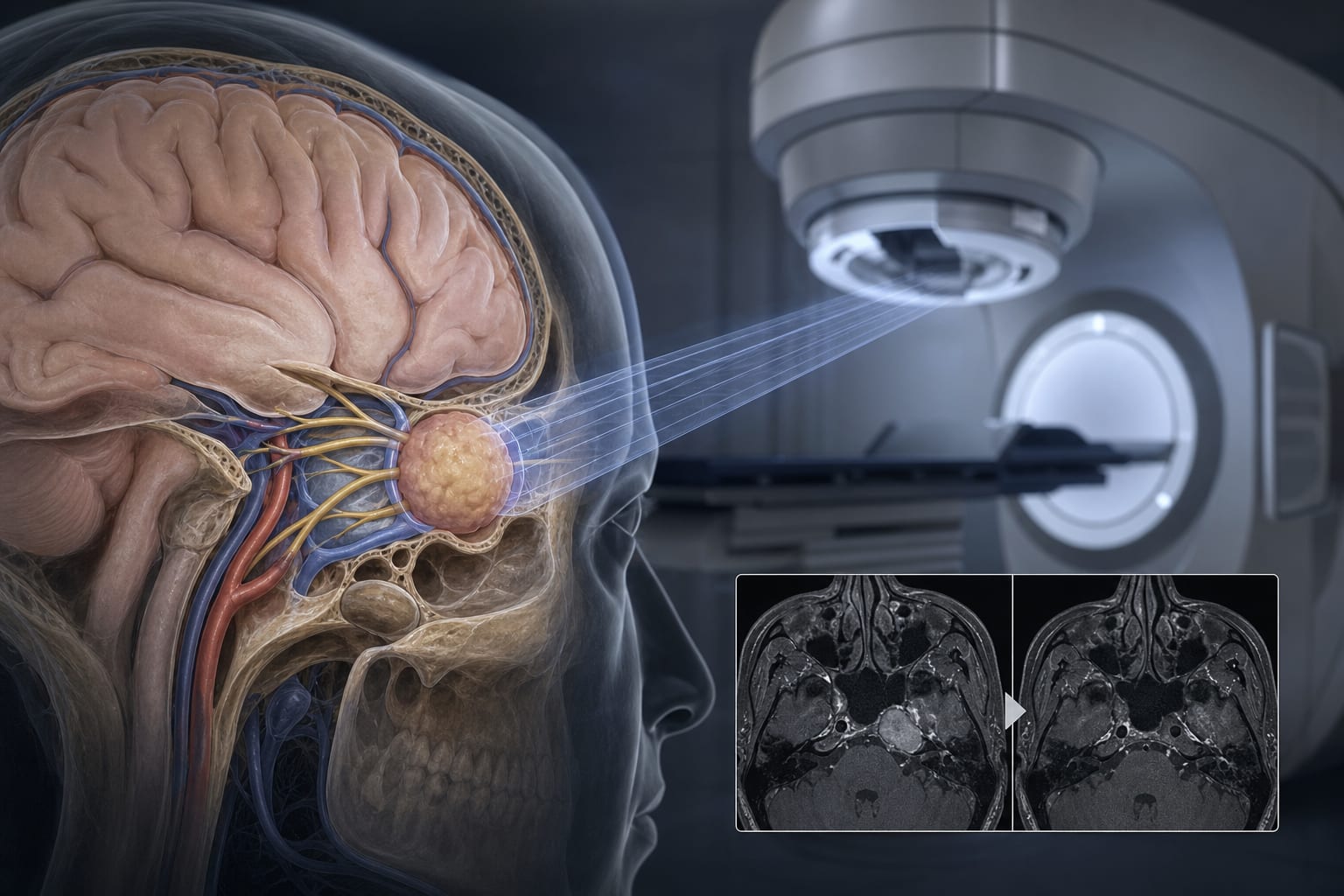
To report long-term outcomes, including local control, symptom response, and treatment-related toxicity, for patients with symptomatic cavernous sinus meningiomas treated with fractionated stereotactic radiotherapy (fSRT).
Approach:
Study Design: A single-center retrospective cohort study of patients treated with fSRT for cavernous sinus meningiomas from January 2006 to December 2017.
Inclusion Criteria: Adult patients with symptomatic WHO Grade 1 cavernous sinus meningiomas treated with fSRT and with at least 1 year of follow-up.
Radiation Technique: Patients received 1.8–2.0 Gy per fraction (total 50–54 Gy over 25–30 fractions) using intensity-modulated radiation therapy (IMRT) or volumetric Modulated Arc Therapy (VMAT).
Outcome Measures: Demographic data, dosimetric characteristics, clinical evaluations, and MRI follow-ups were analyzed to assess local control and symptom response.
Key Findings:
Long-term local control rates with fSRT for cavernous sinus meningiomas exceed 85% at 5 and 10 years based on the study's results.
The study indicates that fSRT has a superior complication profile compared to stereotactic radiosurgery (SRS).
Symptom response and treatment-related toxicity were assessed over a minimum follow-up of one year in the study.
Interpretation:
The study presents data on the efficacy and safety of fSRT for treating symptomatic WHO Grade 1 cavernous sinus meningiomas.
Limitations:
The retrospective design may introduce selection bias.
Findings from a single-institution study may limit generalizability.
Conclusion:
The study suggests that fSRT is an effective treatment option for symptomatic cavernous sinus meningiomas, showing favorable long-term outcomes.
by Ryan Shah, Shray Jain, Nilanjan Haldar, Lauren A. Holt, Robert L. Walker, Christopher J. Farrell, Debanjan Haldar, James J. Evans, Gregory S. Alexander, Wenyin Shi