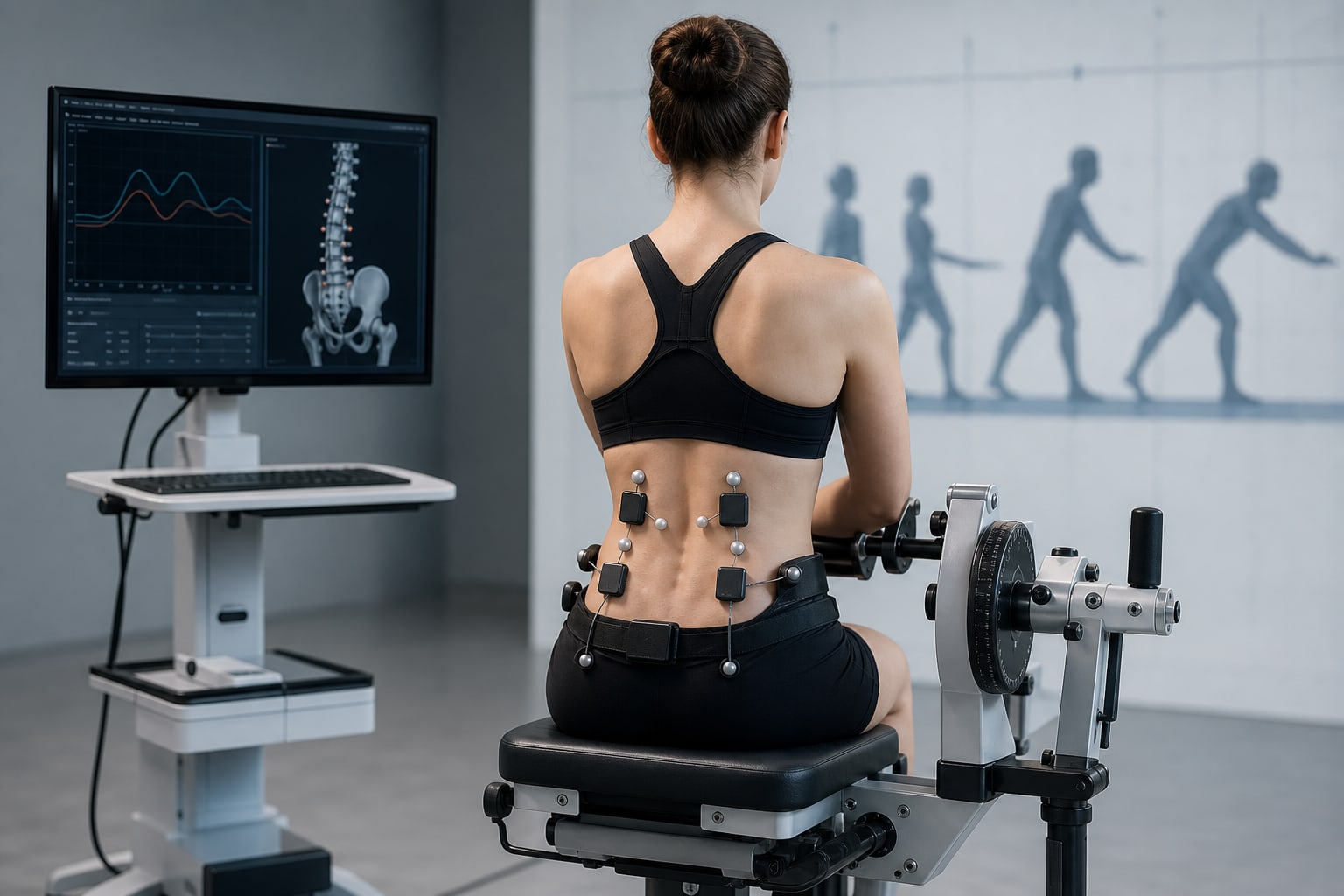
To compare the psychometric properties (reliability and validity) of available tools for measuring lumbar proprioception, map their technical characteristics, and determine their clinical feasibility.
Approach:
Literature Search: A literature search was conducted via PubMed and Web of Science using MeSH terms related to 'lumbar spine' and 'proprioception,' supplemented by keywords such as 'motion sense,' 'vibration sense,' and 'force sense.'
Assessment Focus: The review focused on contemporary methodologies for assessing lumbar position, motion, vibration, and force sense, while excluding outdated techniques.
Key Findings:
Position sense via inclinometer-based active joint repositioning is the most widely applied method.
Common clinical tools like dual inclinometry and tape measurement demonstrate weak concurrent validity and low test-retest reliability.
Direct metrics for proprioception (motion threshold, active repositioning, passive repositioning) lack significant inter-modal correlation.
Postural balance analysis offers a holistic view but is limited by confounding factors and does not isolate localized proprioception.
Interpretation:
Despite the emergence of various methodologies, the inclinometer-based active joint repositioning paradigm shows the highest feasibility for clinical practice, yet a universally accepted gold standard is lacking.
Limitations:
Absence of a gold standard for proprioception measurement.
Weak validity and reliability of commonly used clinical tools.
Limited application of postural balance analysis due to confounding factors.
Conclusion:
Objective quantification of lumbar proprioception requires further comprehensive exploration.
A VHA study across 11 vendors finds AI-generated primary care notes score lower than clinician-written notes, with the largest deficits in thoroughness, organization, and usefulness