AI-enabled eye-movement and emerging multimodal frameworks for precision dyslexia screening and reading pattern analysis - Summary - MDSpire

AI-enabled eye-movement and emerging multimodal frameworks for precision dyslexia screening and reading pattern analysis

  • By

  • Ashit Kumar Dutta

  • Moattar Raza Rizvi

  • Farha Mujeeb Ahmed Shaikh

  • Adel Mefleh Widyan

  • June 19, 2026

  • 0 min

Share

Objective:

To integrate evidence on eye-movement-based and multimodal computational methods for dyslexia screening and risk identification during reading tasks.

Approach:
    Key Findings:
    • Twenty-three articles included from 50 screened, covering various study types related to eye-movement biomarkers and machine-learning predictions.
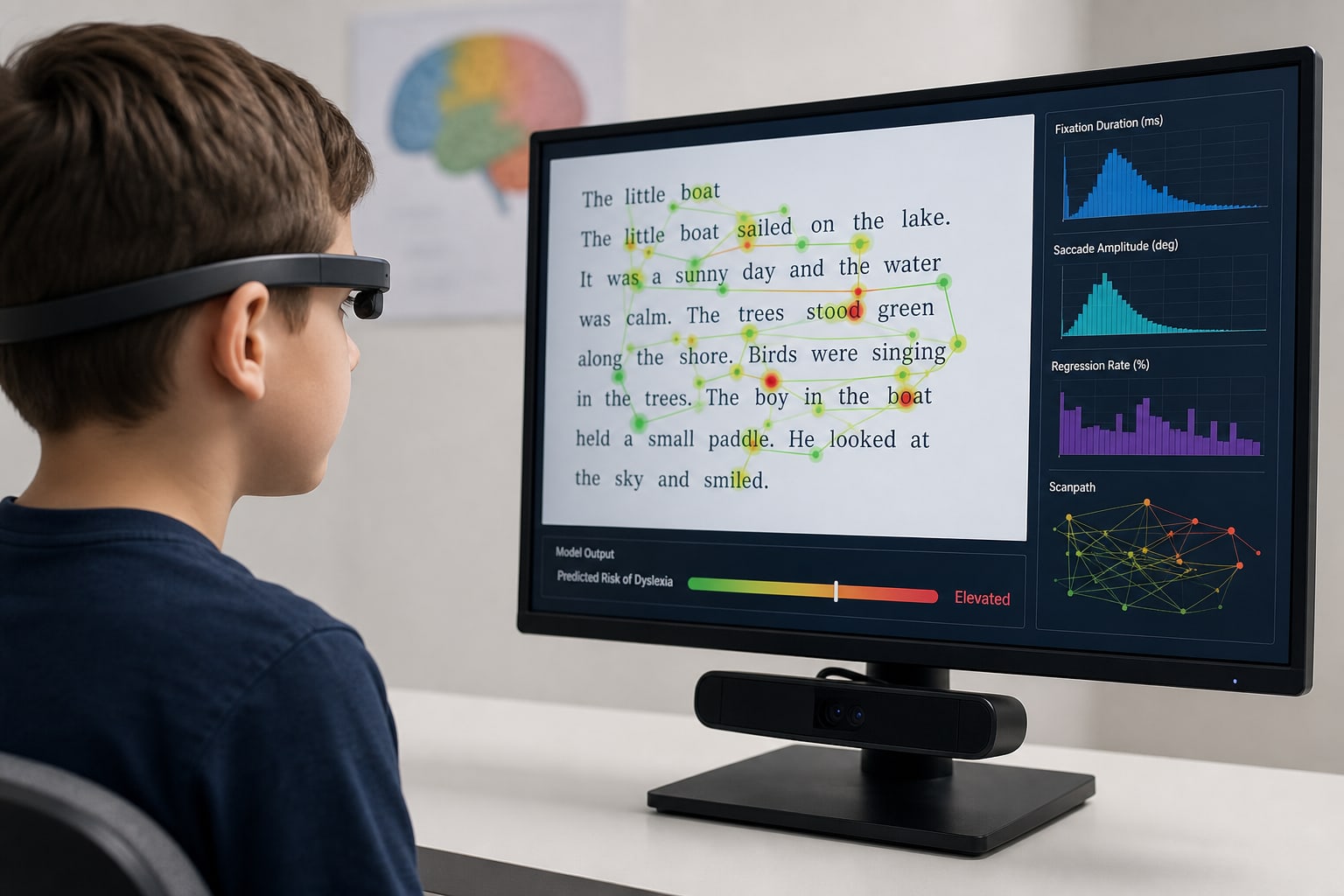
    • Dyslexic readers showed longer fixation durations, increased regression behavior, and reduced saccadic efficiency.
    • Machine-learning algorithms achieved classification accuracies ranging from 80% to 95%, with some studies reporting accuracies approaching 99% under specific conditions.
    Interpretation:

    There is significant heterogeneity in datasets, feature extraction methods, and validation schemes, with many studies using proxy diagnostic labels and small datasets.

    Limitations:
    • Heterogeneity in datasets and methods.
    • Many studies relied on small or internally derived datasets.
    • Limited multimodal evidence, with most studies focusing on eye-movement data.
    Conclusion:

    Eye-movement based computational systems are a promising, non-invasive method for scalable dyslexia screening.
    Sources:

Original Source(s)

Related Content