Red Blood Cell Transfusion Characteristics and Morbidity or Mortality in Very-Low-Birth-Weight Infants - Summary - MDSpire

Red Blood Cell Transfusion Characteristics and Morbidity or Mortality in Very-Low-Birth-Weight Infants

  • By

  • Jeanne E. Hendrickson

  • Rebecca J. Birch

  • Elizabeth A. K. Rowley

  • Martha Sola-Visner

  • Brian R. Branchford

  • Xuxin Chen

  • Brian Custer

  • Robert A. DeSimone

  • Daniel W. Bougie

  • Erika M. Edwards

  • Ruchika Goel

  • Jerome Gottschall

  • Eldad A. Hod

  • Morvarid Moayeri

  • Nareg H. Roubinian

  • Oliver Karam

  • Jeffrey J. VanWormer

  • Elizabeth F. Stone

  • Naomi L. C. Luban

  • Cassandra D. Josephson

  • Ravi M. Patel

  • NHLBI Recipient Epidemiology Donor Evaluation Study–IV–Pediatric (REDS-IV-P)

  • Alan E. Mast

  • Lisa Baumann Kreuziger

  • Elliott P. Vichinsky

  • Bryan R. Spencer

  • Bruce S. Sachais

  • Kathy Chapman

  • Philip J. Norris

  • Mars Stone

  • Paul M. Ness

  • Steve H. Kleinman

  • June 24, 2026

  • 0 min

Share

Objective:

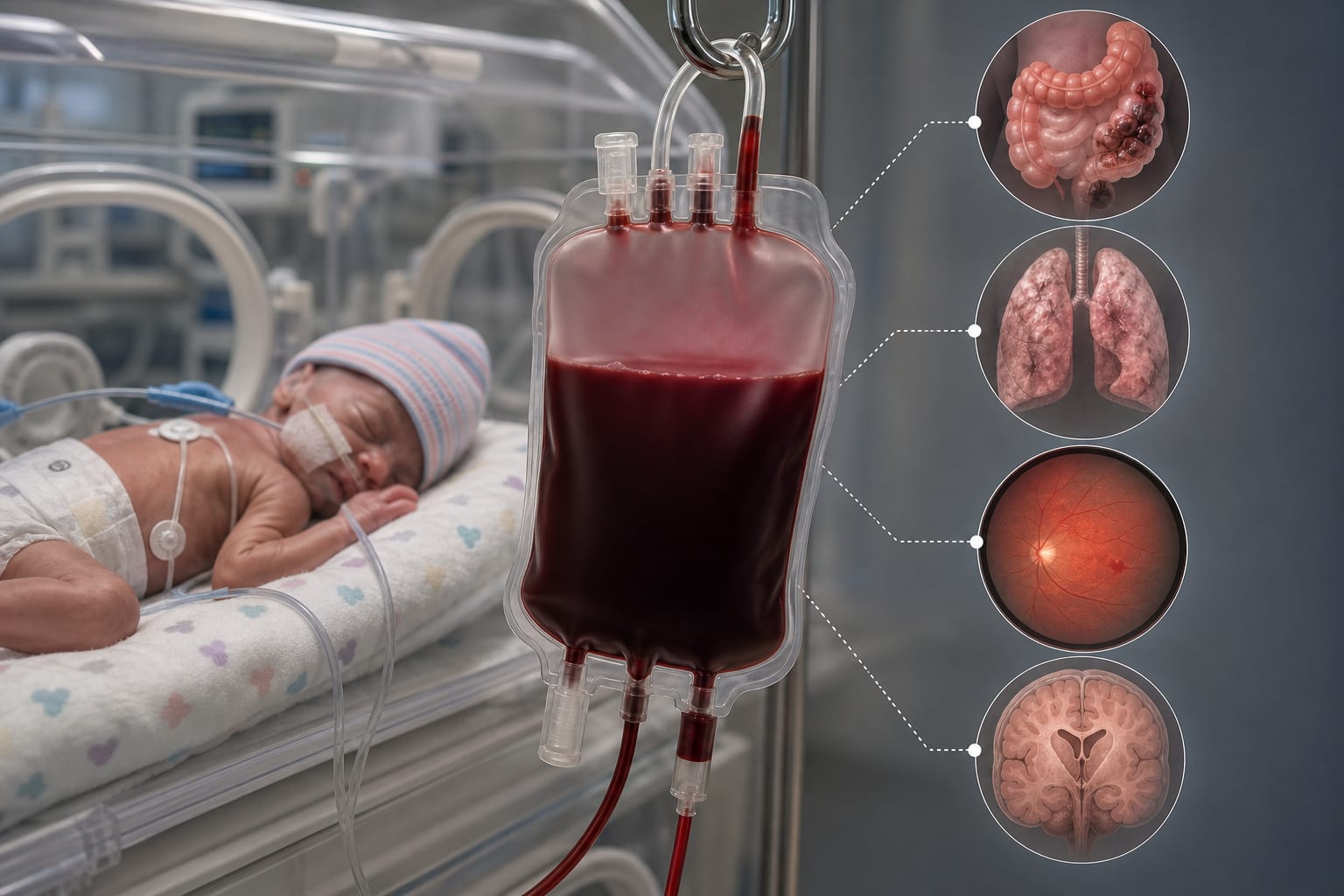
To identify modifiable transfusion characteristics associated with serious morbidity and mortality in very-low-birth-weight (VLBW) infants, including blood donor characteristics, RBC unit attributes, pretransfusion hemoglobin levels, and transfusion volumes.

Approach:
  • Study Design: A prospective cohort study of VLBW infants receiving RBC transfusions across US hospitals participating in the REDS-IV-P.
  • Data Sources: Utilized linked databases including the REDS-IV-P Vein-to-Vein database, Vermont Oxford Network, and electronic medical records.
  • Outcome Measures: Primary outcome was a composite measure of serious adverse events including IVH, NEC, sepsis, BPD, ROP, or death.
  • Statistical Analysis: Used generalized estimating equations and Cox proportional hazard modeling to assess associations between transfusion characteristics and outcomes.
Key Findings:
  • More than half of VLBW infants receive RBC transfusions, with specific transfusion characteristics potentially impacting morbidity and mortality outcomes.
  • No significant difference in outcomes was observed based on higher vs lower RBC transfusion thresholds.
Interpretation:

The study explores how specific transfusion characteristics affect health outcomes in VLBW infants, addressing gaps in previous research focused solely on transfusion thresholds.

Limitations:
  • Study limited to infants in participating hospitals, which may affect generalizability.
  • Potential confounding factors, such as variations in clinical practices and patient demographics, were not fully accounted for in the analysis.
Conclusion:

The study provides insights into the relationship between transfusion characteristics and adverse outcomes in VLBW infants.

Original Source(s)

Related Content