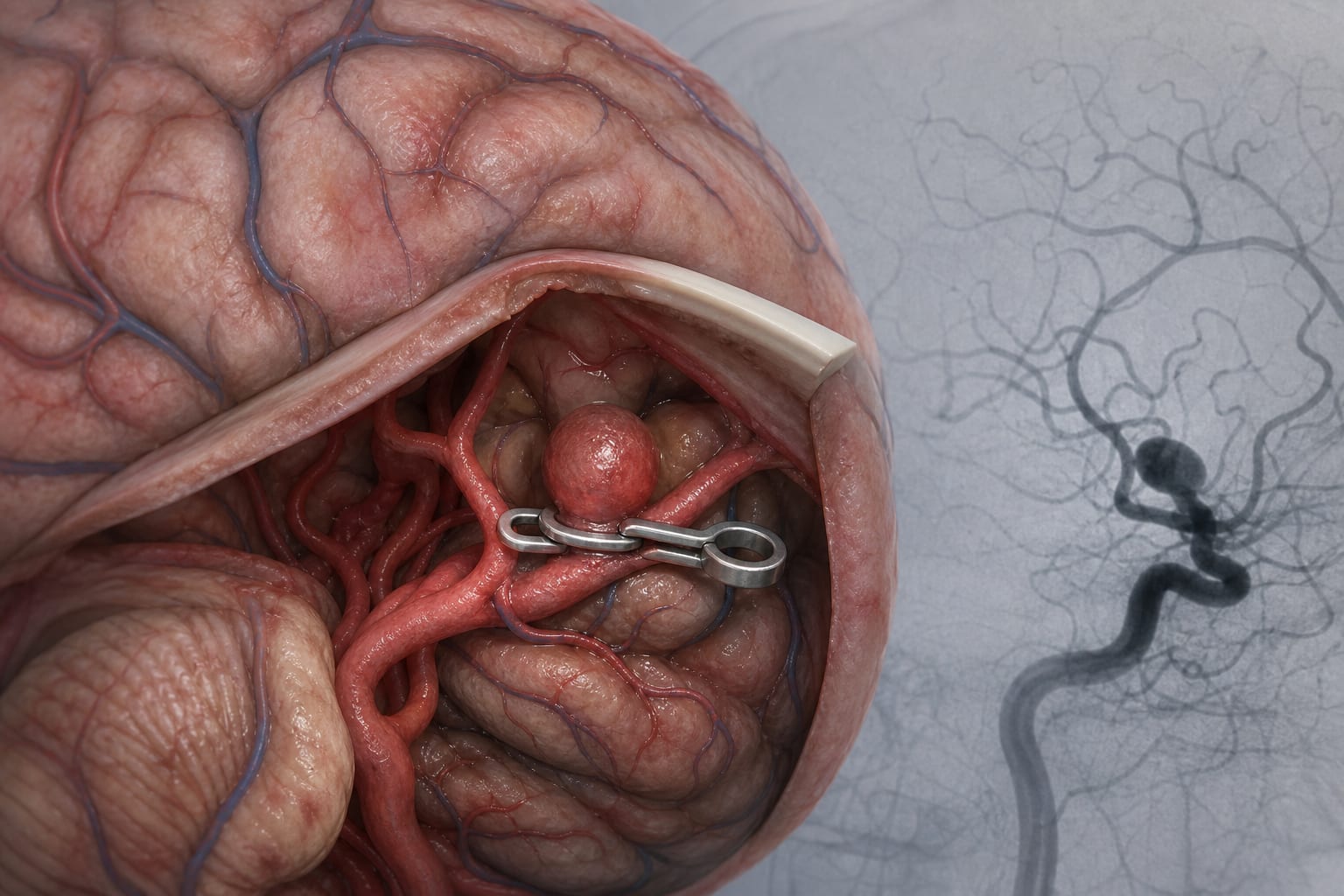
Contemporary indications and outcomes of open surgical cerebral aneurysm management in the endovascular era
By
Jonathan Rychen
Christian Ferreira
Marcio Y. Ferreira
Zoey Croft
Valentin F. Weiger
Griffin Thomas
Christian Rajkovic
Katherine Stark
Yafell Serulle
Jason A. Ellis
David J. Langer
June 24, 2026
Objective: To delineate the contemporary indications and outcomes of open microsurgical treatment for intracranial aneurysms in the current endovascular era.
Approach: Study Design: Retrospective single-center analysis of patients treated for intracranial aneurysms between 2019 and 2023.Patient Selection: Included adult patients with both ruptured and unruptured aneurysms, focusing on those deemed unsuitable for endovascular therapy.Outcome Assessment: Evaluated reasons for surgical intervention, outcomes, and complications associated with open surgery.Key Findings: 39.1% of aneurysms were treated with open surgery, while 60.9% received endovascular therapies. 41.4% of surgical cases presented with subarachnoid hemorrhage. Main reasons for selecting open surgery included wide-necked aneurysms (27%) and branch incorporation at the neck (19%). Complete aneurysm occlusion was achieved in 93.3% of surgical cases. Major and minor complication rates were 3.6% and 7.9%, respectively. Prior endovascular treatment had been performed in 15.7% of surgical cases. Adjunctive techniques to clipping, including anterior or posterior clinoidectomy, were necessary in 9.3% of cases. Interpretation:
Limitations: Retrospective design may introduce selection bias. Single-center study limits generalizability of findings. Conclusion: