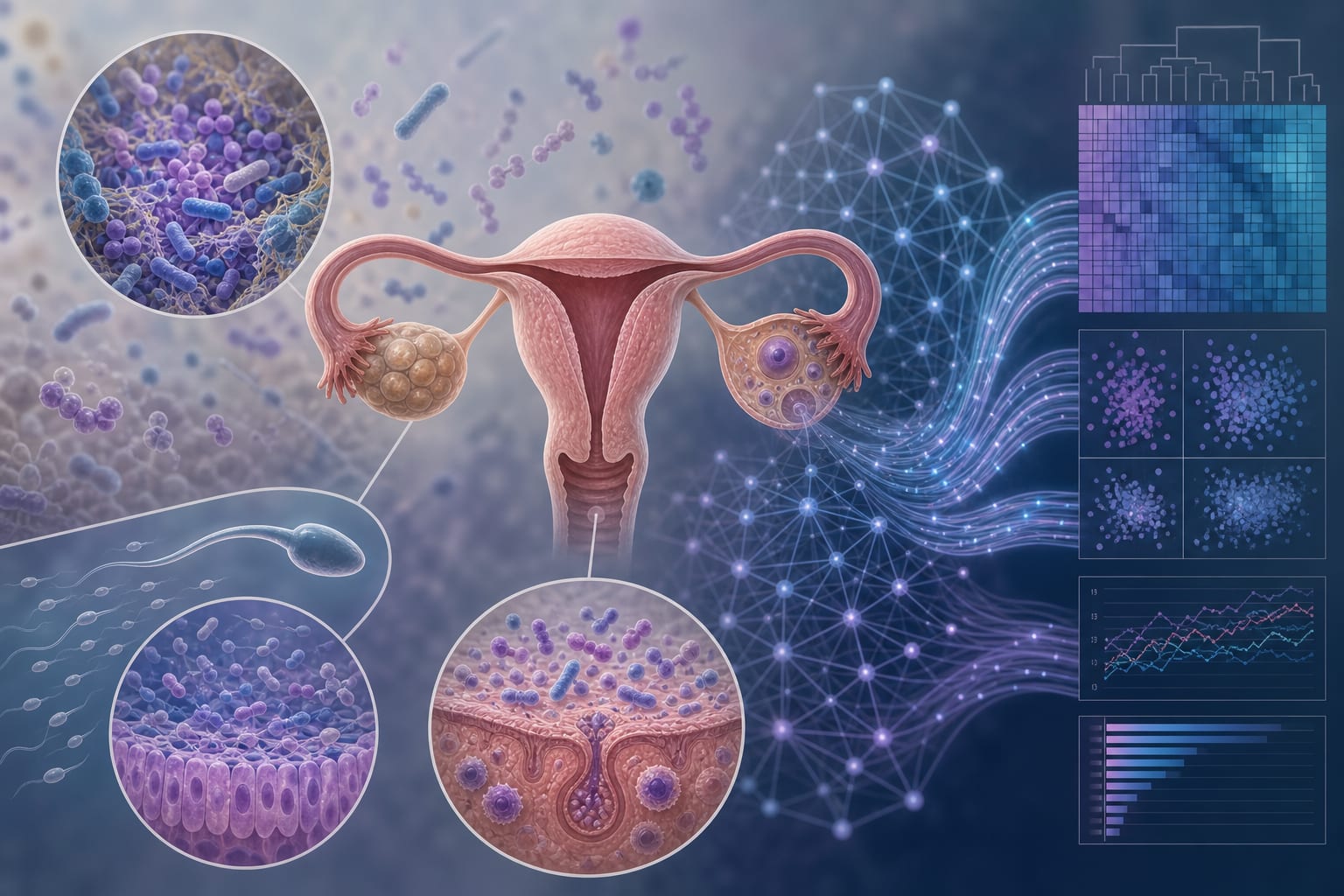
To highlight the characteristics and challenges of reproductive microbiome data and discuss machine learning (ML) and deep learning (DL) approaches in microbiome research relevant to reproductive medicine.
Approach:
Key Findings:
The reproductive microbiome is linked to various aspects of reproductive health, including sperm quality and pregnancy outcomes.
Current research is limited by small cohort sizes and a descriptive approach, necessitating advanced computational frameworks.
ML and DL can identify non-linear patterns in high-dimensional microbiome data, which are crucial for predicting clinical outcomes.
Interpretation:
Transitioning from descriptive to predictive reproductive medicine requires integrating ML/DL approaches with biological knowledge, addressing challenges such as small cohort sizes through data harmonization.
Limitations:
Small cohort sizes in reproductive studies limit the robustness of findings.
Low biomass environments in reproductive tracts pose challenges for data processing.
Variability in sampling protocols and physiological dynamics complicate data interpretation.
Conclusion:
The review emphasizes the need for standardizing analytical workflows and prioritizing interpretability in ML/DL applications to enhance future microbiome studies in reproductive health.
by Ignacio Garach Vélez, Irene Leonés-Baños, Bárbara A. Folch, Laura Antequera, Ignacio Rojas, Francisco Ortuño, María José Sáez Lara, Signe Altmäe, Luis Javier Herrera
Achievable goals, activity tracking, and social support are among the strategies JAMA researchers recommend for patients with chronic medical conditions.