Immunotherapeutic potential of PD-1 blockade in chronic Leishmania mexicana infection through the enhancement of progenitor-like CXCR5+ and intermediate CXCR5+TIM-3+ exhausted T cells - Summary - MDSpire
Advertisement
Immunotherapeutic potential of PD-1 blockade in chronic Leishmania mexicana infection through the enhancement of progenitor-like CXCR5+ and intermediate CXCR5+TIM-3+ exhausted T cells
To investigate the effectiveness of anti-PD-1 immune checkpoint therapy during chronic L. mexicana infection and its impact on T cell exhaustion.
Approach:
Study Design: C57BL/6 mice chronically infected with L. mexicana were treated with a variable-dose anti-PD-1 monoclonal antibody regimen starting from day 45 post-infection.
Treatment Regimen: The treatment consisted of three 250 μg induction doses followed by five 100 μg maintenance doses.
Outcome Measures: Lesion progression, parasite burden, and T cell responses were assessed through various immunological assays.
Key Findings:
Anti-PD-1 therapy limited lesion progression and reduced parasite burden in infected mice.
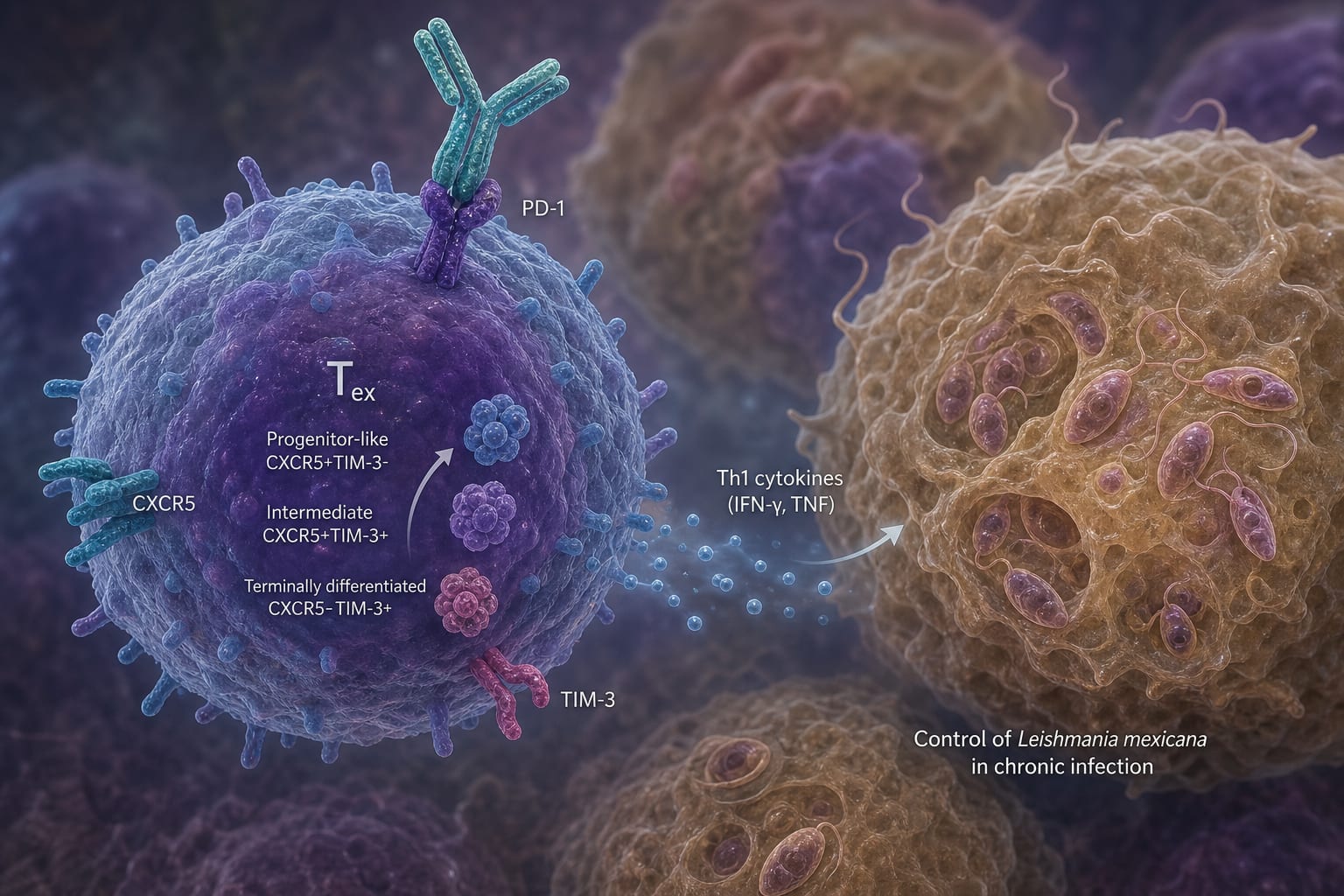
Enhanced antigen-specific Th1 immune response was observed, with increased expression of CD69, Ki-67, IFN-γ, and GrzmB in T cells.
Confocal microscopy revealed increased co-production of IFN-γ and TNF-α by T cells in lesion sites.
PD-1 blockade enhanced PD-1+CXCR5+ and PD-1+TIM-3+ Tex cells in lesion sites.
Anti-PD-1 treatment expanded progenitor-like CXCR5+TIM-3- Tex cells and intermediate CXCR5+TIM-3+ Tex cells in draining lymph nodes.
Interpretation:
PD-1 blockade improves clinical and parasitological outcomes in chronic L. mexicana infection by enhancing Th1-type immunity and remodeling the exhausted T-cell compartment.
Limitations:
The study was conducted in a mouse model, which may not fully replicate human disease.
Further research is needed to understand the long-term effects and safety of PD-1 blockade in chronic leishmaniasis.
Conclusion:
The study supports further investigation of PD-1/PD-L1 checkpoint blockade as a potential immunotherapeutic strategy for diffuse cutaneous leishmaniasis.