Anatomy-guided context-aware deep learning for lumbar degenerative disease grading and burden-aware risk assessment on MRI - Summary - MDSpire

Anatomy-guided context-aware deep learning for lumbar degenerative disease grading and burden-aware risk assessment on MRI

  • By

  • Zhijin Chai

  • Chen Liu

  • Rujie Qin

  • Dexuan Zhao

  • Ankang Shi

  • June 26, 2026

  • 0 min

Share

Objective:

To propose an anatomy-guided, multi-sequence, multi-level deep learning framework for grading lumbar degenerative diseases and assessing patient-level risk via MRI.

Approach:
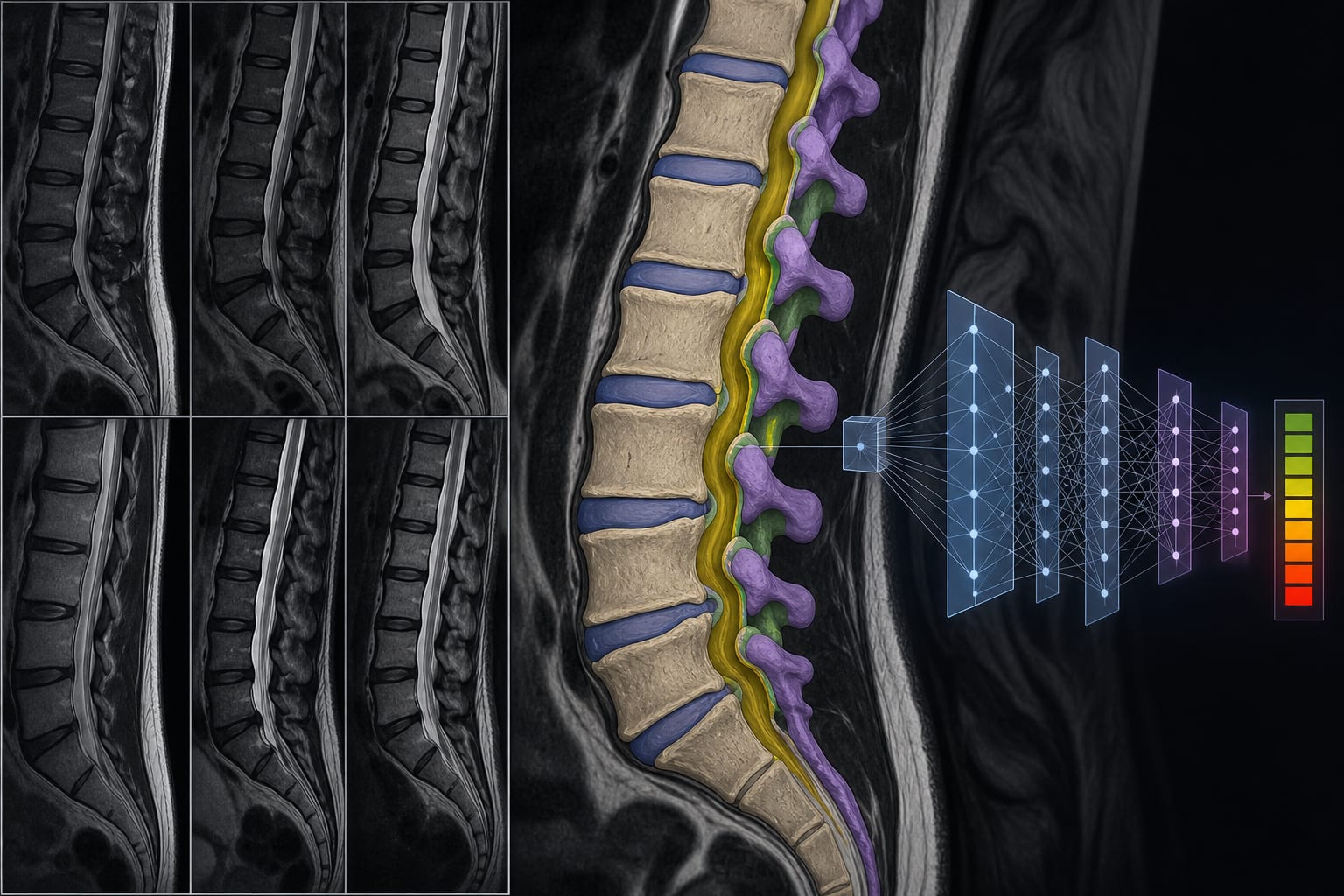
  • Anatomical Parsing Module: Pre-trained to segment vertebral bodies, intervertebral discs, and the spinal canal for stable level localization and structural priors.
  • Multi-Sequence MRI Patches: Localized patches and quantitative anatomical biomarkers are jointly encoded and modeled by a lightweight Transformer to capture contextual dependency across lumbar levels.
  • Grading and Assessment: Enables segment-level ordinal grading and Clinically Significant Degeneration Score (CSDS)-based patient-level burden assessment.
Key Findings:
  • TheproposedframeworkachievedaMacroF1-scoreof0.783±0.010,aCohen'sKappaof0.765±0.012,aweightedloglossof0.463±0.018,andapatient-levelAUCof0.891±0.009.Additionally,anatomy-guidedcropping,quantitativebiomarkerfusion,spine-contextmodeling,andconsistencyregularizationeachcontributedtoperformancegains.
Interpretation:

The integration of anatomical priors, structured biomarkers, and multilevel context is associated with improvements in diagnostic accuracy and interpretability in lumbar MRI assessment.

Limitations:
  • Existingmethodsstillfacechallengesrelatedtoanatomicalambiguityandinter-subjectstructuralvariation.Furthermore,manystudiesfocusonisolatedsegment-levelassessmentswithoututilizingexplicitanatomicalpriors.
Conclusion:

The proposed framework demonstrates enhanced diagnostic performance and interpretability, contributing to more standardized lumbar MRI assessments.

Original Source(s)

Related Content