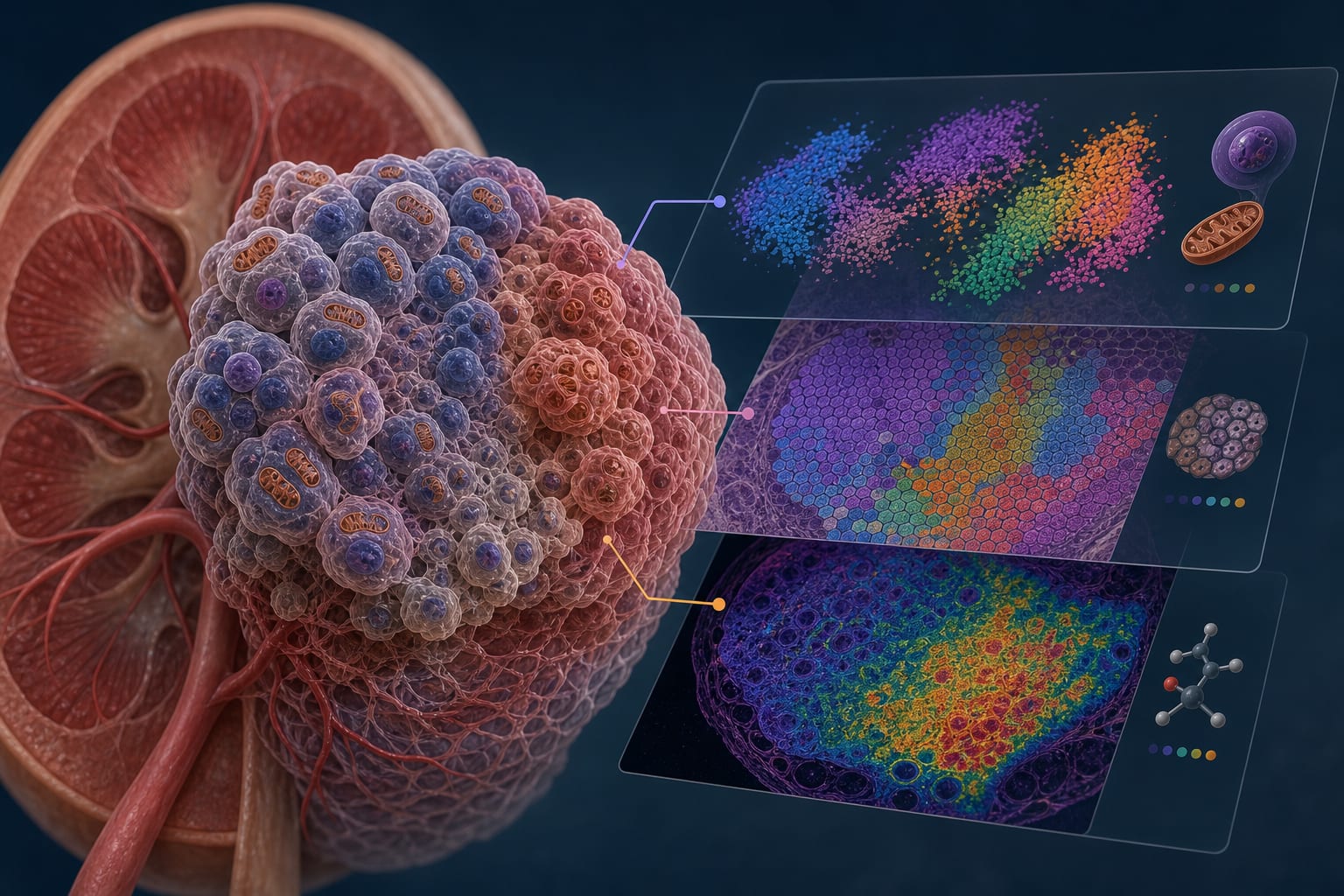
To investigate the role of nucleo-mitochondrial expression asymmetry (NMA) in tumor proliferation and spatial niche dynamics in clear cell renal cell carcinoma (ccRCC), highlighting its significance in disease progression.
Approach:
Key Findings:
Identified a malignant subpopulation (C0) characterized by NMA, with decreased nucleo-mitochondrial coordination.
C0 exhibited the highest ribosomal activity, peak differentiation potential, and concentrated G2M/S-phase activity.
C0-dominant regions acted as metabolic hubs, correlating with total metabolic flux and accumulation of TCA cycle intermediates.
NMA-driven niches transitioned from an immune-active core to stroma-shielded metabolic islands as ccRCC progressed.
MT-CO1 protein levels positively correlated with the proliferation marker Ki67 and served as an independent prognostic factor for overall survival.
Interpretation:
NMA is characterized as a hallmark of ccRCC progression and spatial niche reconstruction, providing insights into tumor biology and potential clinical applications, particularly in treatment strategies.
Limitations:
The study is limited to the specific cohort and methodologies employed, which may affect generalizability; further validation in larger, diverse populations is necessary to confirm findings.
Specific methodological concerns should be addressed to enhance the robustness of the conclusions drawn.
Conclusion:
NMA represents a critical aspect of ccRCC evolution, offering a novel framework for metabolic risk stratification via MT-CO1, with implications for future treatment strategies.