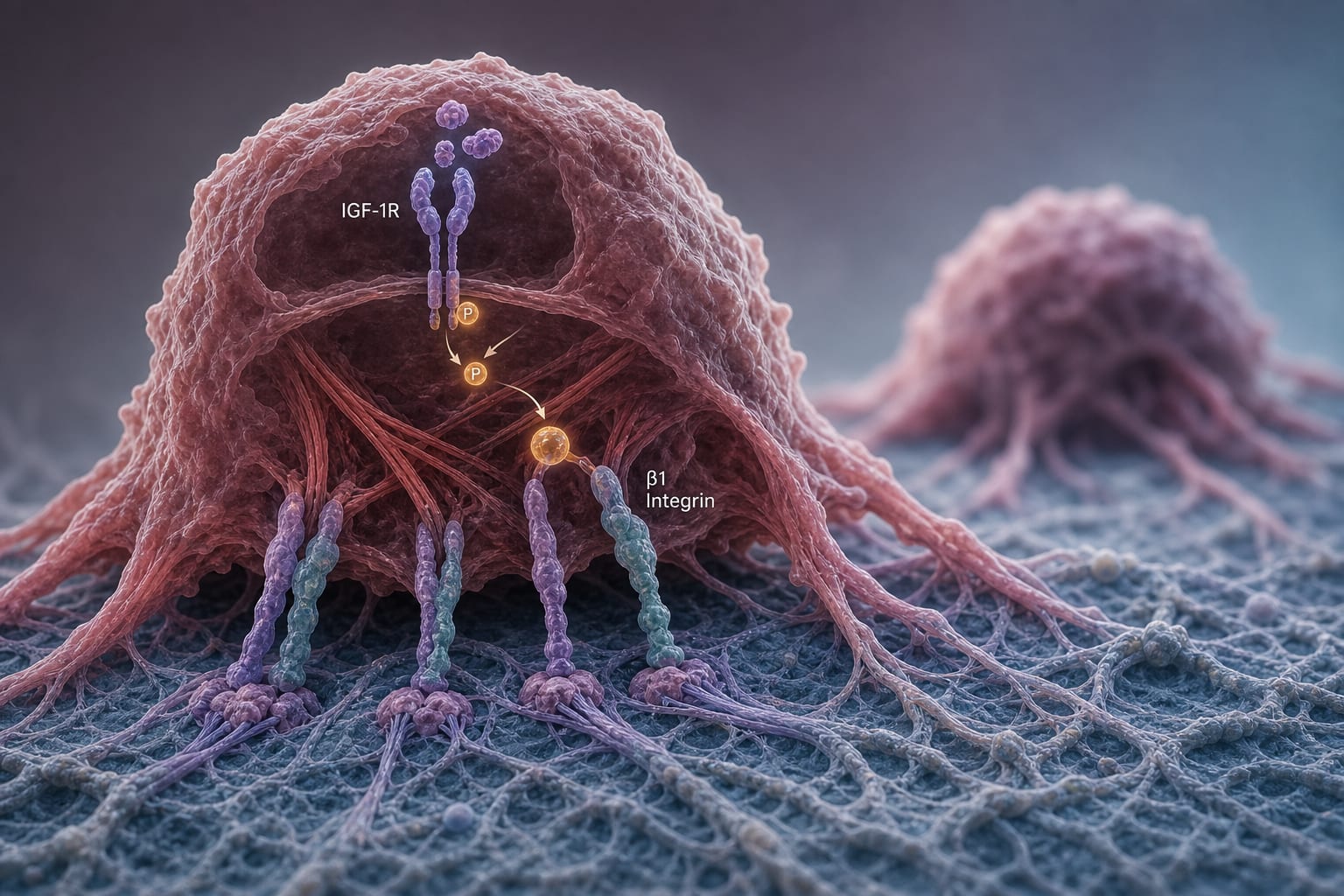
To investigate the role of IGF1R in regulating cancer cell adhesion in breast cancer, particularly in triple-negative breast cancer (TNBC), and to understand its implications for metastasis.
Key Findings:
IGF-1 stimulation increased MDA-MB-231 TNBC adhesion, reversible by IGF1R inhibitors, highlighting a complex regulatory mechanism.
IGF1R knockdown also stimulated cell adhesion, indicating a paradoxical role that warrants further investigation.
Increased adhesion was β1 integrin dependent, as shown by integrin knockdown reversing effects, emphasizing the interplay between these pathways.
Inhibition of IGF1R signaling reduced adhesion to HUVEC endothelial cells, suggesting potential therapeutic implications.
Interpretation:
The findings suggest that both IGF-1 stimulation and IGF1R knockdown enhance cell adhesion by removing IGF1R from the cell surface, which inhibits β1 integrin function, potentially guiding future therapeutic strategies.
Limitations:
The study primarily focused on specific breast cancer cell lines, which may limit generalizability to other breast cancer subtypes.
Further in vivo studies are needed to validate findings in a more complex biological context, particularly regarding the tumor microenvironment.
Conclusion:
This study elucidates the dual role of IGF1R in modulating breast cancer cell adhesion, highlighting its potential as a therapeutic target in TNBC metastasis.
by Christopher A. Galifi, Elvan Dogan, Luis Fernandez Almansa, Krystopher Maingrette, Simran S. Shah, Joseph J. Bulatowicz, Karen Ebenezer, Utz Herbig, Amir K. Miri, Teresa L. Wood