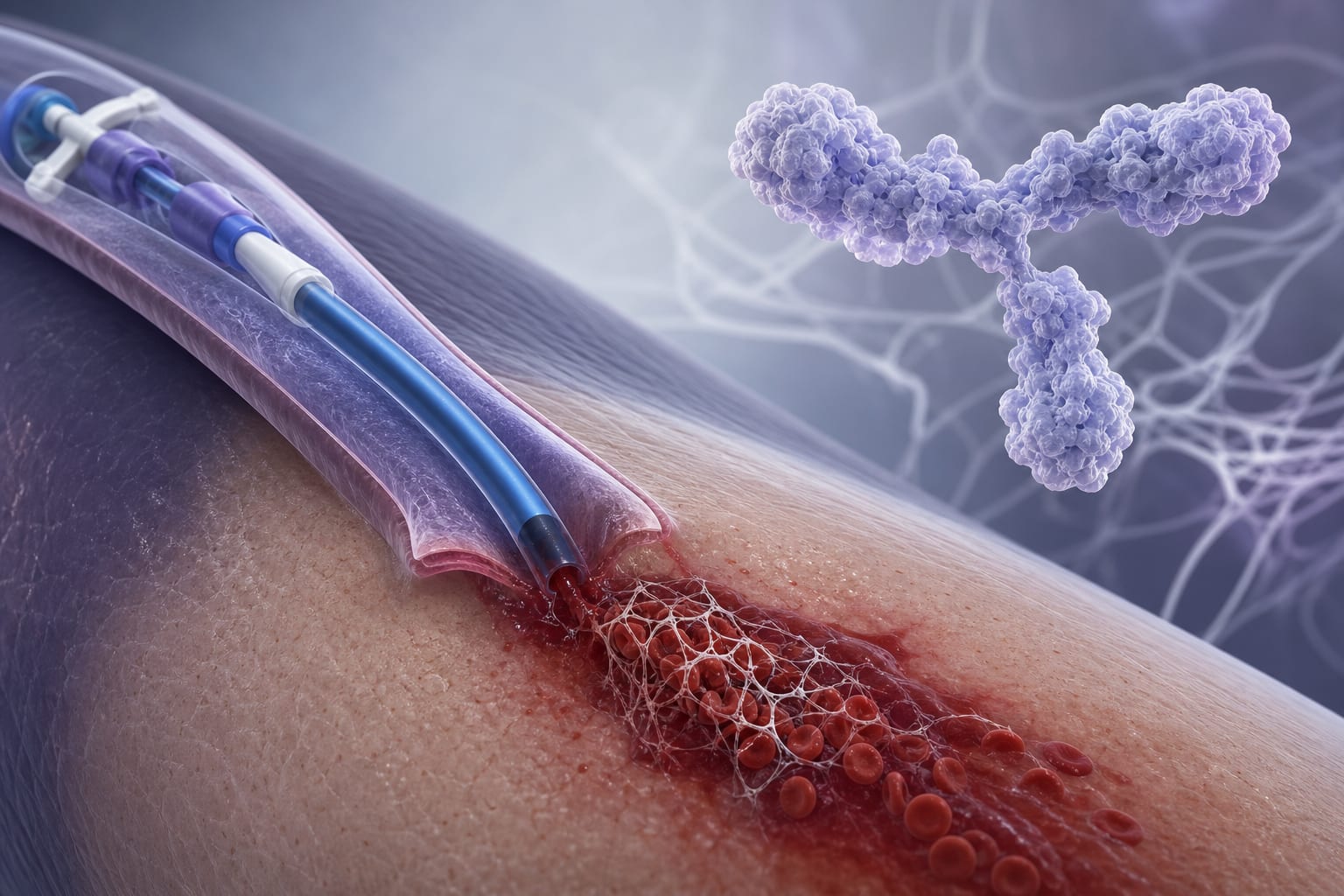
Fibrinogen and catheter advancement difficulty: unveiling the key predictors of early in-situ bleeding after peripherally inserted central catheter insertion
By
Shusheng Jiao
Hongjie Yang
Jianling Yang
Jianxia Zhi
July 15, 2026
Objective: To identify and analyze factors associated with puncture site bleeding within 48 hours of PICC insertion.
Approach: Study Design: A single-center, retrospective observational study was conducted, analyzing a cohort of patients who underwent PICC insertion.Data Collection: Patient-related and procedure-related factors were collected and analyzed to identify significant predictors of bleeding.Statistical Analysis: Univariate analyses were performed followed by multivariable logistic regression to identify independent risk factors.Key Findings: In-situ hemorrhage incidence was 21.9% among 375 patients. Lower fibrinogen levels were identified as an independent risk factor for bleeding (OR = 0.762 per 1 g/L increase, 95% CI: 0.583–0.995, p = 0.046). Catheter advancement difficulty was also a significant predictor of bleeding (OR = 2.560, 95% CI: 1.010–6.485, p = 0.047). A tumor diagnosis was unexpectedly associated with a reduced risk of bleeding (OR = 0.331, 95% CI: 0.142–0.768, p = 0.011). The number of puncture attempts showed a trend toward significance (OR = 1.661, 95% CI: 0.999–2.750, p = 0.060). Interpretation: Lower fibrinogen levels and catheter advancement difficulty are significant predictors of early bleeding following PICC placement.
Limitations: The study design is retrospective, which may introduce bias. The association between tumor diagnosis and reduced bleeding risk is counterintuitive and should be considered hypothesis-generating. Conclusion: Lower fibrinogen levels and catheter advancement difficulty are independent risk factors for early PICC-related bleeding.