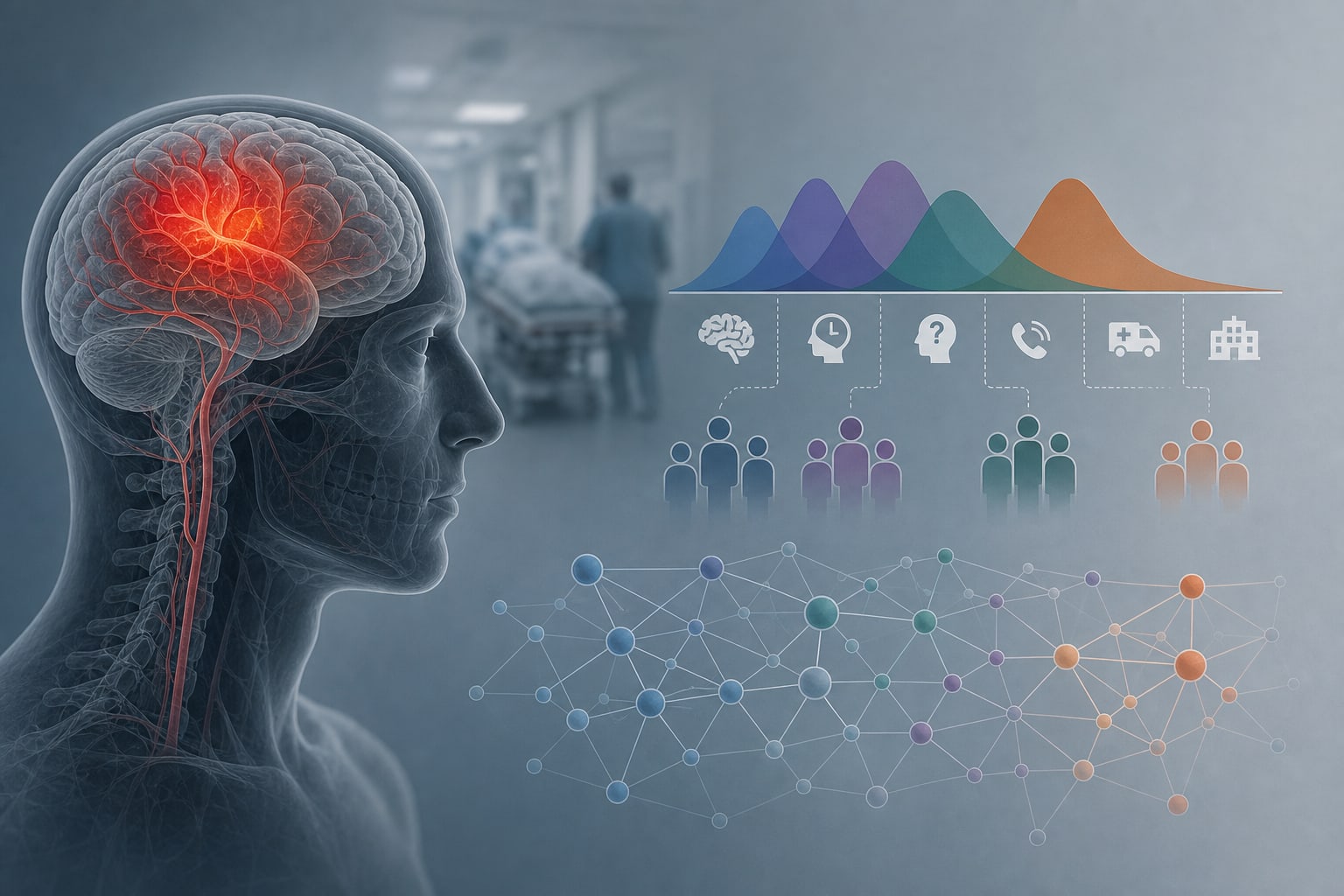
To identify potential profile types characterizing emergency department presentations among patients with acute ischemic stroke (AIS) and analyze differences in demographic, clinical features, and clinical outcomes across profiles.
Approach:
Study Design: Convenience sampling of 220 AIS patients admitted from January to December 2024.
Latent Profile Analysis: Utilized Mplus 8.0 software to perform LPA with eight indicators related to prehospital behaviors.
Statistical Analysis: Demographic and clinical features compared using χ2 tests and Kruskal-Wallis H tests; Spearman correlation and multivariate ordinal logistic regression were used for outcome analysis.
Key Findings:
Four latent profiles identified: rapid EMS-activated profile (31.36%), delayed recognition-self-presentation profile (27.73%), family involvement-cautious decision-making profile (16.82%), and multiple barriers-delayed presentation profile (24.09%).
Significant differences in age, education level, residence, living alone status, number of comorbidities, onset time, and NIHSS score across profiles (p < 0.05).
The rapid EMS-activated profile had the highest reperfusion therapy rate (63.77%) and favorable prognosis rate (72.46%).
The multiple barriers-delayed presentation profile had the lowest reperfusion rate (7.55%) and highest poor prognosis rate (86.79%) (p < 0.001).
Significant positive correlations between mRS scores and various time intervals related to symptom recognition and presentation (all p < 0.001).
Latent profile membership was confirmed as an independent prognostic factor for mRS, with the Multiple Barriers-Delayed Presentation Profile associated with higher odds of poor prognosis (OR = 4.87, 95% CI: 2.92–8.13, p < 0.001).
Interpretation:
Emergency presentation patterns among AIS patients exhibit significant heterogeneity, allowing classification into four distinct profiles with varying clinical outcomes.
Limitations:
Study based on a single hospital's patient population, which may limit generalizability.
Convenience sampling may introduce selection bias.
Conclusion:
Latent profile classification reveals distinct behavioral characteristics among AIS patients, highlighting differences in presentation efficiency and clinical outcomes.