On-treatment change in bone turnover markers predicts 2-year bone mineral density after sequential therapy following romosozumab: a real-world cohort study - Summary - MDSpire
Conexiant’s news site is now MDSpire News. Learn more
Advertisement
Change in Bone Turnover Markers During Treatment as a Predictor of Two-Year Bone Mineral Density Following Sequential Romosozumab Therapy: Insights from a Real-World Cohort Study
To investigate whether on-treatment changes in bone turnover markers (BTMs) predict 2-year cumulative bone mineral density (BMD) changes after sequential therapy following romosozumab treatment, specifically focusing on ΔP1NP and ΔTRACP-5b.
Approach:
Key Findings:
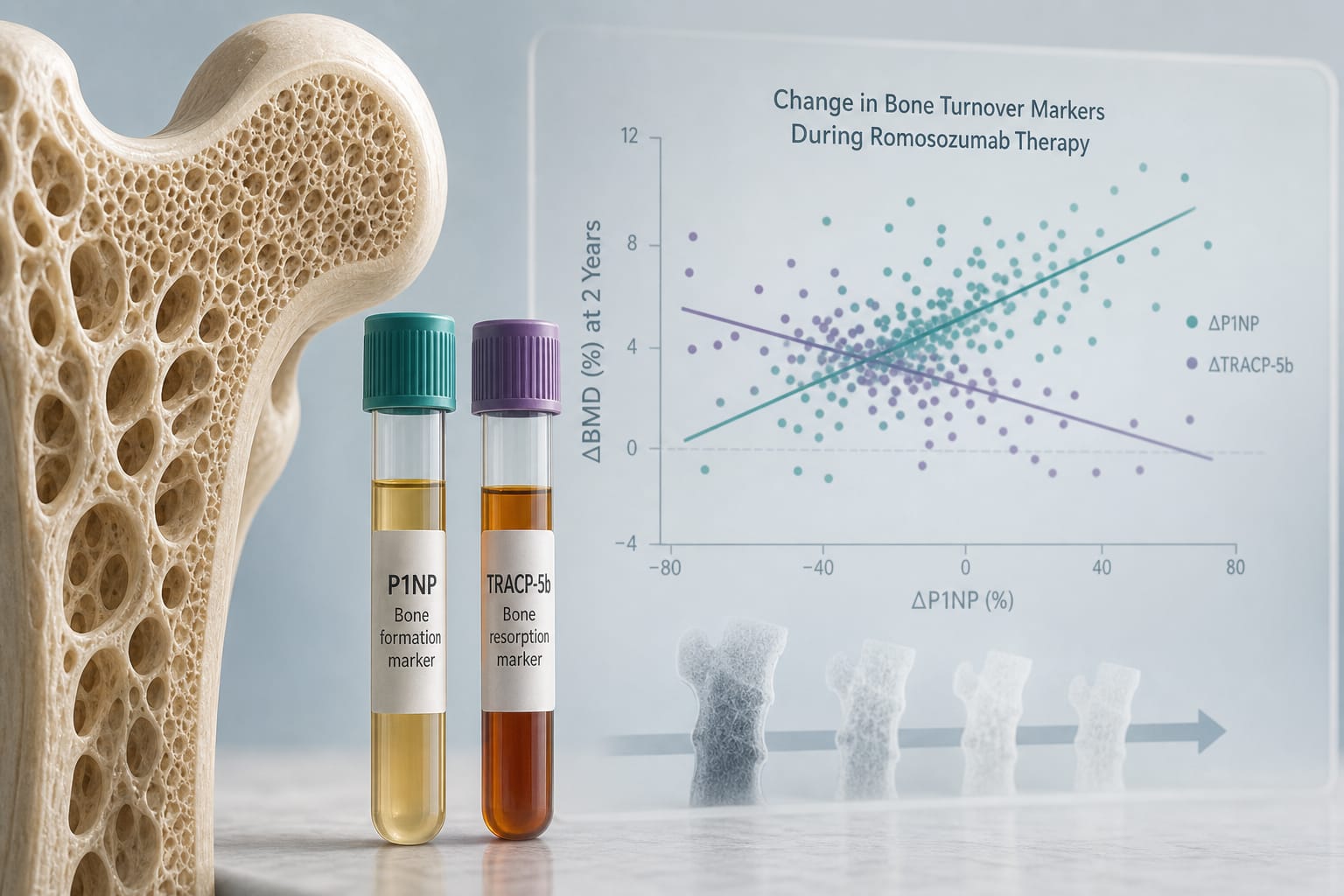
ΔP1NP was significantly correlated with the 24-month cumulative LS-BMD change (ρ=−0.375, p<0.0001).
A greater decline in P1NP during romosozumab treatment predicted greater cumulative BMD gain.
The optimal ΔP1NP cutoff was −40.3 μg/L (AUC = 0.761; sensitivity=0.545, specificity=0.854).
Patients in the highest ΔP1NP decline tertile achieved 23.5% cumulative LS-BMD gain versus 12.3% in the lowest tertile (p=0.0003).
The predictive value was stronger in treatment-naïve patients compared to previously treated patients.
ΔTRACP-5b showed a similar association (ρ=−0.348, p=0.0001, n=114).
Interpretation:
On-treatment ΔP1NP is an independent predictor of 2-year cumulative BMD after sequential therapy following romosozumab, particularly in treatment-naïve patients.
Limitations:
Single-center retrospective design.
Predominantly female Japanese population (96.9%), which may limit generalizability.
Monitoring BTM changes during romosozumab treatment may have clinical utility, but further validation through prospective multicenter studies is necessary.