Red cell distribution width: a novel and accessible predictor for immune checkpoint inhibitor-associated myocarditis—a retrospective cohort study - Summary - MDSpire
Advertisement
Red cell distribution width: a novel and accessible predictor for immune checkpoint inhibitor-associated myocarditis—a retrospective cohort study
To investigate the role of red blood cell distribution width (RDW) in immune checkpoint inhibitor (ICI)-associated myocarditis and its potential as a diagnostic indicator.
Approach:
Study Design: A single-center retrospective study was conducted from January 2020 to January 2024, including 51 patients with PD-1 inhibitor-associated myocarditis, 58 patients with viral myocarditis, and 50 anti-PD-1-treated patients without myocarditis.
Data Analysis: Clinical and laboratory data, including RDW and troponin T (TnT), were analyzed using statistical tests such as one-way ANOVA and ROC curve analysis.
Key Findings:
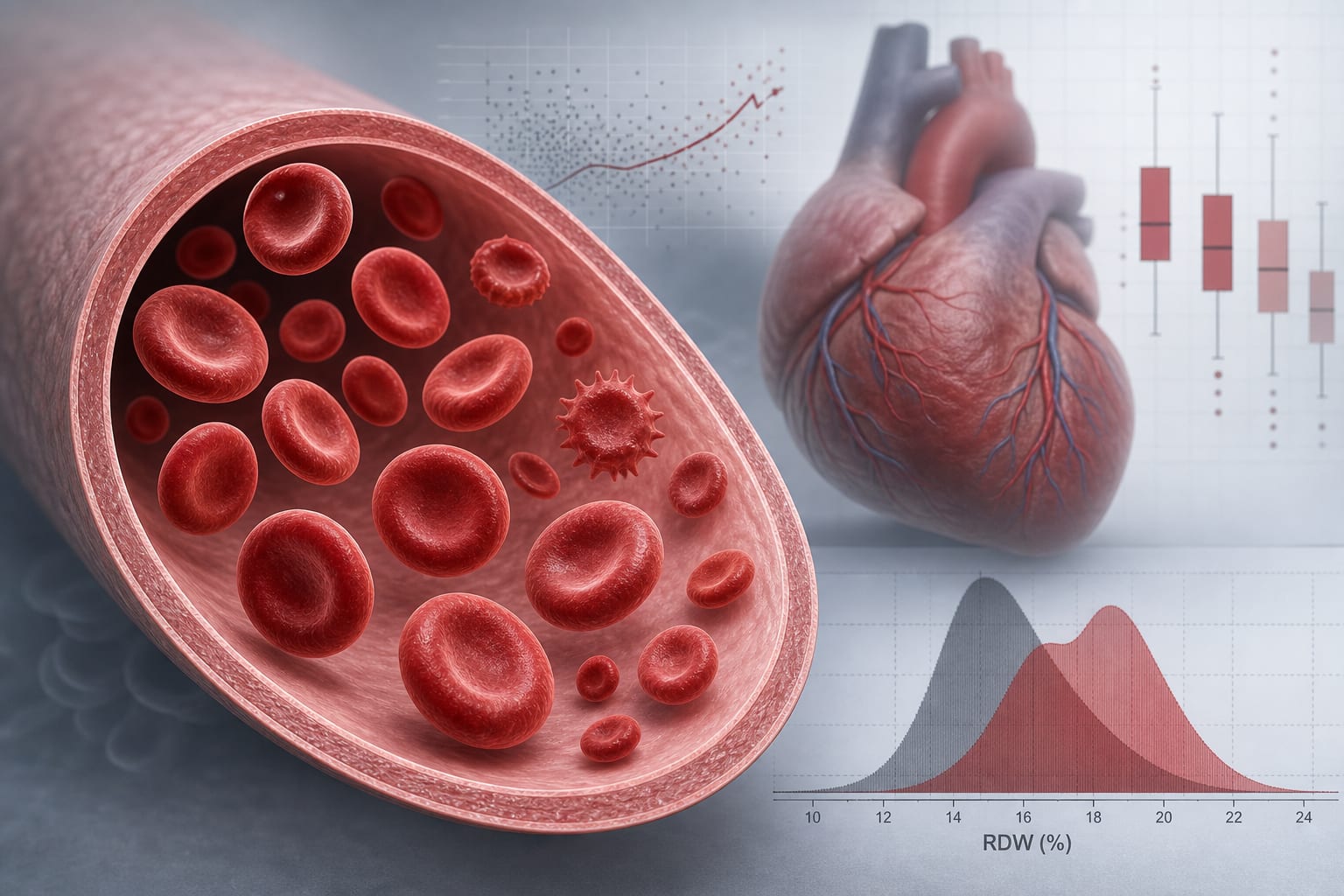
RDW was significantly elevated in the ICI-associated myocarditis group compared to both control groups (P < 0.05).
Multivariate logistic regression identified RDW (OR = 3.78) and ln(TnT) (OR = 12.12) as independent factors associated with ICI-associated myocarditis (P < 0.05).
ROC analysis showed RDW had an AUC of 0.8882 (cut-off = 14.65; sensitivity 85.6%, specificity 90.5%), comparable to TnT (AUC = 0.9102).
The mean onset time after PD-1 inhibition therapy was 153.5 ± 184.5 days, and the mean hospitalization period was 13.6 ± 17.5 days.
Interpretation:
Limitations:
The study is retrospective and conducted at a single center, which may limit generalizability.
The diagnostic criteria for ICI-associated myocarditis are not standardized, leading to potential subjectivity in diagnosis.
Conclusion:
RDW may serve as a practical, noninvasive, complementary auxiliary indicator for early screening and risk stratification of ICI-associated myocarditis.