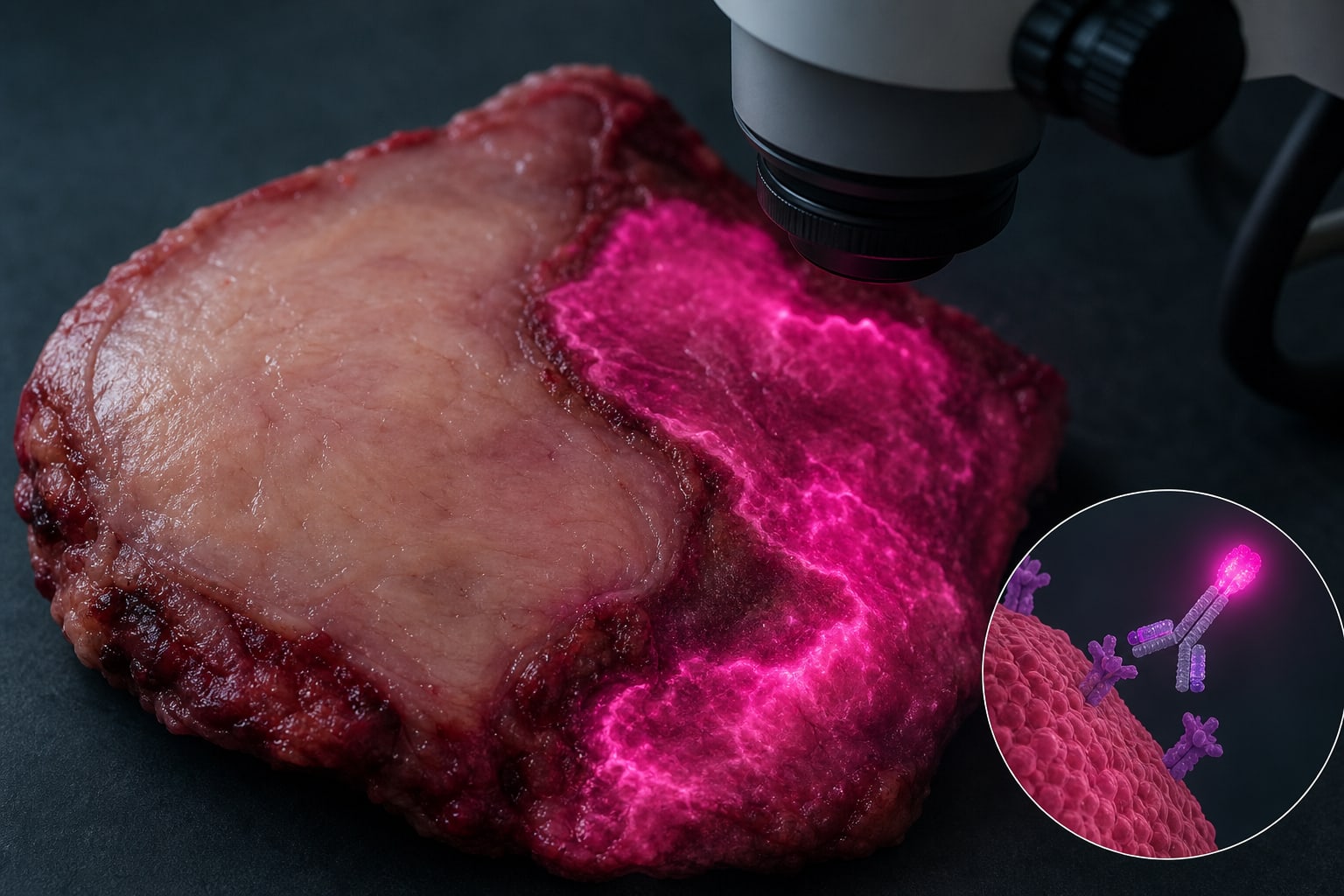
Targeting EpCAM expression via near-infrared fluorescent antibodies enables microscopic delineation of primary and recurrent HNSCC - Summary - MDSpire

Targeting EpCAM expression via near-infrared fluorescent antibodies enables microscopic delineation of primary and recurrent HNSCC

  • By

  • Bernd Uhl

  • Dennis Eggert

  • Bojan Smiljanov

  • Katharina von Thun und Hohenstein

  • Christoph Walz

  • Gisela Kranz

  • Sabina Schwenk-Zieger

  • Florian Haring

  • Joshua Luft

  • Jiahang Song

  • Vincent Holtmann

  • Philipp Baumeister

  • Christoph A. Reichel

  • Olivier Gires

  • Martin Canis

  • Christian Betz

  • May 25, 2026

  • 0 min

Share

Objective:

To investigate the use of IRDye800CW-labeled anti-EpCAM antibodies for fluorescent-guided differentiation of HNSCC from adjacent non-cancerous tissues.

Approach:
    Key Findings:
    • Approximately 90% of HNSCC exhibit high EpCAM expression.
    • IRDye800CW provides superior imaging properties such as deeper light penetration and reduced background fluorescence.
    Interpretation:

    The study suggests that IRDye800CW-labeled anti-EpCAM antibodies could improve intraoperative identification of tumor margins in HNSCC surgery.

    Limitations:
    • The study does not provide clinical outcomes or efficacy data from surgical applications.
    • The translation of findings into clinical practice remains to be validated.
    Conclusion:

    The use of fluorescent-guided techniques targeting EpCAM may enhance surgical outcomes in HNSCC.

Original Source(s)

Related Content