Postoperative complications after cataract surgery with and without concurrent minimally invasive glaucoma surgery in patients with primary open angle glaucoma: a comparative risk analysis - Summary - MDSpire
Advertisement
Postoperative complications after cataract surgery with and without concurrent minimally invasive glaucoma surgery in patients with primary open angle glaucoma: a comparative risk analysis
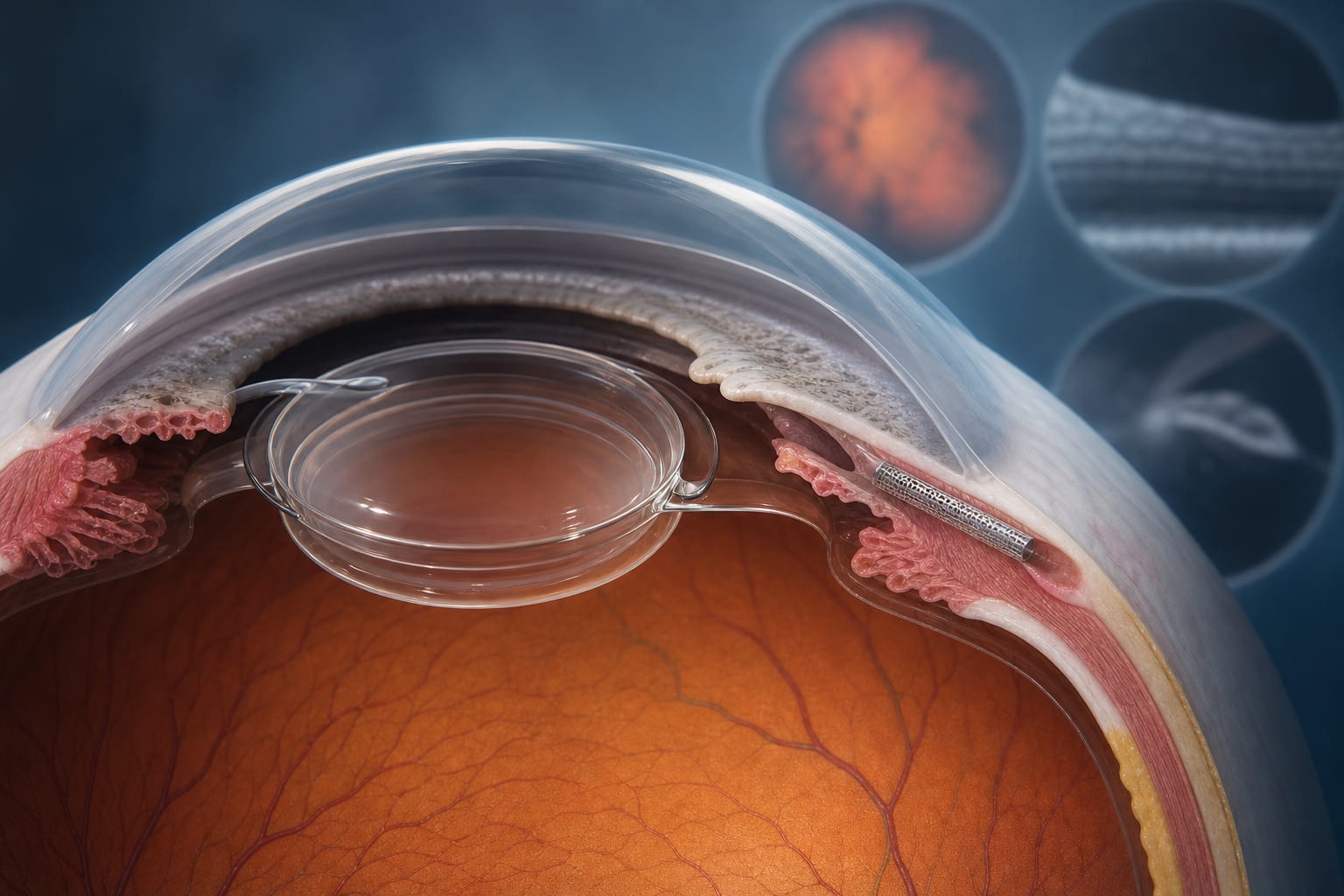
To compare postoperative complication risks between cataract extraction with intraocular lens implantation (CE/IOL) alone and combined with minimally invasive glaucoma surgery (MIGS) in patients with primary open-angle glaucoma (POAG).
Approach:
Study Design: Retrospective cohort study utilizing the TriNetX US Collaborative Network to identify adults with POAG who underwent CE/IOL with or without MIGS from 2006 to 2026.
Data Analysis: Cumulative postoperative incidence of hyphema, cystoid macular edema (CME), retinal detachment (RD), and endophthalmitis were evaluated at four time intervals up to 90 days postoperatively, using propensity score matching and chi-square tests.
Key Findings:
After propensity score matching, each routine cataract surgery cohort (with and without MIGS) comprised 7,998 patients. Patients undergoing CE/IOL with MIGS had a significantly higher rate of hyphema (1.19%) compared to CE/IOL alone (0.15%) at 1–90 days postoperatively (P<0.0001).
Cumulative incidence rates of CME (2.585% vs 2.376%, P = 0.3993), RD (0.215% vs 0.139%, P = 0.2566), and endophthalmitis (0.276% vs 0.15%, P = 0.0862) were not statistically different between the two groups.
Interpretation:
Combined CE/IOL with MIGS is associated with a significantly increased risk of postoperative hyphema, while rates of CME, RD, and endophthalmitis are comparable to CE/IOL alone.
Limitations:
Retrospective design may introduce selection bias.
Data sourced from a single database may limit generalizability.
Conclusion:
Combined CE/IOL with MIGS increases the risk of hyphema without affecting other complication rates.