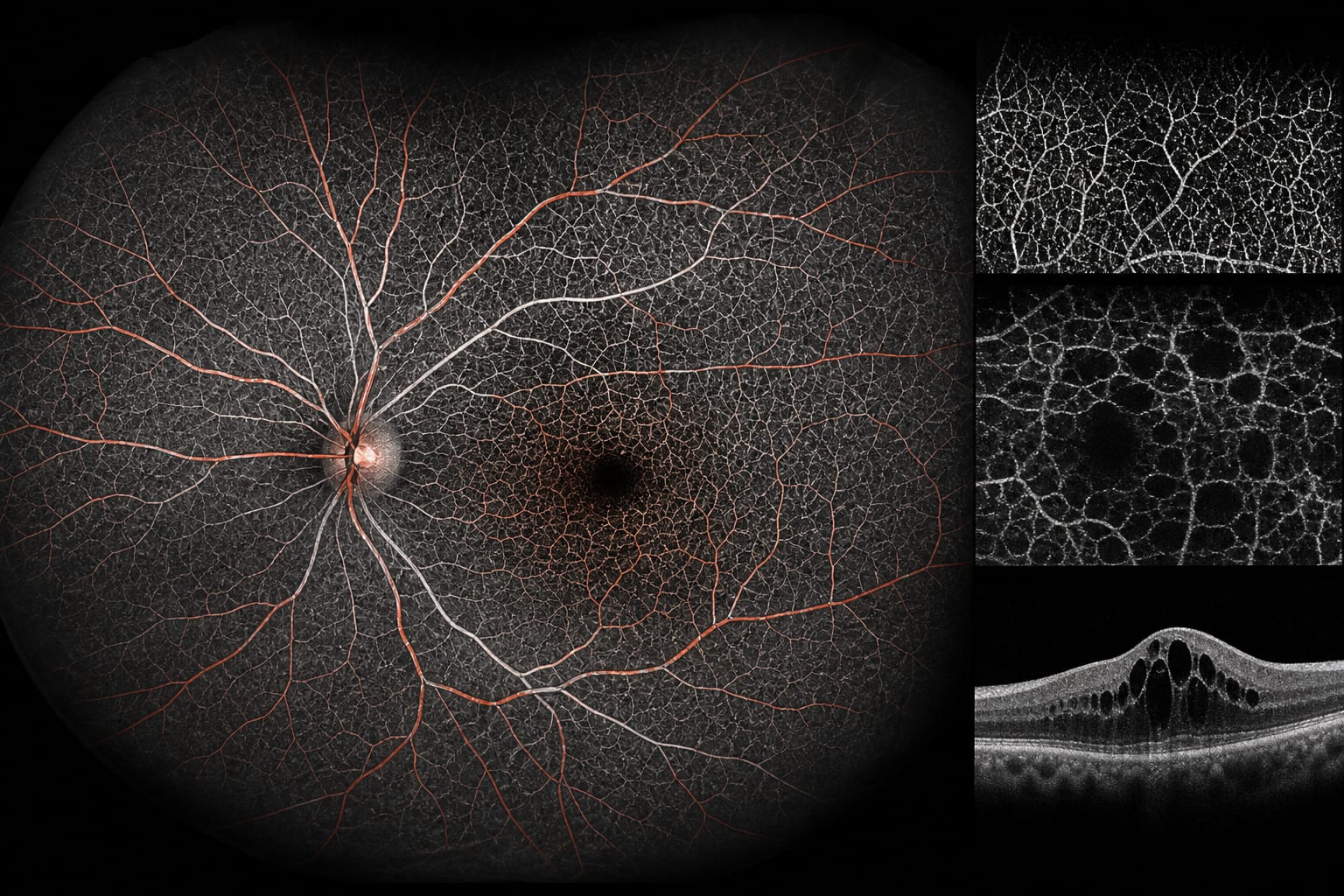
To propose a novel framework, VesselMetaKAN, for robust and interpretable classification of diabetic retinopathy (DR) by integrating vessel guidance and meta-learning.
Approach:
Stage 1: Vessel Segmentation: Employs GMF-SwinUnet for topology-aware vessel segmentation using Frangi-guided attention fusion, reliability gating, and clDice loss.
Stage 2: Classification: Utilizes KAN-MAML, combining Kolmogorov-Arnold networks with radial basis function expansions for interpretable classification, guided by vessel probability maps from Stage 1.
Key Findings:
VesselMetaKAN achieved 74.9 ± 0.4% accuracy, 58.7 ± 0.6% macro-F1, and 0.838 ± 0.005 QWK on APTOS 2019 dataset. The best single run reached 75.44% accuracy, 59.44% macro-F1, and 0.843 QWK.
Outperformed EfficientNet-B4 on principal grading metrics with paired bootstrap significance (p < 0.05).
Ablation studies confirmed the contributions of vessel guidance, KAN-based interpretability, and meta-learning.
Interpretation:
Conclusion:
VesselMetaKAN integrates vessel segmentation, topology-aware losses, interpretable classification, and meta-learning, addressing critical challenges in DR grading.