Feasibility and preliminary signal of cerebellar intermittent theta burst stimulation for static balance in cerebellar ataxia: a pilot study - Summary - MDSpire
Advertisement
Feasibility and preliminary signal of cerebellar intermittent theta burst stimulation for static balance in cerebellar ataxia: a pilot study
To evaluate the short-term effects of 50 Hz cerebellar intermittent theta burst stimulation (iTBS) on static balance and prefrontal cortical activation in patients with cerebellar ataxia (CA).
Approach:
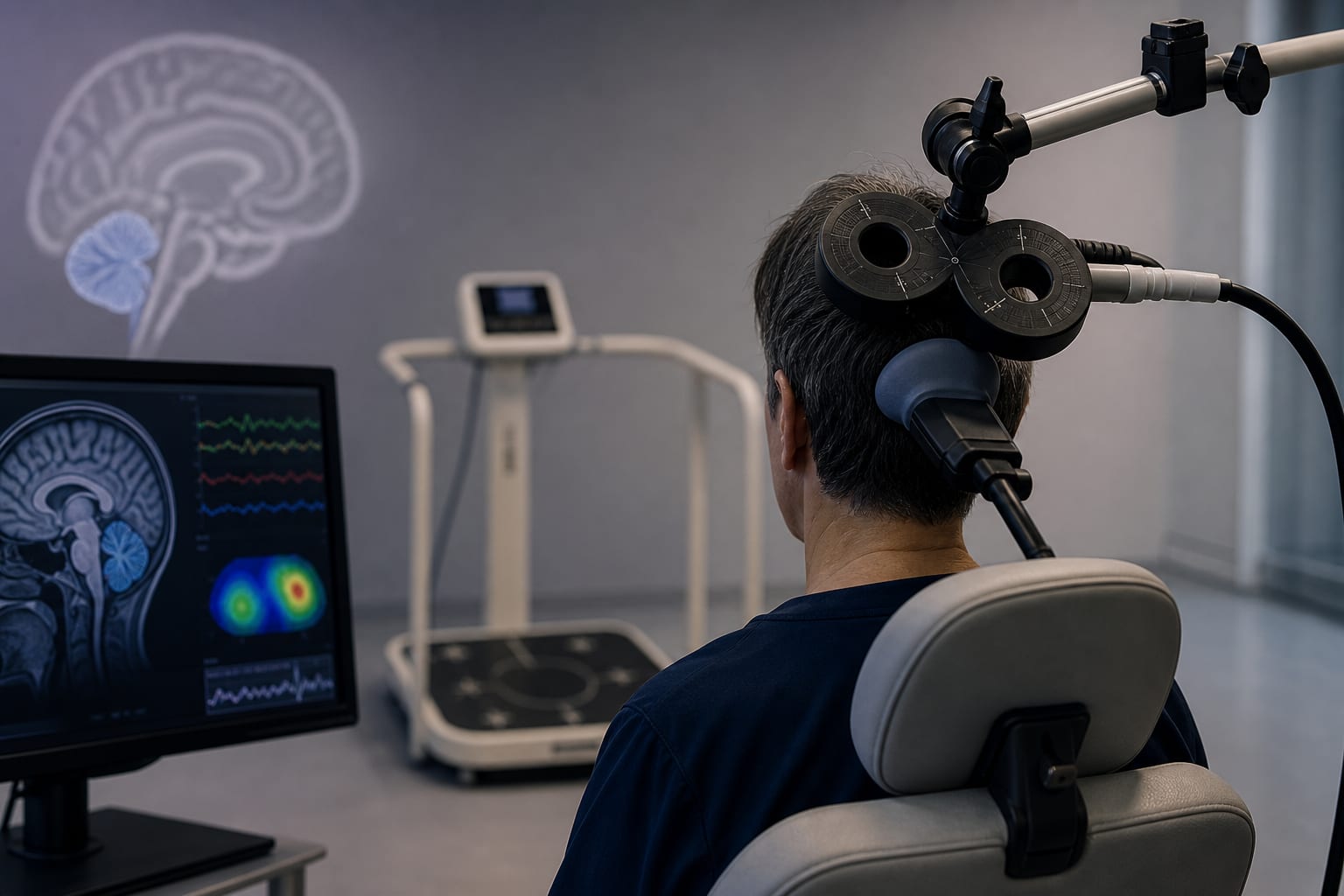
Participants: Ten patients with CA (4 males; mean age, 57.6 ± 9.1 years) underwent iTBS over the bilateral cerebellum for five consecutive days.
Intervention: iTBS was applied for 8 minutes per session at 80% active motor threshold.
Assessment: Static balance was assessed using a Balance Trainer 4 (BT4) under eyes-open (EO) and eyes-closed (EC) conditions at baseline, immediately post-intervention, and 6 weeks post-treatment.
Additional Measures: Clinical scales and functional near-infrared spectroscopy (fNIRS) were used to evaluate motor and cognitive responses.
Key Findings:
Significant improvements in postural balance were observed immediately post-intervention (V1) compared to baseline (V0) under both EO and EC conditions, as assessed by clinical scales.
Improvements included decreased anterior–posterior sway and total displacement under EO, and improved medial–lateral sway under EC (p < 0.05).
These effects were not sustained at 6 weeks post-treatment (V2).
Dizziness was reported as a mild–moderate adverse event in 50% of participants, resolving without treatment discontinuation.
Interpretation:
50 Hz cerebellar iTBS was well tolerated and transiently enhanced postural stability in CA patients, with fNIRS monitoring indicating cortical engagement during cognitive-motor integration.
Limitations:
Small sample size of ten patients limits generalizability.
Short follow-up period may not capture long-term effects.
Conclusion:
The study provides evidence for the effects of 50 Hz cerebellar iTBS on postural stability in CA patients, with fNIRS serving as a candidate biomarker for monitoring neuromodulation effects.