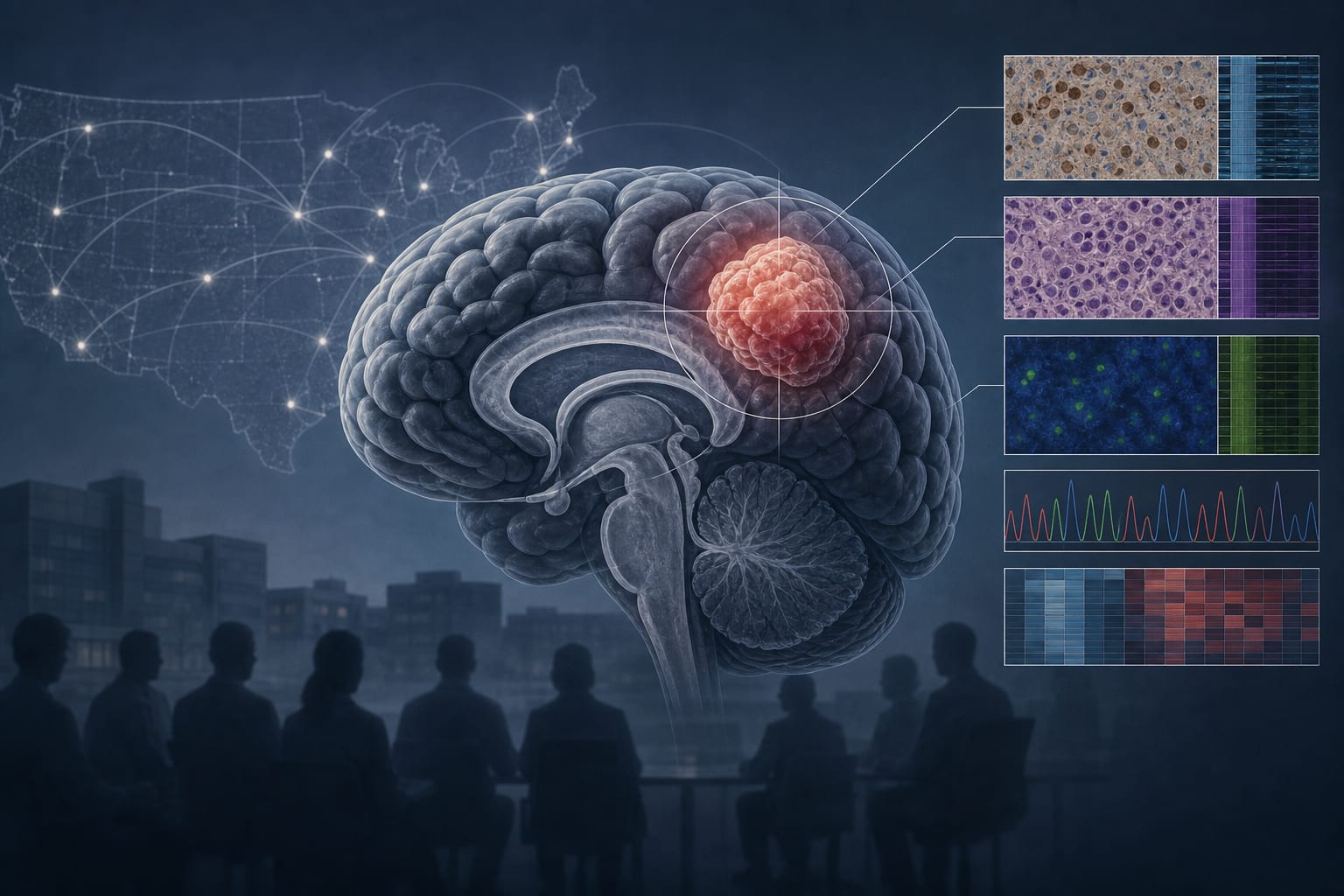
To outline the evolution and impact of RTOG/NRG trials on clinical standards for CNS tumors.
Approach:
Foundational era: Established radiotherapy dose, fractionation, and feasibility for gliomas through early investigations.
Methodological maturation: Developed prognostic stratification and efficient phase II trials to address limitations of radiotherapy intensification.
Key Findings:
RTOG/NRG trials have significantly influenced evidence-based care for CNS tumors, particularly through the validation of molecular stratification.
Long-term follow-up from RTOG 94-02 demonstrated that incorporating PCV into radiotherapy doubled survival among patients with 1p19q co-deleted, IDH mutant high-grade gliomas.
The integration of patient-reported outcomes and cognitive function assessments has become standard in CNS trials.
Collaborative efforts with other NCTN groups have accelerated trial accrual and evidence generation, enhancing the robustness of findings.
Interpretation:
The trials have evolved to address the complexities of CNS tumors, integrating advanced methodologies and collaborative frameworks as demonstrated through various studies.
Limitations:
Generalizability of findings may be constrained due to the unique challenges posed by CNS tumors, including biological heterogeneity and infiltrative growth.
Single-institution studies may not capture the full spectrum of treatment responses, limiting the applicability of findings.
Conclusion:
RTOG/NRG trials have established a robust framework for the treatment of CNS tumors, emphasizing the importance of multi-institutional collaboration and methodological advancements in trial design. Compliance with regulatory standards and ethical considerations has been prioritized throughout the trial processes to ensure the integrity and applicability of findings.
by Kavita Sehrawat, Mei-Yin C. Polley, Michael A. Vogelbaum, Mark Gilbert, Arnab Chakravarti, Daniel P. Cahill, Andrew B. Lassman, David R. Raleigh, Erik P. Sulman, Mitch Machtay, Quynh Thu Le, Walter Curran, Vinai Gondi, Minesh P. Mehta
The goal of this clinical trial is to learn if Adaptive Radiation Therapy (ART) is safe and effective in treating patients with locally advanced pancreatic cancer.