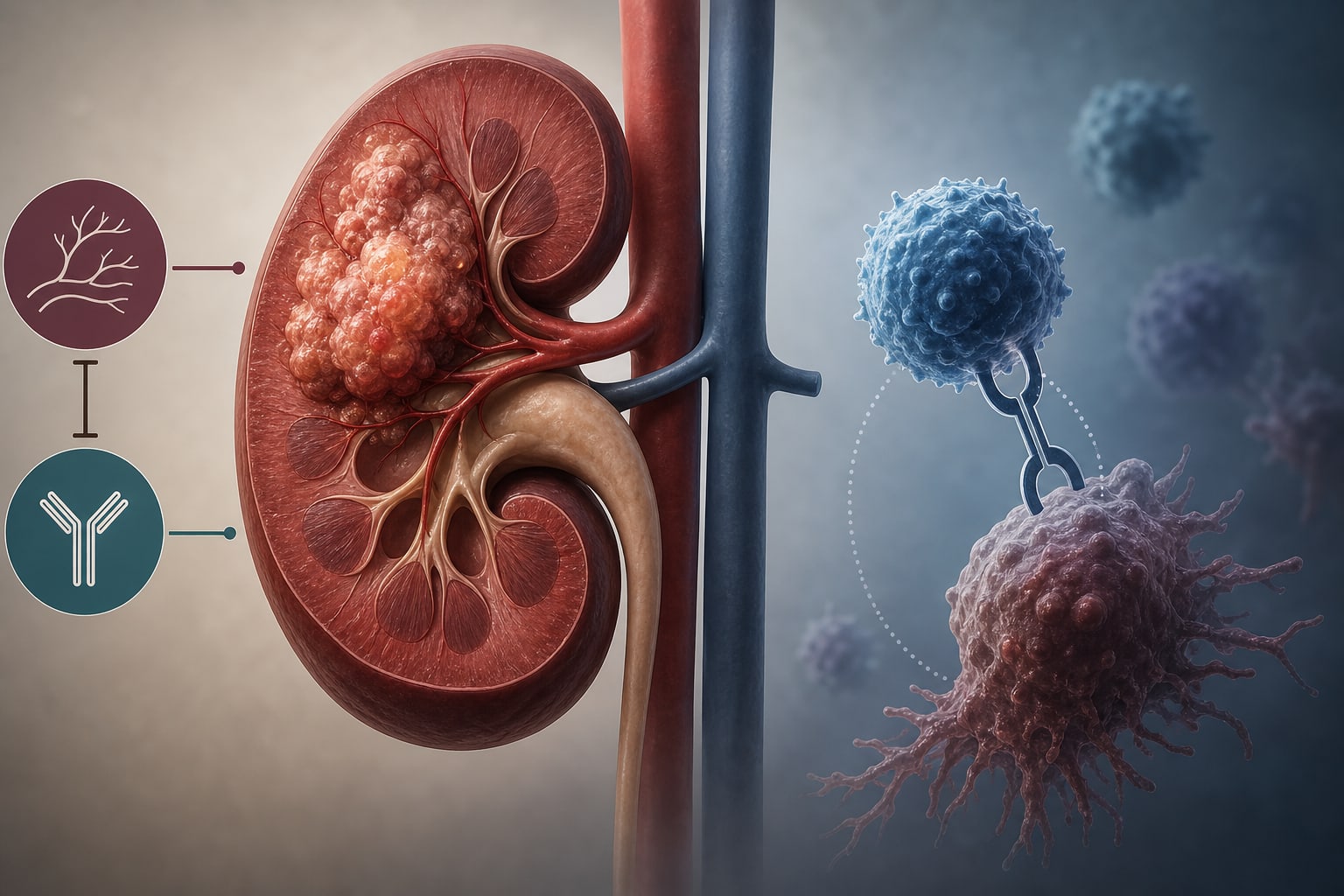
To describe therapy management and adverse event (AE) management among patients with advanced renal cell carcinoma (aRCC) treated with first-line axitinib-pembrolizumab, and to understand oncologists' perspectives on the safety profile and management of AEs, particularly regarding the complexities of overlapping toxicities.
Key Findings:
Axitinib-pembrolizumab treatment led to significant clinical benefits in overall survival and progression-free survival compared to sunitinib, with specific statistics to be included.
Treatment-related AEs resulted in high rates of interruption or discontinuation of axitinib (62% interruption, 20% discontinuation) and pembrolizumab (44% interruption, 21% discontinuation).
Physicians reported challenges in managing overlapping toxic effects between immune checkpoint inhibitors and TKIs.
Interpretation:
The study highlights the urgent need for improved management strategies for AEs in patients receiving axitinib-pembrolizumab, as current practices may not adequately address the complexities of overlapping toxicities, potentially impacting patient outcomes.
Limitations:
The study's sample size was determined by feasibility rather than hypothesis testing, which may limit generalizability.
Data was collected from a specific network of oncologists, which may not represent broader clinical practices.
Potential biases in physician-reported data may affect the findings.
Conclusion:
Understanding physician perspectives and management practices for AEs in aRCC patients treated with axitinib-pembrolizumab is crucial for optimizing treatment outcomes and identifying areas for additional support, ultimately improving patient care.
by Neil J. Shah, Yaa Ababio, Anthony Eccleston, Dharanija Rao, Scott P. Kelly, Jane Chang, Sarah Lucht, Caleb Paydar, Bryce A. Van Doren, Emily Bland, William John, Sarah Giegerich, JaLyna Laney, Bruce Feinberg, Kevin K. Zarrabi