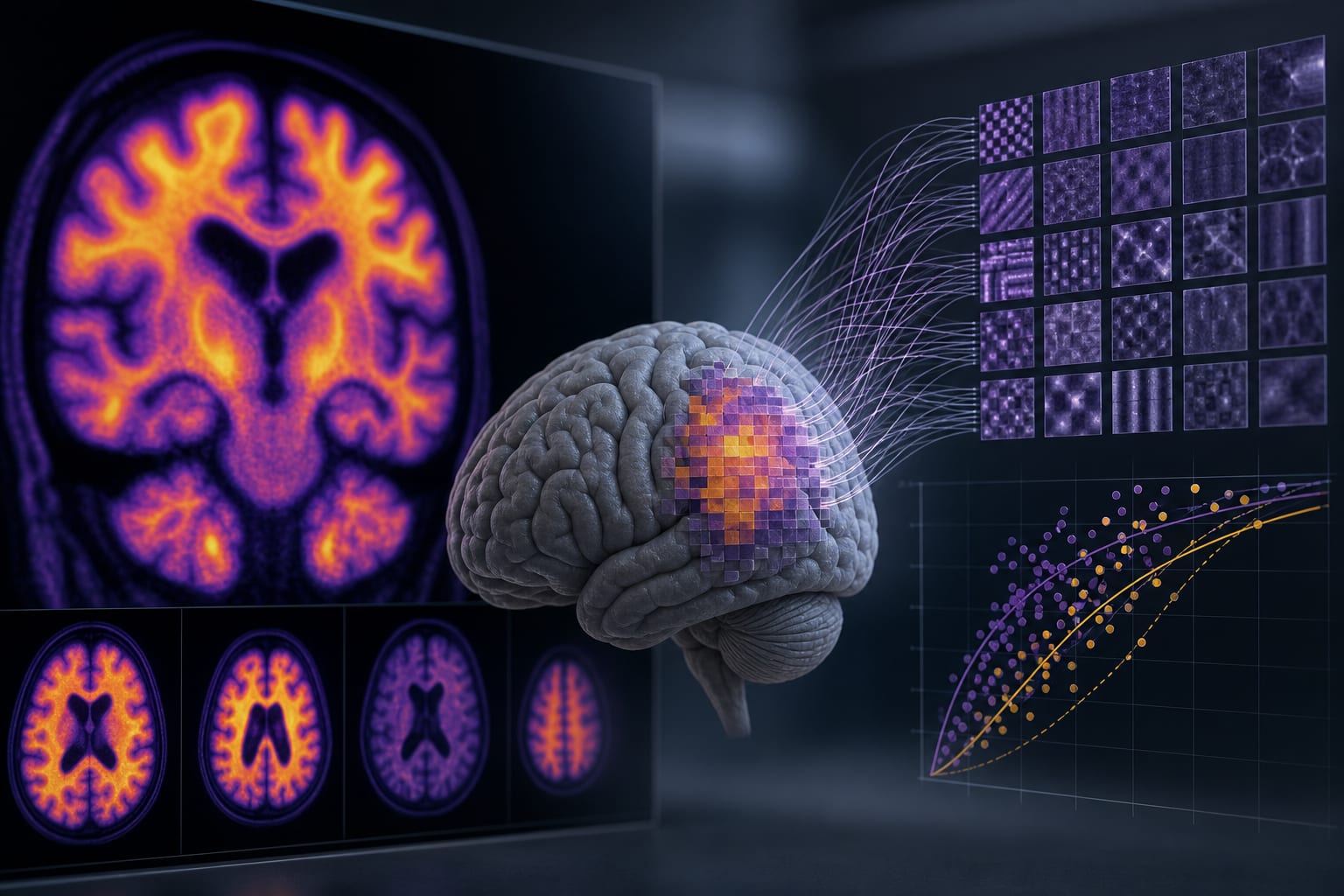
To evaluate the diagnostic performance of AI-enhanced PET radiomics for Alzheimer’s disease (AD) compared to standard PET diagnosis, focusing on its effectiveness in early detection.
Key Findings:
Nine studies (n = 5,765) were included, showing significant heterogeneity in sensitivity (SE) and specificity (SP).
In AD vs. HC, proteinopathy PET had SE 0.89, SP 0.91, AUC 0.96; 18F-FDG PET had SE 0.92, SP 0.92, AUC 0.94.
In AD vs. MCI, proteinopathy PET showed better performance (SE 0.94, SP 0.95, AUC 0.96) compared to 18F-FDG PET (AUC 0.84).
AD vs. MCI comparisons yielded significantly higher diagnostic metrics than AD vs. HC.
Interpretation:
AI-radiomics applied to proteinopathy PET shows promise for differentiating AD from MCI, but offers limited advantages when distinguishing AD from HC, indicating a need for further exploration.
Limitations:
Data variability and potential bias may affect results.
Lack of external validation limits generalizability.
There is a need for multi-site validation and uniform reporting standards to enhance reliability.
Conclusion:
AI-enhanced radiomics in proteinopathy PET may improve early diagnostic assessments for AD, necessitating further validation to confirm its efficacy.