Asymmetric surge optimization during peak seasons: a discrete-event simulation of centralized fast-track operating rooms at a China National Children's Medical Center - Summary - MDSpire
Conexiant’s news site is now MDSpire News. Learn more
Advertisement
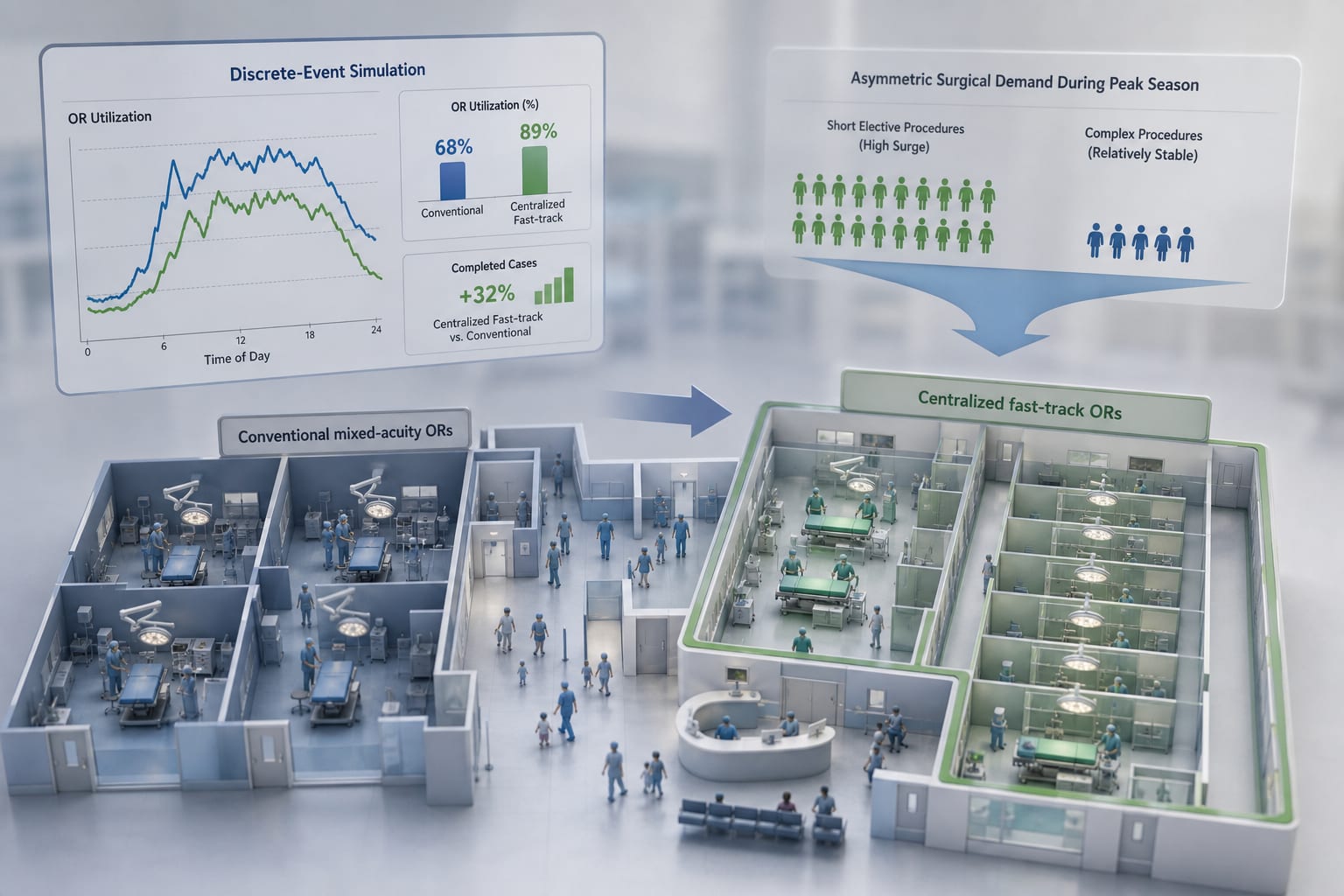
Optimizing Asymmetric Surgical Demand During Peak Seasons: A Discrete-Event Simulation of Centralized Fast-Track Operating Rooms at a Pediatric Medical Center in China
To evaluate an asymmetric, centralized fast-track operating room allocation strategy using discrete-event simulation to manage increased pediatric surgery demand during peak seasons.
Approach:
Model Construction: Developed a discrete-event simulation model using retrospective operational data from Shanghai Children's Medical Center.
Simulation Mechanism: Introduced a Prospective Simulation Probing mechanism under a dynamic safety-buffer policy to determine daily capacities.
Turnover Scenarios: Modeled fast-track turnover times with reductions of 5, 10, and 15 minutes compared to regular OR turnover times.
Key Findings:
The optimized 15-minute turnover-reduction scenario yielded a mean total throughput of 3,588.7 cases (median 3,589; 95% simulation interval, 3,562–3,614), a 38.29% increase over the historical baseline of 2,595 cases (95% interval for increase, 37.26%–39.27%).
The conservative 10-minute reduction scenario resulted in a mean throughput of 3,208.3 cases (median not specified), a 23.63% increase.
Centralized pooling protected throughput for complex surgeries while increasing capacity for fast-track procedures.
Interpretation:
The study suggests that separating short fast-track procedures from complex surgeries can enhance OR efficiency and throughput.
Limitations:
Implementation depends on staffing flexibility and local cost considerations.
The study is based on a single medical center's data, which may limit generalizability.
Conclusion:
Discrete-event simulation indicates that a centralized fast-track OR allocation strategy can manage the surge in pediatric surgeries during peak seasons.
Baptist Health South Florida will host the Baptist Health Heart & Vascular Care 43rd Annual Echocardiography and Structural Heart Symposium on Oct. 2-3 at the Loews Coral Gables Hotel.