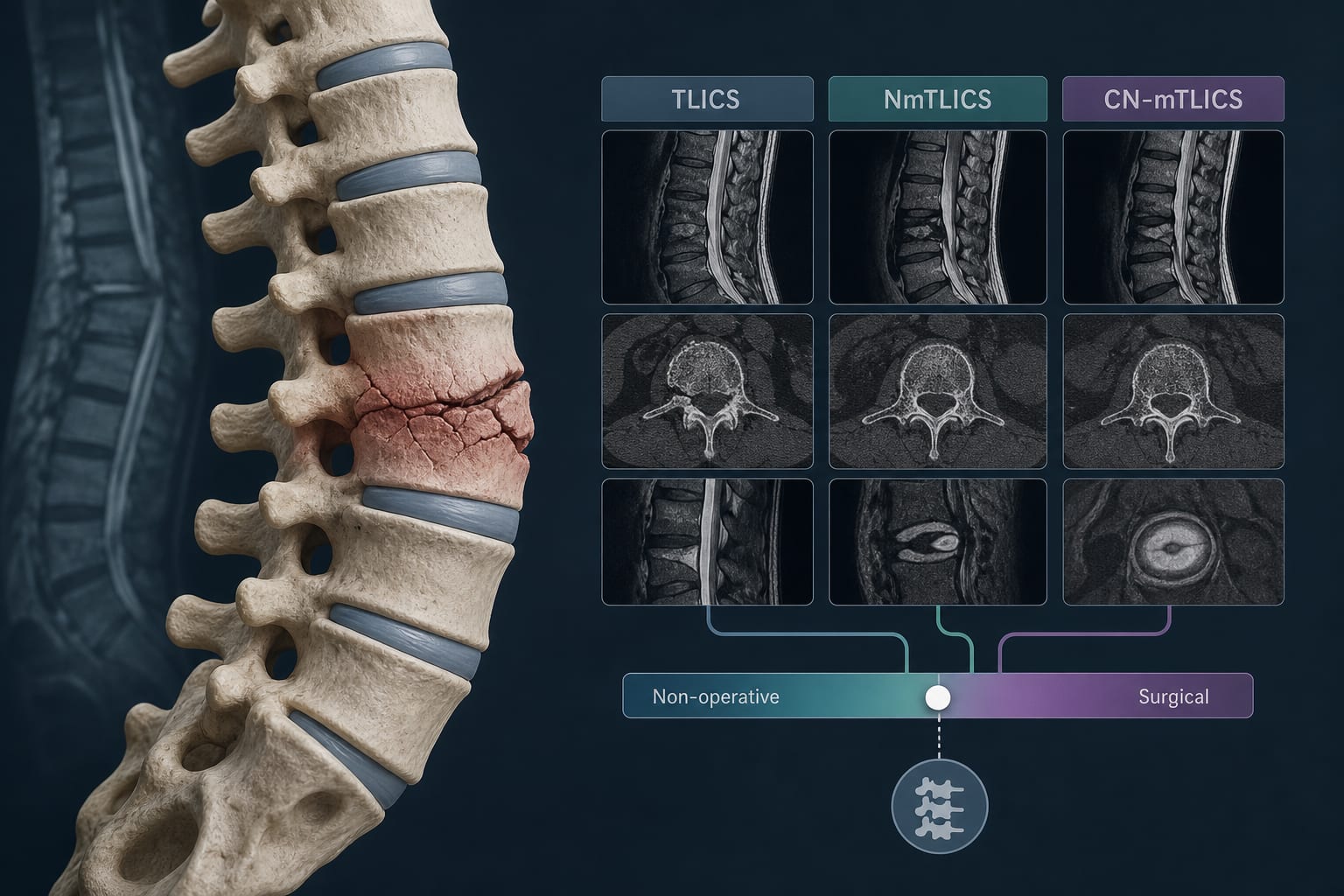
To compare the Novel Modified Thoracolumbar Injury Classification System (NmTLICS) and the China-modified Thoracolumbar Injury Classification System (CN-mTLICS) in guiding surgical decision-making for thoracolumbar fractures.
Approach:
Study Design: Retrospective analysis of imaging data from 101 patients with single-level thoracolumbar fractures.
Scoring Systems: Patients were scored using traditional TLICS, NmTLICS, and CN-mTLICS by two independent observers.
Statistical Analysis: Inter-observer agreement assessed with Cohen's Kappa; diagnostic efficacy evaluated by ROC curve; classification accuracy compared with Cochran's Q-test.
Key Findings:
NmTLICS (κ = 0.896) and CN-mTLICS (κ = 0.866) showed better inter-observer agreement than traditional TLICS (κ = 0.849).
NmTLICS and CN-mTLICS had significantly higher sensitivity and negative predictive value than traditional TLICS (P < 0.01).
NmTLICS identified 6 cases of severe vertebral collapse missed by CN-mTLICS, while CN-mTLICS detected 5 cases of severe intervertebral disc injury missed by NmTLICS.
Interpretation:
Both NmTLICS and CN-mTLICS improved the identification of severe burst fractures compared to TLICS, enhancing surgical decision-making without significant loss of specificity.
Limitations:
Findings are based on a single-center study and treatment decisions rather than long-term outcomes.
Prospective multicenter validation is needed before routine clinical application.
Conclusion:
NmTLICS and CN-mTLICS effectively reduce under-triage of severe burst fractures, addressing different clinical dimensions.